Sony
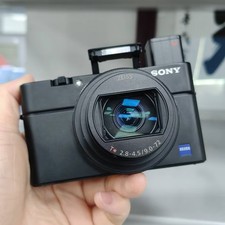
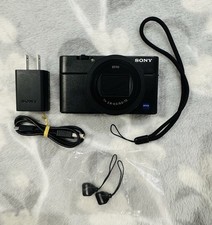
 Sony RX100 VII
The Sony RX100 VII is a fixed-lens premium compact built for people who want a genuinely pocketable camera that responds like a fast mirrorless. Sony aims it at travelers and parents who record life on the move and have no interest in carrying an interchangeable-lens kit.
- Lens mount
- Fixed lens
- Effective pixels
- 20.1 MP
- Sensor format
- 1-inch
- In-body image stabilization
- 4 stops
- Continuous shooting (electronic)
- 20 fps
- Max video resolution
- 4K
How fast is it for action?
Speed is the reason to pick this camera. The electronic shutter runs blackout-free at 20 fps while autofocus and exposure keep tracking, so bursts of a sprinting child or a passing bike stay visible in the finder from first frame to last. Sony's Single Burst mode adds another trick: seven frames at up to 90 fps for the instant you cannot time by hand.
Buyers who live on the mechanical shutter should note the limits. The fastest mechanical rate is 10 fps, the top mechanical shutter speed is 1/2000 s, and the 20 fps 'Hi' setting runs on the electronic shutter alone. Subject detection recognizes humans and animals through Eye AF and Real-time Tracking, but Sony lists no bird or vehicle categories. Wildlife and motorsport shooters lose the ready-made recognition modes other systems offer.
What can the sensor deliver?
Image quality comes from a 20.1 MP stacked CMOS sensor in 1-inch format, large enough for sharp prints and cropping room in a body that vanishes into a pocket. The native ISO ceiling is 12,800, which keeps routine shooting clean but limits dim interiors and night streets compared with larger-sensor bodies. Choose it for portability first, low light second.
Sony rates the optical SteadyShot at 4.0 stops, measured at the 200 mm telephoto end rather than as a body-only CIPA figure, so handheld shooting at full zoom stays realistic. The 4:3, 1:1 and 16:9 framings are in-camera crops over the native 3:2 sensor area, so those files carry less of the sensor's detail. Work from the full frame when resolution matters.
Is the video good enough?
The video headline is 4K up to 30 fps, and the full sensor width feeds that top setting, so the frame you compose is the frame you record. Editors can grade S-Log2, S-Log3 or HLG through the Picture Profile presets, a genuine color toolset this small. Casual creators get usable footage straight off the card.
The ceiling is the codec. Everything records H.264 through XAVC S or AVCHD, with no HEVC option, and raw video output is not offered, so long projects cost more storage and edit time than modern workflows expect. Filmmakers who need efficient files or raw capture should compare the rest of this class first.
Is it really pocketable?
This is the core promise: 302 g and a 42.8 mm depth make it jacket-pocket cargo rather than a bag commitment. The 2.36 M-dot EVF at 0.59× magnification steadies composition in harsh sun, and the 3-inch screen tilts for selfie framing without swinging outward like a fully articulated display. Commuters and travelers get serious control without a gear decision.
What about power and connections?
Battery life is rated at 260 shots, stretching to 310 with two-second auto monitor-off, so a full sightseeing day argues for a spare. Charging and powered operation run through the Multi/Micro-USB (USB 2.0) terminal, not USB-C, and video out rides a micro HDMI port. Keep the old cable in the bag for hotel-night top-ups.
Full specs
Overview
- Release date
- Not published
- Launch price
- Not published
- Lens mount
- Fixed lens
- High resolution pixel-shift mode
- Not published
Sensor & Image
- Effective pixels
- 20.1 MP
- Sensor format
- 1-inch
- Native ISO maximum
- 12,800 ISO
- In-body image stabilization
- 4 stops
Sony rates the optical (lens-shift) SteadyShot at 4.0 stops at the 200 mm telephoto end, not a body-only CIPA figure.
- Sensor readout speed
- Not published
- Sensor type
- Stacked CMOS
- Aspect ratios
- 3:2, 4:3, 1:1, 16:9
4:3, 16:9 and 1:1 sizes are in-camera crop modes over the native 3:2 sensor area.
Lens & Autofocus
- Continuous shooting (mechanical)
- 10 fps
The 'Hi' burst setting is electronic-shutter only; 10 fps ('Mid') is the fastest mechanical-shutter continuous rate.
- Continuous shooting (electronic)
- 20 fps
Blackout-free 20 fps continuous includes AF/AE tracking; the separate 'Single Burst' mode takes 7 shots at up to 90 fps.
- Max mechanical shutter speed
- 2,000 1/s
- Pre-burst capture duration
- Not published
- AF subject detection
- Human, animal
Maker names only human and animal recognition (Eye AF / Real-time Tracking); no bird or vehicle categories are listed.
Video
- Max video resolution
- 4K
- 4K max frame rate
- 30 fps
- Video codecs
- H.264
Both XAVC S and AVCHD recording use MPEG-4 AVC/H.264; there is no HEVC/H.265 option.
- 4K max frame rate (full width)
- 30 fps
- Raw video recording
- None
Sony's movie-format list contains only XAVC S (H.264) and AVCHD; no raw video output is offered.
- Video bit depth
- Not published
- Log profile support
- Yes
S-Log2, S-Log3 and HLG log gammas are selectable via Picture Profile presets PP1–PP10.
- Video dynamic range (log)
- Not published
Viewfinder & Screen
- Viewfinder resolution
- 2.36 M dots
- Viewfinder magnification
- 0.59 x
- Screen size
- 3 in
- Screen articulation
- Tilting
Screen tilts up about 180° for selfies and down about 90°; it does not swing outward like a fully articulated display.
- Rear screen resolution
- 0.92 M dots
Handling & Power
- Battery life
- 260 shots
260 shots assume default monitor settings; Sony also lists 310 shots when 'Auto Monitor Off' is set to 2 s.
- Memory card slots
- Not published
- Weather sealing
- Not published
- Weight
- 302 g
- Width
- 101.6 mm
- Height
- 58.1 mm
- Depth
- 42.8 mm
- USB charging & power delivery
- Yes
In-body USB charging and power supply work over the Multi/Micro-USB (USB 2.0) terminal — not USB-C.
- Minimum operating temperature
- 0 °C
- Headphone port
- Not published
- HDMI port type
- Micro
The Verdict
Buy the Sony if pocketable speed is the mission: blackout-free bursts, subject-tracking autofocus and a real EVF in a body light enough to carry every day, at the cost of a fixed lens. Look elsewhere if you need frame rates above its video ceiling, raw recording, USB-C convenience or a fully articulating screen. The same logic sends low-light specialists toward larger-sensor cameras.
FAQ
Is the Sony RX100 VII good for vlogging?
The screen tilts up about 180° to frame yourself and down about 90°, but it does not swing outward like a fully articulated display, so tripod-mounted framing is fiddly.
Can the RX100 VII recognize birds or cars?
Sony lists only human and animal subject detection via Eye AF and Real-time Tracking, so there are no bird or vehicle modes.
Is the RX100 VII weather sealed?
No sealing rating is published, and the minimum operating temperature is 0 °C, so plan on fair-weather use.
When did the Sony RX100 VII launch, and what did it cost?
Neither a release date nor a USD launch price appears on the maker specification pages this page is built from, so both fields stay unpublished here.
Spotted something wrong? Tap the next to any section or spec group to let us know. Every report is read.