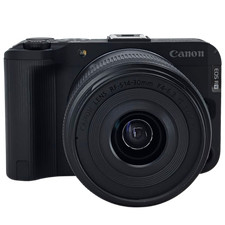
Compare · 2 products compared
Canon EOS R50 VvsSony RX100 VII: Which Should You Buy?
Both are compact 4K creator cameras with log profiles and light bodies. The fork is the format: the Canon takes interchangeable RF lenses on a larger APS-C sensor, while the Sony is a fixed-lens compact with a built-in viewfinder that stays pocketable. Choose the system you can grow into, or the camera you always carry.
eBay prices refresh hourly — check the listing before you buy. We may earn a commission.
- MOST WINS
 Canon
CanonBest for Creators who want interchangeable lenses, graded video and long battery life
9of 17 specs better - Sony
Best for Travelers who need a pocketable camera with a built-in viewfinder and fast bursts
8of 17 specs better
Biggest differences
Battery life
Canon EOS R50 V leads
+85%
higher is better
- Canon EOS R50 V480 shots
- Sony RX100 VII260 shots
Native ISO maximum
Canon EOS R50 V leads
2.5×
higher is better
- Canon EOS R50 V32,000 ISO
- Sony RX100 VII12,800 ISO
Max mechanical shutter speed
Canon EOS R50 V leads
2×
higher is better
- Canon EOS R50 V4,000 1/s
- Sony RX100 VII2,000 1/s
4K max frame rate
Canon EOS R50 V leads
2×
higher is better
- Canon EOS R50 V59.94 fps
- Sony RX100 VII30 fps
Where each one wins
Canon EOS R50 V
- Effective pixels
- Sensor format
- Native ISO maximum
- Continuous shooting (mechanical)
- Max mechanical shutter speed
- 4K max frame rate
- Screen articulation
- Rear screen resolution
- Battery life
Sony RX100 VII
- Sensor type
- Continuous shooting (electronic)
- 4K max frame rate (full width)
- Viewfinder resolution
- Weight
- Width
- Height
- Depth
What both have
- Aspect ratios3:2, 4:3, 1:1, 16:9
- Max video resolution4K
- Log profile support✓
- Screen size3 in
- USB charging & power delivery✓
- Minimum operating temperature0 °C
- HDMI port typeMicro
Every spec
Red marks the better value in each row.
| Spec | Canon EOS R50 V | Sony RX100 VII |
|---|---|---|
| Overview | ||
| Release date | 2025-04 | Not published |
| Launch price | 649 USD | Not published |
| Lens mount | Canon RF | Fixed lens |
| High resolution pixel-shift mode | Not published | Not published |
| Sensor & Image | ||
| Effective pixels | 24.2 MP | 20.1 MP |
| Sensor format | APS-C | 1-inch |
| Native ISO maximum | 32,000 ISO | 12,800 ISO |
| In-body image stabilization | Not published | 4 stops1 |
| Sensor readout speed | Not published | Not published |
| Sensor type | CMOS | Stacked CMOS |
| Aspect ratios | 3:2, 4:3, 1:1, 16:9 | 3:2, 4:3, 1:1, 16:92 |
| Lens & Autofocus | ||
| Continuous shooting (mechanical) | 12 fps | 10 fps3 |
| Continuous shooting (electronic) | 15 fps | 20 fps4 |
| Max mechanical shutter speed | 4,000 1/s | 2,000 1/s |
| Pre-burst capture duration | Not published | Not published |
| AF subject detection | Human, animal, vehicle | Human, animal5 |
| Video | ||
| Max video resolution | 4K | 4K |
| 4K max frame rate | 59.94 fps | 30 fps |
| Video codecs | H.264, HEVC, XF-AVC, XF-HEVC | H.2646 |
| 4K max frame rate (full width) | 29.97 fps7 | 30 fps |
| Raw video recording | Not published | None8 |
| Video bit depth | 10 bit | Not published |
| Log profile support | Yes | Yes9 |
| Video dynamic range (log) | Not published | Not published |
| Viewfinder & Screen | ||
| Viewfinder resolution | 0 M dots10 | 2.36 M dots |
| Viewfinder magnification | Not published | 0.59 x |
| Screen size | 3 in | 3 in |
| Screen articulation | Fully articulated | Tilting11 |
| Rear screen resolution | 1.04 M dots | 0.92 M dots |
| Handling & Power | ||
| Battery life | 480 shots12 | 260 shots13 |
| Memory card slots | 1 slots | Not published |
| Weather sealing | None | Not published |
| Weight | 370 g | 302 g |
| Width | 119.3 mm | 101.6 mm |
| Height | 73.7 mm | 58.1 mm |
| Depth | 45.2 mm | 42.8 mm |
| USB charging & power delivery | Yes14 | Yes15 |
| Minimum operating temperature | 0 °C | 0 °C |
| Headphone port | Yes | Not published |
| HDMI port type | Micro | Micro |
Notes on 15 values — test conditions and caveats
- 1Sony RX100 VII, In-body image stabilization: Sony rates the optical (lens-shift) SteadyShot at 4.0 stops at the 200 mm telephoto end, not a body-only CIPA figure.
- 2Sony RX100 VII, Aspect ratios: 4:3, 16:9 and 1:1 sizes are in-camera crop modes over the native 3:2 sensor area.
- 3Sony RX100 VII, Continuous shooting (mechanical): The 'Hi' burst setting is electronic-shutter only; 10 fps ('Mid') is the fastest mechanical-shutter continuous rate.
- 4Sony RX100 VII, Continuous shooting (electronic): Blackout-free 20 fps continuous includes AF/AE tracking; the separate 'Single Burst' mode takes 7 shots at up to 90 fps.
- 5Sony RX100 VII, AF subject detection: Maker names only human and animal recognition (Eye AF / Real-time Tracking); no bird or vehicle categories are listed.
- 6Sony RX100 VII, Video codecs: Both XAVC S and AVCHD recording use MPEG-4 AVC/H.264; there is no HEVC/H.265 option.
- 7Canon EOS R50 V, 4K max frame rate (full width): Full-width 4K tops out at 29.97 fps; 4K 50p/60p uses a crop to 64% of the sensor's horizontal area.
- 8Sony RX100 VII, Raw video recording: Sony's movie-format list contains only XAVC S (H.264) and AVCHD; no raw video output is offered.
- 9Sony RX100 VII, Log profile support: S-Log2, S-Log3 and HLG log gammas are selectable via Picture Profile presets PP1–PP10.
- 10Canon EOS R50 V, Viewfinder resolution: The EOS R50 V has no built-in electronic viewfinder; framing is done on the rear screen only.
- 11Sony RX100 VII, Screen articulation: Screen tilts up about 180° for selfies and down about 90°; it does not swing outward like a fully articulated display.
- 12Canon EOS R50 V, Battery life: Canon's CIPA rating uses the supplied LP-E17 battery with the LCD in power-saving mode.
- 13Sony RX100 VII, Battery life: 260 shots assume default monitor settings; Sony also lists 310 shots when 'Auto Monitor Off' is set to 2 s.
- 14Canon EOS R50 V, USB charging & power delivery: USB charging requires a genuine (authenticated) Canon battery; unauthenticated batteries will not charge over USB.
- 15Sony RX100 VII, USB charging & power delivery: In-body USB charging and power supply work over the Multi/Micro-USB (USB 2.0) terminal — not USB-C.
Video
The headline numbers mislead. The Canon's 4K reaches 59.94 fps only in a cropped mode that frames through 64% of the sensor's horizontal area. Frame full width and both cameras sit at about 30p, which is the Sony's hard ceiling. If you want slow motion of a wide scene, neither camera delivers it cleanly.
Where Canon clearly leads is recording capability. It captures 10-bit video with a choice of H.264, HEVC, XF-AVC and XF-HEVC codecs, while the Sony lists only H.264, and both cameras support log profiles for grading. Extra bit depth holds skies and skin tones together when you push a grade in editing. For anything beyond casual clips, the Canon is the stronger video machine.
Burst and autofocus
The Sony is the sheer-speed pick. Its electronic shutter takes 20 fps blackout-free with AF and AE tracking still running, against 15 fps on the Canon, and a Single Burst mode adds seven frames at up to 90 fps per press. Switch to mechanical shutters and the Canon leads 12 fps to 10, supported by a top speed of 1/4000 s against the Sony's 1/2000 s, useful for freezing fast motion in bright light.
Autofocus leans the other way. The Canon recognizes people, animals and vehicles, while Sony's maker names only human and animal detection, with no bird or vehicle categories on its list. Anyone pointing a camera at traffic, race craft or busy intersections gains a named detection mode on the Canon that the Sony's list doesn't include. That is a real edge for street and motorsport work.
Viewfinder and screen
The Sony has a 2.36 M-dot electronic viewfinder at 0.59x magnification. The Canon has no viewfinder at all, so every shot is framed on its rear screen. In harsh sunlight an EVF is the difference between a confirmed frame and hopeful guessing, which makes the Sony the safer tool for travel, street and bright outdoor work.
Canon answers behind the camera. Its fully articulated screen swings out for vlogging, waist-level shots and awkward angles, while the Sony's panel only tilts up about 180 degrees for selfies and down for high-angle framing. Resolution is a near tie at 1.04 M dots versus 0.92 M dots. Eye-level shooters get the Sony, and vloggers get the Canon.
Image quality and stabilization
The Canon counts 24.2 MP on a larger APS-C sensor, against 20.1 MP on the Sony's 1-inch chip. Native ISO runs to 32,000 on the Canon and 12,800 on the Sony. More sensor area gathers more light, which in practice means cleaner indoor and evening shots before noise sets in. Sony's counterweight is its stacked CMOS sensor, a fast-reading design that is exactly what enables the blackout-free bursts.
Handheld steadiness also runs Sony's way. Sony rates its optical SteadyShot at 4 stops of correction, a figure taken at the 200 mm telephoto end rather than as a body-only CIPA number. Canon publishes no in-body stabilization rating, so there is nothing verified to weigh against it. For long walking takes or slow shutter work, Sony is the one making a testable claim.
Size, battery and carry
The Sony wins the carry test outright. It weighs 302 g against the Canon's 370 g and is smaller in every dimension, so it genuinely slips into a jacket pocket. What the Canon buys with its extra size is an RF mount, meaning the camera can change lenses as your work changes, something a fixed-lens compact can never do.
Endurance favors the Canon: 480 shots per charge, a rating taken with the LCD in power-saving mode, against Sony's 260 on default monitor settings. Sony reaches 310 only when the auto monitor off timer is set to two seconds. USB charging works on both, with fine print that matters for travel: the Canon requires a genuine Canon battery, and the Sony's terminal is micro-USB rather than USB-C.
The Verdict
Buy the Canon EOS R50 V if graded video, lens choice and battery endurance matter more than carrying less. Buy the Sony RX100 VII if it must fit a jacket pocket but you still want a viewfinder for bright light.
Where to buy
Canon EOS R50 V
Best for Creators who want interchangeable lenses, graded video and long battery life
Sony RX100 VII
Best for Travelers who need a pocketable camera with a built-in viewfinder and fast bursts
FAQ
How much do these cameras cost?
Canon launched the EOS R50 V at $649. No US launch price is published for the Sony RX100 VII.
Is either camera weather sealed?
Canon lists no water or dust resistance for the EOS R50 V. Nothing is published for the Sony RX100 VII either, so plan on keeping both dry.
How many memory cards does each camera hold?
The Canon EOS R50 V has a single card slot. Sony does not publish a slot count for the RX100 VII.
Does the Sony RX100 VII have a headphone jack?
The Sony's specifications do not list a headphone port. The Canon EOS R50 V does include one, so it is the surer choice for monitoring audio while recording.
Can these cameras be used in freezing weather?
Both list 0 °C as their minimum operating temperature, so neither is rated for hard freezes.
Spotted something wrong? Tap the next to any section or spec group to let us know. Every report is read.