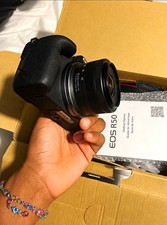
Compare · 2 products compared
Canon EOS R50vsSony RX100 VII: which should you buy?
Both have a built-in electronic viewfinder and subject-detecting autofocus, so on paper they look closer than they are. The Canon EOS R50 is an interchangeable-lens APS-C mirrorless body, while the Sony RX100 VII is a pocketable fixed-lens compact with optical stabilization and a faster burst. Which to buy comes down to size versus system growth.
eBay prices refresh hourly — check the listing before you buy. We may earn a commission.
 Canon
CanonBest for First mirrorless buyers who want lens choices, low-light headroom and a vlogging screen
9of 20 specs better- MOST WINSSony
Best for Pocket-first travelers who prize stabilization and fast burst over lens choice
11of 20 specs better
Biggest differences
Battery life
Canon EOS R50 leads
+69%
higher is better
- Canon EOS R50440 shots
- Sony RX100 VII260 shots
Native ISO maximum
Canon EOS R50 leads
2.5×
higher is better
- Canon EOS R5032,000 ISO
- Sony RX100 VII12,800 ISO
Max mechanical shutter speed
Canon EOS R50 leads
2×
higher is better
- Canon EOS R504,000 1/s
- Sony RX100 VII2,000 1/s
Rear screen resolution
Canon EOS R50 leads
+76%
higher is better
- Canon EOS R501.62 M dots
- Sony RX100 VII0.92 M dots
Features not all of them have
Log profile support
- Canon EOS R50✕
- Sony RX100 VII✓
Where each one wins
Canon EOS R50
- Effective pixels
- Sensor format
- Native ISO maximum
- Continuous shooting (mechanical)
- Max mechanical shutter speed
- Viewfinder magnification
- Screen articulation
- Rear screen resolution
- Battery life
Sony RX100 VII
- In-body image stabilization
- Sensor type
- Continuous shooting (electronic)
- 4K max frame rate
- 4K max frame rate (full width)
- Log profile support
- Screen size
- Weight
- Width
- Height
- Depth
What both have
- Aspect ratios3:2, 4:3, 1:1, 16:9
- Max video resolution4K
- Raw video recordingNone
- Viewfinder resolution2.36 M dots
- USB charging & power delivery✓
- Minimum operating temperature0 °C
- HDMI port typeMicro
Every spec
Red marks the better value in each row.
| Spec | Canon EOS R50 | Sony RX100 VII |
|---|---|---|
| Overview | ||
| Release date | Not published | Not published |
| Launch price | 679.99 USD1 | Not published |
| Lens mount | Canon RF | Fixed lens |
| High resolution pixel-shift mode | Not published | Not published |
| Sensor & Image | ||
| Effective pixels | 24.2 MP | 20.1 MP |
| Sensor format | APS-C | 1-inch |
| Native ISO maximum | 32,000 ISO | 12,800 ISO |
| In-body image stabilization | 0 stops2 | 4 stops3 |
| Sensor readout speed | Not published | Not published |
| Sensor type | CMOS | Stacked CMOS |
| Aspect ratios | 3:2, 4:3, 1:1, 16:9 | 3:2, 4:3, 1:1, 16:94 |
| Lens & Autofocus | ||
| Continuous shooting (mechanical) | 12 fps | 10 fps5 |
| Continuous shooting (electronic) | 15 fps | 20 fps6 |
| Max mechanical shutter speed | 4,000 1/s | 2,000 1/s |
| Pre-burst capture duration | 0 s7 | Not published |
| AF subject detection | Human, animal, bird, vehicle | Human, animal8 |
| Video | ||
| Max video resolution | 4K | 4K |
| 4K max frame rate | 29.97 fps | 30 fps |
| Video codecs | H.264, HEVC | H.2649 |
| 4K max frame rate (full width) | 29.97 fps | 30 fps |
| Raw video recording | None10 | None11 |
| Video bit depth | 10 bit12 | Not published |
| Log profile support | No13 | Yes14 |
| Video dynamic range (log) | Not published | Not published |
| Viewfinder & Screen | ||
| Viewfinder resolution | 2.36 M dots | 2.36 M dots |
| Viewfinder magnification | 0.95 x | 0.59 x |
| Screen size | 2.95 in | 3 in |
| Screen articulation | Fully articulated | Tilting15 |
| Rear screen resolution | 1.62 M dots | 0.92 M dots |
| Handling & Power | ||
| Battery life | 440 shots16 | 260 shots17 |
| Memory card slots | 1 slots | Not published |
| Weather sealing | None18 | Not published |
| Weight | 375 g19 | 302 g |
| Width | 116.3 mm | 101.6 mm |
| Height | 85.5 mm | 58.1 mm |
| Depth | 68.8 mm | 42.8 mm |
| USB charging & power delivery | Yes20 | Yes21 |
| Minimum operating temperature | 0 °C22 | 0 °C |
| Headphone port | No23 | Not published |
| HDMI port type | Micro | Micro |
Notes on 23 values — test conditions and caveats
- 1Canon EOS R50, Launch price: US RRP at launch as listed by Trusted Reviews; the page does not state whether it is body-only.
- 2Canon EOS R50, In-body image stabilization: No in-body stabilisation; shake control relies on lens IS or Movie Digital IS.
- 3Sony RX100 VII, In-body image stabilization: Sony rates the optical (lens-shift) SteadyShot at 4.0 stops at the 200 mm telephoto end, not a body-only CIPA figure.
- 4Sony RX100 VII, Aspect ratios: 4:3, 16:9 and 1:1 sizes are in-camera crop modes over the native 3:2 sensor area.
- 5Sony RX100 VII, Continuous shooting (mechanical): The 'Hi' burst setting is electronic-shutter only; 10 fps ('Mid') is the fastest mechanical-shutter continuous rate.
- 6Sony RX100 VII, Continuous shooting (electronic): Blackout-free 20 fps continuous includes AF/AE tracking; the separate 'Single Burst' mode takes 7 shots at up to 90 fps.
- 7Canon EOS R50, Pre-burst capture duration: No pre-capture mode appears anywhere in Canon's official R50 specifications, so it is treated as absent.
- 8Sony RX100 VII, AF subject detection: Maker names only human and animal recognition (Eye AF / Real-time Tracking); no bird or vehicle categories are listed.
- 9Sony RX100 VII, Video codecs: Both XAVC S and AVCHD recording use MPEG-4 AVC/H.264; there is no HEVC/H.265 option.
- 10Canon EOS R50, Raw video recording: Canon lists only MP4 recording with H.264 or HEVC; no raw video is offered internally or externally.
- 11Sony RX100 VII, Raw video recording: Sony's movie-format list contains only XAVC S (H.264) and AVCHD; no raw video output is offered.
- 12Canon EOS R50, Video bit depth: Standard Rec.709 recording is 8-bit; 10-bit output requires HDR PQ to be switched on.
- 13Canon EOS R50, Log profile support: No Canon Log profile; HDR PQ (a PQ gamma curve) is available instead, which is not a log curve.
- 14Sony RX100 VII, Log profile support: S-Log2, S-Log3 and HLG log gammas are selectable via Picture Profile presets PP1–PP10.
- 15Sony RX100 VII, Screen articulation: Screen tilts up about 180° for selfies and down about 90°; it does not swing outward like a fully articulated display.
- 16Canon EOS R50, Battery life: CIPA test with the supplied LP-E17 in power-saving mode; viewfinder shooting is rated at about 310 shots.
- 17Sony RX100 VII, Battery life: 260 shots assume default monitor settings; Sony also lists 310 shots when 'Auto Monitor Off' is set to 2 s.
- 18Canon EOS R50, Weather sealing: Canon's own spec sheet also lists water/dust resistance as not provided, so treat the body as unsealed.
- 19Canon EOS R50, Weight: Black body with battery and card per CIPA; the white version is 376 g with battery and card.
- 20Canon EOS R50, USB charging & power delivery: USB-C charging works with the supplied LP-E17; unauthenticated third-party batteries may not charge.
- 21Sony RX100 VII, USB charging & power delivery: In-body USB charging and power supply work over the Multi/Micro-USB (USB 2.0) terminal — not USB-C.
- 22Canon EOS R50, Minimum operating temperature: Rated operating range is 0–40 °C at up to 85% humidity.
- 23Canon EOS R50, Headphone port: Canon's full port list covers USB-C, mic-in, HDMI micro and the shoe only — no headphone jack.
Pocket camera or lens system?
The Canon takes Canon RF lenses, so a starter zoom can grow into a bag of primes and telephoto glass. The Sony's lens is fixed for life, and that constraint is the price you pay for a 302 g body that lives in a jacket pocket. At 375 g with battery and card, the Canon is a camera you carry in a bag, not a pocket.
Low light and image detail
The Canon's APS-C sensor is the bigger light-gatherer next to the Sony's 1-inch chip, and it has more resolution too, 24.2 MP against 20.1 MP. Its native ISO ceiling stretches to 32,000 versus the Sony's 12,800, which matters most when the light drops. The Sony's stacked design is optimized for fast readout rather than light gathering, so pure image quality favors the Canon.
Handheld steadiness
Sony rates the RX100 VII's optical SteadyShot at 4 stops of shake control, a figure measured at the 200 mm telephoto end rather than a body-only CIPA number. Either way, it is real help for dim interiors and long handheld zooms. The Canon has no in-body stabilization at all, so stills depend on the RF lens's own IS and video on Movie Digital IS. For handheld shooting the Sony wins clearly.
Action and subject tracking
The Sony takes the speed crown with blackout-free 20 fps bursts backed by AF/AE tracking, plus a Single Burst mode that grabs 7 frames at up to 90 fps. Those headline rates are electronic-shutter figures, so mechanical shooting tops out at 10 fps. The Canon counters with 15 fps electronic and 12 fps mechanical, and its autofocus recognizes birds and vehicles, categories the Sony's human-and-animal detection lacks. Frame rate belongs to the Sony; finding the subject in the first place is the Canon's edge.
Video
Video resolution is a wash, so the choice comes down to grading and formats. The Sony offers S-Log2, S-Log3 and HLG through its Picture Profiles, which is what matched, graded footage needs. The Canon has no log curve and reaches 10-bit only with HDR PQ switched on, though it adds HEVC alongside H.264, where every Sony format is H.264. Graded projects favor the Sony; the Canon suits straight-to-web clips.
Viewfinder, screen and battery
The Canon's viewfinder magnifies 0.95x against the Sony's 0.59x, a much larger view for eye-level framing and manual focus. Its screen also swings fully outward for selfies and vlogging, while the Sony's tilts only. Battery life runs 440 shots per charge in Canon's power-saving mode versus 260 on the Sony under default monitor settings, so recharging comes around far less often on the Canon.
The Verdict
Buy the Canon EOS R50 if you want room to add lenses, stronger low-light results and battery that outlasts a full day of shooting. Buy the Sony RX100 VII if a jacket-pocket body with optical stabilization and blackout-free burst speed beats any plan to build a system.
Where to buy
Canon EOS R50
Best for First mirrorless buyers who want lens choices, low-light headroom and a vlogging screen
Sony RX100 VII
Best for Pocket-first travelers who prize stabilization and fast burst over lens choice
FAQ
How much does each camera cost?
The Canon EOS R50 launched at $679.99 in the US, though that RRP doesn't say whether it includes a kit lens. Sony's US launch price for the RX100 VII isn't published, so a direct price call isn't possible.
Can both cameras record 4K video?
Yes, both do, and their top frame rates are practically identical: Canon specifies 29.97 fps and Sony 30 fps.
Is either camera weather sealed?
No. Canon's own specification lists no dust or water resistance for the EOS R50, and Sony publishes no sealing rating for the RX100 VII either.
Can I charge them over USB?
Yes, both charge through the camera body, but the Canon uses USB-C while the Sony uses an older Micro-USB terminal. Bear in mind the Canon may not charge unauthenticated third-party batteries.
Can I monitor audio while filming?
Not on the Canon: its ports include a microphone input but no headphone jack, so you can attach an external mic yet can't listen to sound directly. Sony's headphone support isn't published.
Spotted something wrong? Tap the next to any section or spec group to let us know. Every report is read.