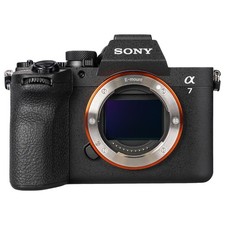
Compare · 2 products compared
Sony a7 VvsSony RX100 VII: Full frame or pocket?
Both are Sony 4K cameras with subject-recognition autofocus and log profiles for grading. The split is basic: the Sony a7 V is a full-frame mirrorless body that takes interchangeable E-mount lenses, while the Sony RX100 VII is a pocketable point-and-shoot with a fixed built-in lens. Pick maximum capability or effortless carry.
eBay prices refresh hourly — check the listing before you buy. We may earn a commission.
- MOST WINS
 Sony
SonyBest for Photo and video shooters who want full-frame quality and deep pro features
15of 20 specs better - Sony
Best for Travelers and everyday shooters who want real capability in a coat pocket
5of 20 specs better
Biggest differences
Battery life
Sony a7 V leads
2.88×
higher is better
- Sony a7 V750 shots
- Sony RX100 VII260 shots
Weight
Sony RX100 VII leads
2.3×
lower is better
- Sony a7 V695 g
- Sony RX100 VII302 g
Native ISO maximum
Sony a7 V leads
4×
higher is better
- Sony a7 V51,200 ISO
- Sony RX100 VII12,800 ISO
Max mechanical shutter speed
Sony a7 V leads
4×
higher is better
- Sony a7 V8,000 1/s
- Sony RX100 VII2,000 1/s
Where each one wins
Sony a7 V
- Effective pixels
- Sensor format
- Native ISO maximum
- In-body image stabilization
- Continuous shooting (electronic)
- Max mechanical shutter speed
- 4K max frame rate
- 4K max frame rate (full width)
- Viewfinder resolution
- Viewfinder magnification
- Screen size
- Screen articulation
- Rear screen resolution
- Battery life
- HDMI port type
Sony RX100 VII
- Sensor type
- Weight
- Width
- Height
- Depth
What both have
- Aspect ratios3:2, 4:3, 1:1, 16:9
- Continuous shooting (mechanical)10 fps
- Max video resolution4K
- Raw video recordingNone
- Log profile support✓
- USB charging & power delivery✓
- Minimum operating temperature0 °C
Every spec
Red marks the better value in each row.
| Spec | Sony a7 V | Sony RX100 VII |
|---|---|---|
| Overview | ||
| Release date | 2025-12 | Not published |
| Launch price | 2,899 USD | Not published |
| Lens mount | Sony E | Fixed lens |
| High resolution pixel-shift mode | No1 | Not published |
| Sensor & Image | ||
| Effective pixels | 33 MP | 20.1 MP |
| Sensor format | Full-frame | 1-inch |
| Native ISO maximum | 51,200 ISO2 | 12,800 ISO |
| In-body image stabilization | 7.5 stops3 | 4 stops4 |
| Sensor readout speed | 15 ms | Not published |
| Sensor type | Partially-stacked CMOS | Stacked CMOS |
| Aspect ratios | 3:2, 4:3, 1:1, 16:9 | 3:2, 4:3, 1:1, 16:95 |
| Lens & Autofocus | ||
| Continuous shooting (mechanical) | 10 fps6 | 10 fps7 |
| Continuous shooting (electronic) | 30 fps8 | 20 fps9 |
| Max mechanical shutter speed | 8,000 1/s | 2,000 1/s |
| Pre-burst capture duration | 1 s | Not published |
| AF subject detection | Human, animal, bird, insect, car, train, airplane | Human, animal10 |
| Video | ||
| Max video resolution | 4K | 4K |
| 4K max frame rate | 119.88 fps11 | 30 fps |
| Video codecs | H.264, HEVC | H.26412 |
| 4K max frame rate (full width) | 60 fps13 | 30 fps |
| Raw video recording | None | None14 |
| Video bit depth | 10 bit | Not published |
| Log profile support | Yes | Yes15 |
| Video dynamic range (log) | Not published | Not published |
| Viewfinder & Screen | ||
| Viewfinder resolution | 3.69 M dots | 2.36 M dots |
| Viewfinder magnification | 0.78 x16 | 0.59 x |
| Screen size | 3.2 in | 3 in |
| Screen articulation | Multi-angle | Tilting17 |
| Rear screen resolution | 2.1 M dots | 0.92 M dots |
| Handling & Power | ||
| Battery life | 750 shots18 | 260 shots19 |
| Memory card slots | 2 slots | Not published |
| Weather sealing | Dust and drip resistant | Not published |
| Weight | 695 g | 302 g |
| Width | 130.3 mm | 101.6 mm |
| Height | 96.4 mm | 58.1 mm |
| Depth | 72.3 mm20 | 42.8 mm |
| USB charging & power delivery | Yes | Yes21 |
| Minimum operating temperature | 0 °C | 0 °C |
| Headphone port | Yes | Not published |
| HDMI port type | Full-size | Micro |
Notes on 21 values — test conditions and caveats
- 1Sony a7 V, High resolution pixel-shift mode: No in-camera pixel shift; Sony's Extended Hi-Res merges burst frames later in its desktop software.
- 2Sony a7 V, Native ISO maximum: Refers to standard still image shooting prior to ISO expansion.
- 3Sony a7 V, In-body image stabilization: Measured at the center with an FE 50mm F1.2 GM lens mounted per CIPA 2024 standards with long exposure NR off.
- 4Sony RX100 VII, In-body image stabilization: Sony rates the optical (lens-shift) SteadyShot at 4.0 stops at the 200 mm telephoto end, not a body-only CIPA figure.
- 5Sony RX100 VII, Aspect ratios: 4:3, 16:9 and 1:1 sizes are in-camera crop modes over the native 3:2 sensor area.
- 6Sony a7 V, Continuous shooting (mechanical): Maximum continuous shooting speed achieved using mechanical shutter in Hi+ mode.
- 7Sony RX100 VII, Continuous shooting (mechanical): The 'Hi' burst setting is electronic-shutter only; 10 fps ('Mid') is the fastest mechanical-shutter continuous rate.
- 8Sony a7 V, Continuous shooting (electronic): Maximum continuous shooting speed achieved using electronic shutter in Hi+ mode.
- 9Sony RX100 VII, Continuous shooting (electronic): Blackout-free 20 fps continuous includes AF/AE tracking; the separate 'Single Burst' mode takes 7 shots at up to 90 fps.
- 10Sony RX100 VII, AF subject detection: Maker names only human and animal recognition (Eye AF / Real-time Tracking); no bird or vehicle categories are listed.
- 11Sony a7 V, 4K max frame rate: Maximum 4K frame rate is available in XAVC HS 4K 4:2:0 10-bit mode.
- 12Sony RX100 VII, Video codecs: Both XAVC S and AVCHD recording use MPEG-4 AVC/H.264; there is no HEVC/H.265 option.
- 13Sony a7 V, 4K max frame rate (full width): 4K 120p needs an APS-C/Super 35 crop; the full sensor width tops out at 4K 60p.
- 14Sony RX100 VII, Raw video recording: Sony's movie-format list contains only XAVC S (H.264) and AVCHD; no raw video output is offered.
- 15Sony RX100 VII, Log profile support: S-Log2, S-Log3 and HLG log gammas are selectable via Picture Profile presets PP1–PP10.
- 16Sony a7 V, Viewfinder magnification: Measured with a 50mm lens focused at infinity at -1 m⁻¹.
- 17Sony RX100 VII, Screen articulation: Screen tilts up about 180° for selfies and down about 90°; it does not swing outward like a fully articulated display.
- 18Sony a7 V, Battery life: Measured using the LCD monitor under standard CIPA test conditions.
- 19Sony RX100 VII, Battery life: 260 shots assume default monitor settings; Sony also lists 310 shots when 'Auto Monitor Off' is set to 2 s.
- 20Sony a7 V, Depth: Overall maximum depth including the viewfinder eyepiece is 82.4 mm.
- 21Sony RX100 VII, USB charging & power delivery: In-body USB charging and power supply work over the Multi/Micro-USB (USB 2.0) terminal — not USB-C.
Image quality and low light
The a7 V's full-frame sensor is the decisive image-quality divide here: 33 megapixels on a chip far larger than the RX100 VII's 1-inch type. Expect cleaner files in dim rooms, easier background blur and much more room to crop before detail collapses. When light or print size decides the shot, this is where the a7 V wins.
Low light adds two more gaps: native ISO tops out at 51,200 against 12,800, and stabilization is rated at 7.5 stops in-body on the a7 V versus 4 stops of lens-shift SteadyShot on the RX100 VII. Those ratings aren't measured the same way (frame-center body shake versus telephoto-end lens shift), so read them as a direction rather than a ratio. Handheld night shooting belongs to the a7 V.
Which is better for action?
The a7 V is the action camera: 30 fps electronic bursts against the RX100 VII's blackout-free 20 fps, plus subject recognition that adds birds, insects, cars, trains and planes to the usual people-and-animal detection. The compact still nails people and pets, and its Single Burst mode fires at up to 90 fps for peak-moment timing. For committed wildlife or sports, though, the a7 V is the surer tool.
Shutter and readout widen the gap. The a7 V's mechanical shutter runs to 1/8000 s against 1/2000 s on the RX100 VII, enough to freeze daylight action at wide apertures. A sensor that clears a frame in about 15 ms keeps those electronic bursts coherent, and a 1-second pre-burst rescues plays you'd otherwise miss.
Video
Both record 4K with S-Log and HLG profiles available, so graded footage is possible either way. The ceilings are not close: the a7 V's 10-bit XAVC HS mode reaches 4K 119.88 fps, while the RX100 VII stops at 30 fps. If slowing the world down is on your shot list, only one of these cameras can.
The fine print matters: 4K at that high frame rate crops the sensor to APS-C, and full-width 4K tops out at 60 fps. The a7 V also offers HEVC next to H.264, which trims file sizes, and adds a headphone jack plus full-size HDMI for monitoring. The RX100 VII records H.264 only over a micro HDMI, ample for clips and vlogs but thin for an edited production.
Viewfinder and screen
Framing favors the a7 V, starting with a 3.69M-dot finder that shows far more detail than the RX100 VII's 2.36M-dot pop-up EVF. Its 3.2-inch screen swings out multi-angle for low and overhead work, while the RX100 VII tilts up for selfies but never leaves the body. The pocket camera's finder is a genuine bonus at this size — just not an equal — and every other composition job is easier on the a7 V.
Size, battery and travel
Portability is the RX100 VII's whole argument, and it wins outright: 302 g against 695 g, a body that slides into a jacket rather than a dedicated bag. The a7 V answers with staying power — 750 shots per charge against 260 and dual card slots for in-camera backup — so endurance and expandability live on the big body.
USB charging works on both, but the RX100 VII pulls power through its Multi/Micro-USB terminal rather than USB-C, so pack its cable. The a7 V also carries a published dust-and-drip-resistant build, while no sealing is published for the RX100 VII. In foul weather or on long days, the a7 V is the body built to be pushed.
The Verdict
Buy the Sony a7 V if you shoot for print, clients or big screens, want pro-grade video and subject tracking, and can live with the weight and the $2,899 body-only price. Buy the Sony RX100 VII if the camera has to live in a coat pocket and you accept the fixed lens and smaller sensor as the fair trade for that freedom.
Where to buy
Sony a7 V
Best for Photo and video shooters who want full-frame quality and deep pro features
Sony RX100 VII
Best for Travelers and everyday shooters who want real capability in a coat pocket
FAQ
When was the Sony a7 V released?
It arrived in December 2025. Sony's specification pages publish no release date for the RX100 VII.
Can the Sony a7 V shoot pixel-shift high-resolution images?
No, there is no in-camera pixel-shift mode. Sony's Extended Hi-Res feature instead saves a burst of frames to merge later in desktop software, and no comparable mode is published for the RX100 VII.
Can you change the lens on the Sony RX100 VII?
No, the RX100 VII's lens is built in and cannot be swapped. The a7 V accepts Sony E-mount lenses, so its capabilities grow with what you attach.
Is the Sony RX100 VII still worth buying?
Yes, if a camera that fits in a pocket is the point — it still offers fast burst shooting and log-capable 4K. Choose the a7 V when sensor size, video depth or lens flexibility matter more.
Spotted something wrong? Tap the next to any section or spec group to let us know. Every report is read.