Compare · 2 products compared
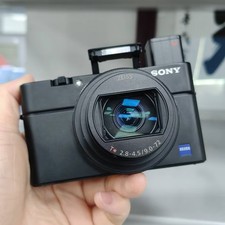
Sony a7 IVvsSony RX100 VII: Full-FramevsPocket
Both Sonys shoot 4K with log profiles and quick burst modes, but they sit a class apart. The a7 IV is a full-frame system camera for image quality and professional control; the RX100 VII is a fixed-lens pocket compact built for speed. Your choice is between growing a system and always having a camera with you.
eBay prices refresh hourly — check the listing before you buy. We may earn a commission.
- MOST WINS
 Sony
SonyBest for Hybrid shooters who want full-frame quality and a system to grow into
12of 19 specs better - Sony
Best for Travelers and street shooters who want pro burst speed in a pocket
7of 19 specs better
Biggest differences
Battery life
Sony a7 IV leads
2.23×
higher is better
- Sony a7 IV580 shots
- Sony RX100 VII260 shots
Weight
Sony RX100 VII leads
2.18×
lower is better
- Sony a7 IV658 g
- Sony RX100 VII302 g
Native ISO maximum
Sony a7 IV leads
4×
higher is better
- Sony a7 IV51,200 ISO
- Sony RX100 VII12,800 ISO
Continuous shooting (electronic)
Sony RX100 VII leads
2×
higher is better
- Sony a7 IV10 fps
- Sony RX100 VII20 fps
Where each one wins
Sony a7 IV
- Effective pixels
- Sensor format
- Native ISO maximum
- In-body image stabilization
- Max mechanical shutter speed
- 4K max frame rate
- Viewfinder resolution
- Viewfinder magnification
- Screen articulation
- Rear screen resolution
- Battery life
- HDMI port type
Sony RX100 VII
- Sensor type
- Continuous shooting (electronic)
- Screen size
- Weight
- Width
- Height
- Depth
What both have
- Continuous shooting (mechanical)10 fps
- Max video resolution4K
- 4K max frame rate (full width)30 fps
- Raw video recordingNone
- Log profile support✓
- USB charging & power delivery✓
- Minimum operating temperature0 °C
Every spec
Red marks the better value in each row.
| Spec | Sony a7 IV | Sony RX100 VII |
|---|---|---|
| Overview | ||
| Release date | 2021-10 | Not published |
| Launch price | 2,499.99 USD | Not published |
| Lens mount | Sony E | Fixed lens |
| High resolution pixel-shift mode | No | Not published |
| Sensor & Image | ||
| Effective pixels | 33 MP | 20.1 MP |
| Sensor format | Full-frame | 1-inch |
| Native ISO maximum | 51,200 ISO1 | 12,800 ISO |
| In-body image stabilization | 5.5 stops2 | 4 stops3 |
| Sensor readout speed | Not published | Not published |
| Sensor type | CMOS | Stacked CMOS |
| Aspect ratios | 3:2 | 3:2, 4:3, 1:1, 16:94 |
| Lens & Autofocus | ||
| Continuous shooting (mechanical) | 10 fps5 | 10 fps6 |
| Continuous shooting (electronic) | 10 fps | 20 fps7 |
| Max mechanical shutter speed | 8,000 1/s | 2,000 1/s |
| Pre-burst capture duration | Not published | Not published |
| AF subject detection | Human, animal, bird | Human, animal8 |
| Video | ||
| Max video resolution | 4K | 4K |
| 4K max frame rate | 60 fps9 | 30 fps |
| Video codecs | H.264, HEVC | H.26410 |
| 4K max frame rate (full width) | 30 fps11 | 30 fps |
| Raw video recording | None12 | None13 |
| Video bit depth | 10 bit | Not published |
| Log profile support | Yes | Yes14 |
| Video dynamic range (log) | 15 stops15 | Not published |
| Viewfinder & Screen | ||
| Viewfinder resolution | 3.69 M dots | 2.36 M dots |
| Viewfinder magnification | 0.78 x | 0.59 x |
| Screen size | 2.95 in16 | 3 in |
| Screen articulation | Fully articulated | Tilting17 |
| Rear screen resolution | 1.04 M dots18 | 0.92 M dots |
| Handling & Power | ||
| Battery life | 580 shots19 | 260 shots20 |
| Memory card slots | 2 slots | Not published |
| Weather sealing | Dust and drip resistant21 | Not published |
| Weight | 658 g | 302 g |
| Width | 131.3 mm | 101.6 mm |
| Height | 96.4 mm | 58.1 mm |
| Depth | 69.7 mm22 | 42.8 mm |
| USB charging & power delivery | Yes23 | Yes24 |
| Minimum operating temperature | 0 °C | 0 °C |
| Headphone port | Yes | Not published |
| HDMI port type | Full-size | Micro |
Notes on 24 values — test conditions and caveats
- 1Sony a7 IV, Native ISO maximum: Native range tops out at ISO 51200; 50-204800 requires expanded ISO settings.
- 2Sony a7 IV, In-body image stabilization: CIPA rating measured with the 50mm F1.4 ZA test lens attached.
- 3Sony RX100 VII, In-body image stabilization: Sony rates the optical (lens-shift) SteadyShot at 4.0 stops at the 200 mm telephoto end, not a body-only CIPA figure.
- 4Sony RX100 VII, Aspect ratios: 4:3, 16:9 and 1:1 sizes are in-camera crop modes over the native 3:2 sensor area.
- 5Sony a7 IV, Continuous shooting (mechanical): 10 fps applies to compressed RAW/JPEG/HEIF; drops to 6 fps for lossless or uncompressed RAW.
- 6Sony RX100 VII, Continuous shooting (mechanical): The 'Hi' burst setting is electronic-shutter only; 10 fps ('Mid') is the fastest mechanical-shutter continuous rate.
- 7Sony RX100 VII, Continuous shooting (electronic): Blackout-free 20 fps continuous includes AF/AE tracking; the separate 'Single Burst' mode takes 7 shots at up to 90 fps.
- 8Sony RX100 VII, AF subject detection: Maker names only human and animal recognition (Eye AF / Real-time Tracking); no bird or vehicle categories are listed.
- 9Sony a7 IV, 4K max frame rate: 4K 60p is only available in Super35mm crop; full-frame 4K tops out at 30p.
- 10Sony RX100 VII, Video codecs: Both XAVC S and AVCHD recording use MPEG-4 AVC/H.264; there is no HEVC/H.265 option.
- 11Sony a7 IV, 4K max frame rate (full width): 4K 60p requires the Super35mm crop; full-width 4K is limited to 30p.
- 12Sony a7 IV, Raw video recording: No internal or external raw recording; HDMI output tops out at 10-bit 4:2:2.
- 13Sony RX100 VII, Raw video recording: Sony's movie-format list contains only XAVC S (H.264) and AVCHD; no raw video output is offered.
- 14Sony RX100 VII, Log profile support: S-Log2, S-Log3 and HLG log gammas are selectable via Picture Profile presets PP1–PP10.
- 15Sony a7 IV, Video dynamic range (log): Sony's claim for S-Log3 per internal tests; stated as 15+ stops.
- 16Sony a7 IV, Screen size: Sony rates the panel at 2.95in (3.0-type); most sources round to 3in.
- 17Sony RX100 VII, Screen articulation: Screen tilts up about 180° for selfies and down about 90°; it does not swing outward like a fully articulated display.
- 18Sony a7 IV, Rear screen resolution: 1,036,800 dots; Sony's retail pages round this to 1.03 megadots.
- 19Sony a7 IV, Battery life: 580 shots per charge with the rear LCD; 520 with the EVF.
- 20Sony RX100 VII, Battery life: 260 shots assume default monitor settings; Sony also lists 310 shots when 'Auto Monitor Off' is set to 2 s.
- 21Sony a7 IV, Weather sealing: Dust and moisture resistant but not IP-rated; Sony does not guarantee 100% sealing.
- 22Sony a7 IV, Depth: Sony lists 79.8mm total depth; 69.7mm is measured from front grip to rear monitor.
- 23Sony a7 IV, USB charging & power delivery: Charging and USB power delivery work only through the USB Type-C port.
- 24Sony RX100 VII, USB charging & power delivery: In-body USB charging and power supply work over the Multi/Micro-USB (USB 2.0) terminal — not USB-C.
Image quality and low light
The a7 IV's full-frame sensor collects far more light than the RX100 VII's 1-inch-type chip and resolves 33 MP against its 20.1 MP. That translates into cleaner dim-light files, shallower depth of field for portraits and more room to crop. The compact holds its own in good light but can't match the tonal headroom.
The headroom continues at high sensitivity. The a7 IV reaches 51,200 native ISO against 12,800, and its in-body stabilization is rated at 5.5 stops, versus 4 for the RX100 VII's lens-shift SteadyShot. Handheld shots in fading light stay usable longer on the big camera.
Speed for sports and action
This one goes to the RX100 VII. Flick its electronic shutter on and the stacked CMOS sensor reads out fast enough for blackout-free 20 fps with autofocus and exposure tracking riding along, while both cameras' mechanical shutters top out at 10 fps, though the a7 IV drops to 6 fps with lossless or uncompressed RAW. For fast, unpredictable subjects, that frame-rate jump is often the difference between catching the peak and missing it.
The a7 IV answers where bursts meet reach and bright light. Its mechanical shutter runs to 1/8000 s against the RX100 VII's 1/2000 s, keeping wide apertures open in full sun, and its subject detection adds birds alongside people and animals. Serious sports and wildlife shooters get a sharper net, just at fewer frames per second.
Video
Video buyers should head straight for the a7 IV. It records 10-bit with an HEVC option, and Sony claims about 15 stops of dynamic range from S-Log3, which gives grading real latitude. The one catch: 4K at 60 fps works only in Super35 crop, which narrows the field of view, so full-width 4K stops at 30 fps.
The RX100 VII shares that full-width ceiling in every mode and records H.264 only, without the HEVC option, though its Picture Profiles include the same Sony log gammas for consistent grading. For the edit desk, the a7 IV adds a headphone jack and a full-size HDMI connection. Casual 4K clips work fine on either.
Viewfinder and screen
The a7 IV's viewfinder is sharper and larger in the eye: 3.69 M dots at 0.78x magnification against 2.36 M dots and 0.59x. Composing through it feels closer to an optical finder, with more detail for manual focus and exposure judgment. The RX100 VII's finder works, but it is smaller and less immersive.
Screens split more decisively. The a7 IV's panel swings fully outward for self-filming and awkward angles, while the RX100 VII tilts up roughly 180° for selfies and down for shooting from the hip. If you vlog or film yourself regularly, the fully articulated display can settle the choice on its own.
Size, battery and storage
The RX100 VII weighs 302 g against the a7 IV's 658 g, and it disappears into a jacket pocket where the bigger body demands a bag. Battery life leans the other way: about 580 shots per charge for the a7 IV (520 through the EVF) versus 260 for the compact. Carry-everywhere days favor the pocket; long stretches of shooting favor the big battery.
The a7 IV also holds two memory cards, so critical shoots get a built-in backup path. Sony publishes no card arrangement for the RX100 VII, so assume no redundancy. It's the same pattern throughout: the a7 IV covers professional contingencies, and the RX100 VII covers the one that matters most — being in your pocket when the moment happens.
The Verdict
Buy the Sony a7 IV if you're building a serious interchangeable-lens kit and can justify the $2,499 body, because its image quality, video tools and endurance carry paid work. Buy the Sony RX100 VII if you want one pocketable camera that's always with you and you rate blackout-free burst shooting above ultimate image quality.
Where to buy
Sony a7 IV
Best for Hybrid shooters who want full-frame quality and a system to grow into
Sony RX100 VII
Best for Travelers and street shooters who want pro burst speed in a pocket
FAQ
Can you change the lens on the Sony RX100 VII?
No. The RX100 VII is a fixed-lens compact, while the a7 IV accepts Sony E-mount lenses, so you can add glass over time as your needs change.
Do either of these Sony cameras record raw video?
No. Neither body offers raw video output — the RX100 VII records H.264 formats only, and the a7 IV has no internal or external raw option.
Is the Sony a7 IV weather sealed?
It's rated as dust- and moisture-resistant, though not IP-certified, and Sony doesn't guarantee complete sealing. No sealing claim is published for the RX100 VII.
Do both cameras support charging over USB?
Yes, both allow in-body USB charging and power delivery. The a7 IV does it over USB-C; the RX100 VII uses its Multi/Micro-USB (USB 2.0) terminal.
What is Single Burst mode on the Sony RX100 VII?
A high-speed capture mode that takes up to 7 shots at up to 90 fps, letting you pick the exact frame after the fact. It runs separately from the normal continuous drive.
Spotted something wrong? Tap the next to any section or spec group to let us know. Every report is read.