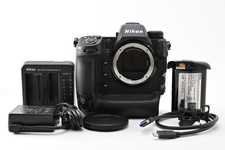
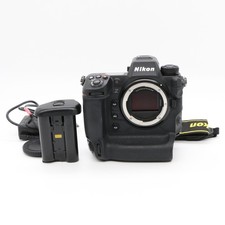
Compare · 2 products compared
Nikon Z9vsFujifilm X100VI: Which Should You Buy?
These two cameras share subject detection, stabilization and log profiles, but they are built for opposite jobs. The Nikon Z9 is a large pro body with a full-frame stacked sensor; the Fujifilm X100VI is a fixed-lens compact you can carry all day. The choice comes down to whether you need interchangeable lenses and speed or portability.
eBay prices refresh hourly — check the listing before you buy. We may earn a commission.
- MOST WINS
 Nikon
NikonBest for Professionals and serious enthusiasts shooting action, wildlife or high-end video
18of 22 specs better - Fujifilm
Best for Travelers and street shooters who want a compact everyday carry
4of 22 specs better
Biggest differences
Weight
Fujifilm X100VI leads
2.57×
lower is better
- Nikon Z91,340 g
- Fujifilm X100VI521 g
Max mechanical shutter speed
Nikon Z9 leads
8×
higher is better
- Nikon Z932,000 1/s
- Fujifilm X100VI4,000 1/s
Battery life
Nikon Z9 leads
2.31×
higher is better
- Nikon Z9740 shots
- Fujifilm X100VI320 shots
Memory card slots
Nikon Z9 leads
2×
higher is better
- Nikon Z92 slots
- Fujifilm X100VI1 slots
Features not all of them have
Headphone port
- Nikon Z9✓
- Fujifilm X100VI✕
Where each one wins
Nikon Z9
- Effective pixels
- Sensor format
- Native ISO maximum
- Sensor type
- Continuous shooting (electronic)
- Max mechanical shutter speed
- Pre-burst capture duration
- Max video resolution
- 4K max frame rate
- Viewfinder magnification
- Screen size
- Rear screen resolution
- Battery life
- Memory card slots
- Weather sealing
- Minimum operating temperature
- Headphone port
- HDMI port type
Fujifilm X100VI
- Weight
- Width
- Height
- Depth
What both have
- In-body image stabilization6 stops
- AF subject detectionHuman, animal, bird, car, train, airplane, motorcycle
- Video bit depth10 bit
- Log profile support✓
- Viewfinder resolution3.69 M dots
- Screen articulationTilting
- USB charging & power delivery✓
Every spec
Red marks the better value in each row.
| Spec | Nikon Z9 | Fujifilm X100VI |
|---|---|---|
| Overview | ||
| Release date | 2021-12 | Not published |
| Launch price | 5,500 USD | Not published |
| Lens mount | Nikon Z | Fixed lens |
| High resolution pixel-shift mode | No | — |
| Sensor & Image | ||
| Effective pixels | 45.7 MP | 40.2 MP |
| Sensor format | Full-frame | APS-C |
| Native ISO maximum | 25,600 ISO | 12,800 ISO |
| In-body image stabilization | 6 stops1 | 6 stops2 |
| Sensor readout speed | Not published | Not published |
| Sensor type | Stacked CMOS | CMOS |
| Aspect ratios | — | 3:2, 4:3, 1:1, 16:9 |
| Lens & Autofocus | ||
| Continuous shooting (mechanical) | Not published | 11 fps |
| Continuous shooting (electronic) | 20 fps | 13 fps |
| Max mechanical shutter speed | 32,000 1/s | 4,000 1/s |
| Pre-burst capture duration | 1 s3 | 0 s4 |
| AF subject detection | Human, animal, bird, car, train, airplane, motorcycle | Human, animal, bird, car, train, airplane, motorcycle |
| Video | ||
| Max video resolution | 8K | 6K |
| 4K max frame rate | 120 fps | 59.94 fps |
| Video codecs | H.264, HEVC, ProRes 422 HQ, ProRes RAW, N-RAW | H.264, HEVC |
| 4K max frame rate (full width) | 30 fps | — |
| Raw video recording | Internal | — |
| Video bit depth | 10 bit | 10 bit |
| Log profile support | Yes | Yes |
| Video dynamic range (log) | Not published | Not published |
| Viewfinder & Screen | ||
| Viewfinder resolution | 3.69 M dots | 3.69 M dots |
| Viewfinder magnification | 0.8 x | 0.66 x |
| Screen size | 3.2 in | 3 in |
| Screen articulation | Tilting | Tilting |
| Rear screen resolution | 2.1 M dots | 1.62 M dots |
| Handling & Power | ||
| Battery life | 740 shots | 320 shots |
| Memory card slots | 2 slots | 1 slots |
| Weather sealing | Dust and drip resistant | None5 |
| Weight | 1,340 g | 521 g |
| Width | 149 mm | 128 mm |
| Height | 149.5 mm | 74.8 mm |
| Depth | 90.5 mm | 55.3 mm |
| USB charging & power delivery | Yes | Yes |
| Minimum operating temperature | -10 °C | 0 °C |
| Headphone port | Yes | No |
| HDMI port type | Full-size | Micro |
Notes on 5 values — test conditions and caveats
- 1Nikon Z9, In-body image stabilization: The 6.0-stop rating requires Synchro VR, combining in-body 5-axis VR with 2-axis lens VR on compatible lenses.
- 2Fujifilm X100VI, In-body image stabilization: 6.0 stops of shake compensation is achieved when using the LCD or EVF.
- 3Nikon Z9, Pre-burst capture duration: Pre-Release Capture is only available in the C30 and C120 high-speed frame capture modes.
- 4Fujifilm X100VI, Pre-burst capture duration: Pre-shot buffers frames while the shutter is half-pressed (e.g., 20 frames at 20fps = 1 second), not a fixed seconds setting.
- 5Fujifilm X100VI, Weather sealing: The camera body itself isn't weather-sealed; weather resistance requires the optional AR-X100 adapter ring and PRF-49 filter.
Sensor and image quality
The Nikon Z9's full-frame stacked sensor gives it a wider field of view with any given lens and typically cleaner high-ISO files, which helps in dim venues and at night. Its pixel count also edges out the Fujifilm X100VI, so large prints and heavy crops hold up slightly better.
The X100VI's APS-C chip is smaller, but it comes with a fixed lens tuned for that sensor, so corner-to-corner sharpness is easier to guarantee. Buyers who shoot wide interiors or push shadows hard will feel the full-frame advantage more than those shooting in daylight.
Video
The Z9 records 8K and can hit 120 fps in 4K, so you get slow-motion options and room to reframe in post that the X100VI simply cannot match with its 6K ceiling and 59.94 fps cap. Internal ProRes and N-RAW recording also mean fewer external boxes on a professional set.
The X100VI covers 4K at 59.94 fps with 10-bit color and a log profile, which is enough for run-and-gun and social delivery. If your work ends up on a phone screen, the gap matters less than the spec sheet suggests.
Speed and autofocus
Both cameras detect the same subject types, so autofocus intelligence is a wash on paper. The Z9 pulls ahead on burst rate and pre-capture: its electronic shutter shoots faster and can buffer a second of frames before you press the button, which is the difference between catching a bird taking off and missing it.
The X100VI's pre-shot mode is not a fixed duration — it buffers while the shutter is half-pressed — so the timing depends on your technique. For continuous action, the Z9 is the safer bet.
Handling, battery and size
The Z9 is a brick: over 1,300 g versus roughly 520 g for the X100VI, and it dwarfs the Fujifilm in every dimension. That weight buys you a bigger grip, two card slots, a full-size HDMI port, a headphone jack and more than double the battery life — all things that matter on a long shoot day.
The X100VI's appeal is the opposite: it disappears into a jacket pocket and gets carried when a bigger camera would stay home. The Z9 is also rated for colder conditions and is dust- and drip-resistant as shipped, while the X100VI needs an optional adapter ring and filter for any weather protection.
Which is best for sports and wildlife?
The Nikon Z9. Its stacked sensor, faster burst, longer pre-capture window and native support for long telephoto lenses through the Nikon Z mount make it the only realistic choice for fast, distant subjects. A fixed 35mm-equivalent lens on the X100VI cannot reach the action.
For travel, street and everyday documentation, the X100VI's small size and built-in lens are the reason to pick it over the Z9.
The Verdict
Buy the Nikon Z9 if you shoot sports, wildlife or professional video and need interchangeable lenses, speed and long battery life. Buy the Fujifilm X100VI if you want a small, light everyday camera that you will actually carry with you. Neither replaces the other — they solve different problems.
Where to buy
Nikon Z9
Best for Professionals and serious enthusiasts shooting action, wildlife or high-end video
Fujifilm X100VI
Best for Travelers and street shooters who want a compact everyday carry
FAQ
Does the Nikon Z9 have a mechanical shutter?
No. Its 32,000 1/s top shutter speed is electronic only, so the mechanical continuous-shooting figure does not apply to it.
Is the Fujifilm X100VI weather-sealed?
Not by itself. Weather resistance only applies when you add the optional AR-X100 adapter ring and PRF-49 filter.
Can the Fujifilm X100VI shoot 4K at 60p?
Yes, it reaches 59.94 fps in 4K, but it cannot match the Z9's 120 fps or 8K option.
How long does the Nikon Z9 battery last?
Rated at 740 shots, which is more than double the X100VI's 320-shot rating.
Does the Fujifilm X100VI support raw video?
No. Raw video recording is internal only on the Nikon Z9; the X100VI records H.264 and HEVC.
Spotted something wrong? Tap the next to any section or spec group to let us know. Every report is read.