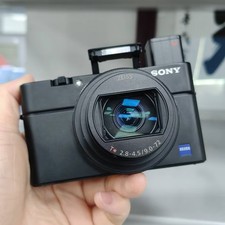
Compare · 2 products compared
Fujifilm X100VIvsSony RX100 VII: Which Compact Wins?
Both are fixed-lens compacts with tilting screens, in-body stabilization, and 4K-or-better video, so the choice is about priorities. The Fujifilm X100VI wins on sensor size, stills resolution, and video specs, while the Sony RX100 VII wins on size and weight. If you want the smallest camera that still shoots fast, the Sony is the one.
eBay prices refresh hourly — check the listing before you buy. We may earn a commission.
- MOST WINS
 Fujifilm
Best for Stills and video shooters who want APS-C quality in a fixed-lens body
11of 17 specs better - Sony
Best for Travelers and everyday carriers who need the smallest fast-shooting compact
6of 17 specs better
Biggest differences
Effective pixels
Fujifilm X100VI leads
2×
higher is better
- Fujifilm X100VI40.2 MP
- Sony RX100 VII20.1 MP
Weight
Sony RX100 VII leads
−42%
lower is better
- Fujifilm X100VI521 g
- Sony RX100 VII302 g
Viewfinder resolution
Fujifilm X100VI leads
+56%
higher is better
- Fujifilm X100VI3.69 M dots
- Sony RX100 VII2.36 M dots
Continuous shooting (electronic)
Sony RX100 VII leads
+54%
higher is better
- Fujifilm X100VI13 fps
- Sony RX100 VII20 fps
Where each one wins
Fujifilm X100VI
- Effective pixels
- Sensor format
- In-body image stabilization
- Continuous shooting (mechanical)
- Max mechanical shutter speed
- Max video resolution
- 4K max frame rate
- Viewfinder resolution
- Viewfinder magnification
- Rear screen resolution
- Battery life
Sony RX100 VII
- Sensor type
- Continuous shooting (electronic)
- Weight
- Width
- Height
- Depth
What both have
- Lens mountFixed lens
- Native ISO maximum12,800 ISO
- Aspect ratios3:2, 4:3, 1:1, 16:9
- Log profile support✓
- Screen size3 in
- Screen articulationTilting
- USB charging & power delivery✓
- Minimum operating temperature0 °C
- HDMI port typeMicro
Every spec
Red marks the better value in each row.
| Spec | Fujifilm X100VI | Sony RX100 VII |
|---|---|---|
| Overview | ||
| Release date | Not published | Not published |
| Launch price | Not published | Not published |
| Lens mount | Fixed lens | Fixed lens |
| High resolution pixel-shift mode | — | Not published |
| Sensor & Image | ||
| Effective pixels | 40.2 MP | 20.1 MP |
| Sensor format | APS-C | 1-inch |
| Native ISO maximum | 12,800 ISO | 12,800 ISO |
| In-body image stabilization | 6 stops1 | 4 stops2 |
| Sensor readout speed | Not published | Not published |
| Sensor type | CMOS | Stacked CMOS |
| Aspect ratios | 3:2, 4:3, 1:1, 16:9 | 3:2, 4:3, 1:1, 16:93 |
| Lens & Autofocus | ||
| Continuous shooting (mechanical) | 11 fps | 10 fps4 |
| Continuous shooting (electronic) | 13 fps | 20 fps5 |
| Max mechanical shutter speed | 4,000 1/s | 2,000 1/s |
| Pre-burst capture duration | 0 s6 | Not published |
| AF subject detection | Human, animal, bird, car, train, airplane, motorcycle | Human, animal7 |
| Video | ||
| Max video resolution | 6K | 4K |
| 4K max frame rate | 59.94 fps | 30 fps |
| Video codecs | H.264, HEVC | H.2648 |
| 4K max frame rate (full width) | — | 30 fps |
| Raw video recording | — | None9 |
| Video bit depth | 10 bit | Not published |
| Log profile support | Yes | Yes10 |
| Video dynamic range (log) | Not published | Not published |
| Viewfinder & Screen | ||
| Viewfinder resolution | 3.69 M dots | 2.36 M dots |
| Viewfinder magnification | 0.66 x | 0.59 x |
| Screen size | 3 in | 3 in |
| Screen articulation | Tilting | Tilting11 |
| Rear screen resolution | 1.62 M dots | 0.92 M dots |
| Handling & Power | ||
| Battery life | 320 shots | 260 shots12 |
| Memory card slots | 1 slots | Not published |
| Weather sealing | None13 | Not published |
| Weight | 521 g | 302 g |
| Width | 128 mm | 101.6 mm |
| Height | 74.8 mm | 58.1 mm |
| Depth | 55.3 mm | 42.8 mm |
| USB charging & power delivery | Yes | Yes14 |
| Minimum operating temperature | 0 °C | 0 °C |
| Headphone port | No | Not published |
| HDMI port type | Micro | Micro |
Notes on 14 values — test conditions and caveats
- 1Fujifilm X100VI, In-body image stabilization: 6.0 stops of shake compensation is achieved when using the LCD or EVF.
- 2Sony RX100 VII, In-body image stabilization: Sony rates the optical (lens-shift) SteadyShot at 4.0 stops at the 200 mm telephoto end, not a body-only CIPA figure.
- 3Sony RX100 VII, Aspect ratios: 4:3, 16:9 and 1:1 sizes are in-camera crop modes over the native 3:2 sensor area.
- 4Sony RX100 VII, Continuous shooting (mechanical): The 'Hi' burst setting is electronic-shutter only; 10 fps ('Mid') is the fastest mechanical-shutter continuous rate.
- 5Sony RX100 VII, Continuous shooting (electronic): Blackout-free 20 fps continuous includes AF/AE tracking; the separate 'Single Burst' mode takes 7 shots at up to 90 fps.
- 6Fujifilm X100VI, Pre-burst capture duration: Pre-shot buffers frames while the shutter is half-pressed (e.g., 20 frames at 20fps = 1 second), not a fixed seconds setting.
- 7Sony RX100 VII, AF subject detection: Maker names only human and animal recognition (Eye AF / Real-time Tracking); no bird or vehicle categories are listed.
- 8Sony RX100 VII, Video codecs: Both XAVC S and AVCHD recording use MPEG-4 AVC/H.264; there is no HEVC/H.265 option.
- 9Sony RX100 VII, Raw video recording: Sony's movie-format list contains only XAVC S (H.264) and AVCHD; no raw video output is offered.
- 10Sony RX100 VII, Log profile support: S-Log2, S-Log3 and HLG log gammas are selectable via Picture Profile presets PP1–PP10.
- 11Sony RX100 VII, Screen articulation: Screen tilts up about 180° for selfies and down about 90°; it does not swing outward like a fully articulated display.
- 12Sony RX100 VII, Battery life: 260 shots assume default monitor settings; Sony also lists 310 shots when 'Auto Monitor Off' is set to 2 s.
- 13Fujifilm X100VI, Weather sealing: The camera body itself isn't weather-sealed; weather resistance requires the optional AR-X100 adapter ring and PRF-49 filter.
- 14Sony RX100 VII, USB charging & power delivery: In-body USB charging and power supply work over the Multi/Micro-USB (USB 2.0) terminal — not USB-C.
Image quality and sensor size
The X100VI's APS-C sensor is far larger than the Sony's 1-inch chip, and it packs roughly twice the pixels. In practice that means cleaner files in low light, more room to crop, and better separation between subject and background when you shoot wide open. The Sony can still produce good images in daylight, but it runs out of headroom sooner once the light drops or you push ISO.
Stabilization tilts the same way. Fujifilm rates its in-body system at 6 stops, and it works with any shutter speed you choose. Sony's 4-stop figure applies to the lens-shift SteadyShot at the telephoto end, so the advantage is smaller at the wide end but real for handheld shooting in dim rooms.
Video
This is the widest gap between the two. The X100VI records 6K and hits 4K at up to 59.94 fps, with 10-bit color and HEVC available. The Sony tops out at 4K/30p and records in 8-bit H.264 only, with no HEVC or raw option. If you shoot video seriously, the Fujifilm is the clear pick.
The Sony's edge is its stacked sensor, which helps with autofocus speed and rolling shutter, and its S-Log2/S-Log3 profiles are mature and well understood by colorists. For casual clips the Sony is fine. For anything you plan to grade or deliver at high frame rates, the Fujifilm is the better tool.
Autofocus and burst shooting
Sony's stacked sensor and Real-time Tracking are the reason the RX100 VII still competes. It shoots blackout-free at 20 fps with AF and AE tracking, and its Single Burst mode fires up to 7 shots at 90 fps. The Fujifilm does 13 fps electronically and 11 fps mechanically, so for fast action the Sony has the edge.
Subject detection flips the result. Fujifilm recognizes humans, animals, birds, cars, trains, airplanes, and motorcycles. Sony lists only human and animal. If you shoot birds or motorsports, the Fujifilm identifies the subject for you; the Sony relies on you placing the tracking box.
Size, weight, and battery
The Sony is dramatically smaller and lighter, at 302 g versus 521 g, and roughly three-quarters the width and depth. That is the difference between a camera you carry every day and one you leave at home. The Sony also charges over USB, though through a Micro-USB port rather than USB-C.
The Fujifilm counters with better battery life, rated at 320 shots versus Sony's 260 under default settings. The Sony can reach 310 shots if you enable Auto Monitor Off at 2 seconds, but that shortens your shooting time per charge. Neither camera is weather-sealed as shipped; the Fujifilm needs an optional adapter ring and filter to claim any weather resistance.
Viewfinder and screen
The X100VI's electronic viewfinder is sharper and larger, at 3.69 M dots and 0.66x magnification versus Sony's 2.36 M dots and 0.59x. That matters for manual focus and for framing in bright light. The rear screen tilts on both, but neither fully articulates, so vloggers and self-shooters get limited flexibility. Fujifilm's rear panel is also higher resolution, at 1.62 M dots against Sony's 0.92 M dots, making image review and menu navigation easier.
The Verdict
Buy the Fujifilm X100VI if image quality, video specs, or subject recognition matter most and you can accept the larger, heavier body. Buy the Sony RX100 VII if pocketability is the priority and you shoot mostly in good light with fast-moving subjects. Neither is weather-sealed out of the box. The X100VI is the better all-rounder; the Sony is the better travel companion.
Where to buy
Fujifilm X100VI
Best for Stills and video shooters who want APS-C quality in a fixed-lens body
Sony RX100 VII
Best for Travelers and everyday carriers who need the smallest fast-shooting compact
FAQ
Does the Fujifilm X100VI have a built-in flash?
Not stated in the specs reviewed here. The Sony RX100 VII also has no flash figure listed, so neither can be confirmed from the data on this page.
Can I use the X100VI in the rain?
Only with the optional AR-X100 adapter ring and PRF-49 filter attached; the body itself is not weather-sealed. The Sony's weather sealing is not published.
Which camera has USB-C charging?
Neither. The Sony charges over a Micro-USB (USB 2.0) terminal, and the Fujifilm's port type is not specified in the data reviewed here.
Does the Sony RX100 VII shoot 4K at 60 fps?
No. The Sony's maximum 4K frame rate is 30 fps. The Fujifilm X100VI reaches 59.94 fps in 4K, which is the main reason it wins for video.
What is the minimum operating temperature for both cameras?
Both are rated to 0 °C, so neither is suited to sub-freezing shooting without care. Cold-weather performance beyond that figure is not published for either.
Spotted something wrong? Tap the next to any section or spec group to let us know. Every report is read.