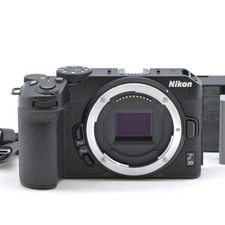
Compare · 2 products compared
Fujifilm X100VIvsNikon Z 30: Specs Compared
Both the Fujifilm X100VI and Nikon Z 30 use an APS-C sensor and a 3-inch screen, so the choice comes down to how you shoot. The Fujifilm X100VI locks in a fixed lens with stabilization and high resolution; the Nikon Z 30 takes interchangeable Z lenses and flips its screen for vlogging. One is a carry-everywhere camera, the other a small system body.
eBay prices refresh hourly — check the listing before you buy. We may earn a commission.
 Fujifilm
Best for Stills shooters and video creators who want one fixed-lens camera with IBIS, an EVF and 6K
6of 12 specs better- Nikon
Best for Vloggers and lens-swappers who want a light, flip-screen Z-mount body
6of 12 specs better
Biggest differences
Native ISO maximum
Nikon Z 30 leads
4×
higher is better
- Fujifilm X100VI12,800 ISO
- Nikon Z 3051,200 ISO
Effective pixels
Fujifilm X100VI leads
+92%
higher is better
- Fujifilm X100VI40.2 MP
- Nikon Z 3020.9 MP
4K max frame rate
Fujifilm X100VI leads
2×
higher is better
- Fujifilm X100VI59.94 fps
- Nikon Z 3030 fps
Rear screen resolution
Fujifilm X100VI leads
+56%
higher is better
- Fujifilm X100VI1.62 M dots
- Nikon Z 301.04 M dots
Where each one wins
Fujifilm X100VI
- Effective pixels
- Max video resolution
- 4K max frame rate
- Viewfinder resolution
- Rear screen resolution
- Depth
Nikon Z 30
- Native ISO maximum
- Screen articulation
- Battery life
- Weight
- Height
- HDMI port type
What both have
- Sensor formatAPS-C
- Sensor typeCMOS
- Continuous shooting (mechanical)11 fps
- Max mechanical shutter speed4,000 1/s
- Screen size3 in
- Memory card slots1 slots
- Width128 mm
- USB charging & power delivery✓
- Minimum operating temperature0 °C
Every spec
Red marks the better value in each row.
| Spec | Fujifilm X100VI | Nikon Z 30 |
|---|---|---|
| Overview | ||
| Release date | Not published | Not published |
| Launch price | Not published | Not published |
| Lens mount | Fixed lens | Nikon Z |
| High resolution pixel-shift mode | — | Not published |
| Sensor & Image | ||
| Effective pixels | 40.2 MP | 20.9 MP |
| Sensor format | APS-C | APS-C1 |
| Native ISO maximum | 12,800 ISO | 51,200 ISO2 |
| In-body image stabilization | 6 stops3 | Not published |
| Sensor readout speed | Not published | Not published |
| Sensor type | CMOS | CMOS |
| Aspect ratios | 3:2, 4:3, 1:1, 16:9 | 3:2, 1:1, 16:94 |
| Lens & Autofocus | ||
| Continuous shooting (mechanical) | 11 fps | 11 fps5 |
| Continuous shooting (electronic) | 13 fps | Not published |
| Max mechanical shutter speed | 4,000 1/s | 4,000 1/s |
| Pre-burst capture duration | 0 s6 | Not published |
| AF subject detection | Human, animal, bird, car, train, airplane, motorcycle | — |
| Video | ||
| Max video resolution | 6K | 4K |
| 4K max frame rate | 59.94 fps | 30 fps |
| Video codecs | H.264, HEVC | H.264 |
| 4K max frame rate (full width) | — | 30 fps |
| Raw video recording | — | Not published |
| Video bit depth | 10 bit | Not published |
| Log profile support | Yes | Not published |
| Video dynamic range (log) | Not published | Not published |
| Viewfinder & Screen | ||
| Viewfinder resolution | 3.69 M dots | 0 M dots7 |
| Viewfinder magnification | 0.66 x | Not published |
| Screen size | 3 in | 3 in |
| Screen articulation | Tilting | Fully articulated |
| Rear screen resolution | 1.62 M dots | 1.04 M dots |
| Handling & Power | ||
| Battery life | 320 shots | 330 shots8 |
| Memory card slots | 1 slots | 1 slots |
| Weather sealing | None9 | Not published |
| Weight | 521 g | 405 g |
| Width | 128 mm | 128 mm |
| Height | 74.8 mm | 73.5 mm |
| Depth | 55.3 mm | 59.5 mm |
| USB charging & power delivery | Yes | Yes10 |
| Minimum operating temperature | 0 °C | 0 °C |
| Headphone port | No | Not published |
| HDMI port type | Micro | Mini |
Notes on 10 values — test conditions and caveats
- 1Nikon Z 30, Sensor format: DX format is Nikon's name for its APS-C-size sensor (23.5 x 15.7 mm).
- 2Nikon Z 30, Native ISO maximum: Settings above ISO 51200 (102400, 204800) are expanded, not native.
- 3Fujifilm X100VI, In-body image stabilization: 6.0 stops of shake compensation is achieved when using the LCD or EVF.
- 4Nikon Z 30, Aspect ratios: Native DX ratio is 3:2; 1:1 and 16:9 are in-camera crop modes.
- 5Nikon Z 30, Continuous shooting (mechanical): Nikon's in-house measured maximum; the rate is approximate.
- 6Fujifilm X100VI, Pre-burst capture duration: Pre-shot buffers frames while the shutter is half-pressed (e.g., 20 frames at 20fps = 1 second), not a fixed seconds setting.
- 7Nikon Z 30, Viewfinder resolution: The Z 30 has no electronic viewfinder; compose on the rear LCD.
- 8Nikon Z 30, Battery life: Figure is for the EN-EL25 battery; shot count differs with EN-EL25a.
- 9Fujifilm X100VI, Weather sealing: The camera body itself isn't weather-sealed; weather resistance requires the optional AR-X100 adapter ring and PRF-49 filter.
- 10Nikon Z 30, USB charging & power delivery: In-camera USB charging/power needs Nikon's optional EH-7P or EH-8P adapter.
Sensor and image quality
The Fujifilm X100VI resolves 40.2 MP against 20.9 MP on the Nikon Z 30. That extra resolution is headroom: bigger prints, more room to crop, and more detail kept when you straighten a horizon or punch in on a distant subject. If you rarely crop and mostly share online, the Z 30's 20.9 MP is plenty.
For low light, the Nikon pushes to a native 51,200 ISO while the Fujifilm stops at 12,800. Settings above the Nikon's figure are expanded, not native, so treat both ceilings as the honest limit. The Z 30 gives you roughly two stops more native range, which helps indoors and after dark without raising the shutter speed to a blur.
Handling and stabilization
The Fujifilm X100VI has in-body stabilization rated at 6 stops when using the LCD or EVF. That is the difference between a sharp handheld shot at dusk and a soft one, and it also steadies the 6K footage. The Nikon Z 30 publishes no stabilization figure, so handheld low-light work leans on the lens and your technique.
On size, the Nikon is the lighter body at 405 g versus 521 g, and it is marginally shorter. The Fujifilm is a touch slimmer front to back. Neither is a burden, but the Nikon is the easier one to carry all day on a strap.
Viewfinder and screen
The Fujifilm X100VI has a 3.69 M-dot electronic viewfinder and a 1.62 M-dot tilting rear screen. The Nikon Z 30 has no viewfinder at all — you compose on its 1.04 M-dot screen. That matters most in bright sun, where an EVF lets you frame without fighting glare, and for anyone who prefers the camera to the eye.
The Nikon's screen is fully articulated, so it flips to face you for self-recording or shooting at odd angles. The Fujifilm's tilts but does not face forward. If you vlog or film yourself, the Z 30's screen is the more useful one; if you shoot stills at eye level, the X100VI's viewfinder wins.
Video
The Fujifilm X100VI records 6K and hits 59.94 fps in 4K, plus 10-bit color and a log profile. The Nikon Z 30 tops out at 4K 30 fps with H.264 and no published bit depth or log support. Higher frame rates give you slow motion; 10-bit and log give you more room to grade. For anyone delivering video, the Fujifilm is the stronger tool.
The Z 30's case is ease. Its fully articulated screen and light body make it a friendly first video camera, and 4K 30 is fine for talking-head and casual clips. The catch is that you give up the frame rate, the extra bit depth and the flat profile — harder to match shots or recover highlights later.
Battery, ports and cards
Battery life is nearly a tie: 330 shots from the Nikon Z 30 versus 320 from the Fujifilm X100VI. The Nikon figure applies to the EN-EL25 battery and changes with the EN-EL25a. Both bodies take a single memory card and both support USB charging and power.
Where they part is connectivity. The Nikon uses a full-size Mini HDMI, the Fujifilm a Micro HDMI — the Mini is a sturdier connection for a monitor or recorder and less likely to work loose. The Fujifilm has no headphone port. Note the Z 30's in-camera USB charging needs Nikon's optional EH-7P or EH-8P adapter.
Weather sealing
The Fujifilm X100VI body itself is not weather-sealed. Weather resistance requires the optional AR-X100 adapter ring and PRF-49 filter, so you pay extra and add a part to get it. Nikon does not publish a sealing spec for the Z 30 either.
Treat both as fair-weather cameras unless you add the Fujifilm's adapter kit. If you shoot in rain or dust often, the honest move is to budget for the Fujifilm's accessories or plan to protect whichever body you buy.
The Verdict
Buy the Fujifilm X100VI if you want one carry-everywhere camera with stabilization, a viewfinder and serious video and resolution without buying lenses. Buy the Nikon Z 30 if you want a light, affordable-feeling system body that takes Z lenses, flips its screen for self-recording, and shoots clean video in good light.
Where to buy
Fujifilm X100VI
Best for Stills shooters and video creators who want one fixed-lens camera with IBIS, an EVF and 6K
Nikon Z 30
Best for Vloggers and lens-swappers who want a light, flip-screen Z-mount body
FAQ
Does the Nikon Z 30 have a viewfinder?
No. The Z 30 has no electronic viewfinder, so you compose on the 1.04 M-dot rear screen. That is the trade-off for its small, light body.
Can the Fujifilm X100VI change lenses?
No. It uses a fixed lens, so you are locked to that focal length. The Nikon Z 30 accepts Nikon Z lenses, which is the main reason to choose it over the X100VI.
Which records better video, the X100VI or the Z 30?
The Fujifilm X100VI. It reaches 6K, shoots 4K at 59.94 fps, and records 10-bit with a log profile. The Nikon Z 30 caps at 4K 30 fps with H.264.
Does the X100VI have image stabilization?
Yes. It has in-body stabilization rated at 6 stops when using the LCD or EVF. Nikon does not publish an IBIS figure for the Z 30.
Which lasts longer on a battery?
The Nikon Z 30, but only barely — 330 shots versus 320 for the Fujifilm X100VI. That Nikon figure applies to the EN-EL25 battery and changes with the EN-EL25a.
Spotted something wrong? Tap the next to any section or spec group to let us know. Every report is read.