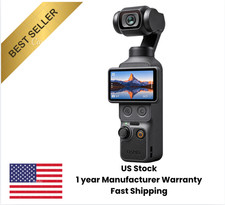
Compare · 2 products compared
DJI Osmo Pocket 4vsGoPro MAX2: Which to Buy
Both are pocket-size stabilized cameras that shoot 10-bit HEVC with a log profile, and neither has a front screen. The split comes down to shape and purpose: the DJI is a gimbal-styled creator tool with a much larger sensor, while the GoPro is a rugged 360-capable action camera you can submerge. Pick by where you film, not by spec count.
eBay prices refresh hourly — check the listing before you buy. We may earn a commission.
 DJI
DJIBest for Handheld creators who want the best low-light image and 4K slow motion
8of 18 specs better- MOST WINSGoPro
Best for Action and water shooters who need rugged, mountable, horizon-locked footage
10of 18 specs better
+ Add a product to compare
Biggest differences
Max frame rate at 4K
DJI Osmo Pocket 4 leads
2.4×
higher is better
- DJI Osmo Pocket 4240 fps
- GoPro MAX2100 fps
Sensor size
DJI Osmo Pocket 4 leads
2.33×
higher is better
- DJI Osmo Pocket 41 in
- GoPro MAX20.43 in
Max frame rate
DJI Osmo Pocket 4 leads
2.4×
higher is better
- DJI Osmo Pocket 4240 fps
- GoPro MAX2100 fps
Height
GoPro MAX2 leads
2.07×
lower is better
- DJI Osmo Pocket 4144.2 mm
- GoPro MAX269.7 mm
Features not all of them have
Horizon lock
- DJI Osmo Pocket 4✕
- GoPro MAX2✓
Removable battery
- DJI Osmo Pocket 4✕
- GoPro MAX2✓
Where each one wins
DJI Osmo Pocket 4
- Sensor size
- Max frame rate at 4K
- Max frame rate
- Max photo resolution
- Rear screen size
- Weight
- Width
- Depth
GoPro MAX2
- Launch price
- Aperture
- Max video resolution
- Max video bitrate
- Horizon lock
- Height
- Waterproof depth
- Battery capacity
- Removable battery
- GPS
What both have
- Video codecsHEVC
- Color bit depth10-bit
- Log profile✓
- Image stabilizationIn-camera
- Rear touchscreen✓
- Memory card slot✓
- Max memory card size1,024 GB
- Wi-Fi standardWi-Fi 6
- Live streaming resolution1080p
- External microphoneBuilt-in
Every spec
Red marks the better value in each row.
| Spec | DJI Osmo Pocket 4 | GoPro MAX2 |
|---|---|---|
| Overview | ||
| Release date | 2026-04 | 2025-09 |
| Launch price | 560 USD | 499.99 USD |
| Sensor & lens | ||
| Sensor size | 1 in | 0.43 in |
| Aperture | 2 f | 1.8 f |
| Field of view | 94 °1 | Not published |
| Video | ||
| Max video resolution | 4K | 8K |
| Max frame rate at 4K | 240 fps2 | 100 fps |
| Max frame rate | 240 fps3 | 100 fps |
| Max video bitrate | 180 Mbps | 300 Mbps4 |
| Video codecs | HEVC | HEVC |
| Color bit depth | 10-bit | 10-bit |
| Log profile | Yes | Yes |
| HDR video | No5 | Not published |
| Time-lapse modes | Time-lapse, hyperlapse | Time-lapse, night-lapse, star trails, light painting |
| Pre-recording | No6 | Not published |
| Max digital zoom | 4 x | Not published |
| Photo | ||
| Max photo resolution | 37 MP | 29 MP |
| RAW photos | Yes | Not published |
| Stabilization | ||
| Image stabilization | In-camera | In-camera |
| Horizon lock | No7 | Yes |
| Screens | ||
| Rear screen size | 2 in | 1.82 in |
| Front screen size | 0 in8 | Not published |
| Rear screen brightness | 1,000 nits | Not published |
| Rear touchscreen | Yes | Yes |
| Front touchscreen | No9 | Not published |
| Body & durability | ||
| Weight | 190.5 g | 195 g |
| Width | 44.4 mm | 64 mm |
| Height | 144.2 mm | 69.7 mm |
| Depth | 33.5 mm | 48.7 mm |
| Waterproof depth | 0 m10 | 5 m |
| Waterproof depth with case | 0 m11 | Not published |
| Min operating temperature | 0 °C | Not published |
| Max operating temperature | 40 °C | Not published |
| Battery | ||
| Battery capacity | 1,545 mAh | 1,960 mAh |
| Claimed max recording time | 240 min12 | Not published |
| Removable battery | No13 | Yes |
| Claimed recording time at 4K | 0 min14 | Not published |
| Storage | ||
| Built-in storage | 107 GB | Not published |
| Memory card slot | Yes | Yes |
| Max memory card size | 1,024 GB | 1,024 GB |
| Connectivity | ||
| GPS | None15 | Built-in |
| Wi-Fi standard | Wi-Fi 6 | Wi-Fi 6 |
| Live streaming resolution | 1080p | 1080p16 |
| Audio | ||
| External microphone | Built-in17 | Built-in18 |
Notes on 18 values — test conditions and caveats
- 1DJI Osmo Pocket 4, Field of view: Derived from the 20 mm-equivalent lens: ~94° diagonal field of view.
- 2DJI Osmo Pocket 4, Max frame rate at 4K: 240fps at 4K is only available in slow motion, not in normal video mode.
- 3DJI Osmo Pocket 4, Max frame rate: Highest continuous slow-motion frame rate is 240fps; a 480fps figure is claimed but unconfirmed.
- 4GoPro MAX2, Max video bitrate: 300 Mbps recording needs the optional GoPro Labs firmware; out of the box the maximum is 120 Mbps.
- 5DJI Osmo Pocket 4, HDR video: The spec table lists no HLG or HDR10 video mode; HDR recording is not stated.
- 6DJI Osmo Pocket 4, Pre-recording: No pre-record or hind-sight buffer mode is listed.
- 7DJI Osmo Pocket 4, Horizon lock: No horizon-lock or horizon-levelling mode is stated; the roll axis is limited to ±45°.
- 8DJI Osmo Pocket 4, Front screen size: No dedicated front-facing screen is listed; the single screen rotates.
- 9DJI Osmo Pocket 4, Front touchscreen: There is no dedicated front-facing screen, so no front touchscreen.
- 10DJI Osmo Pocket 4, Waterproof depth: No waterproof rating is stated for the bare camera; it is not submersible.
- 11DJI Osmo Pocket 4, Waterproof depth with case: DJI lists no waterproof housing for this camera, so there is no housing depth rating.
- 12DJI Osmo Pocket 4, Claimed max recording time: The 240-minute figure is at 1080p/24fps with Wi-Fi and screen off.
- 13DJI Osmo Pocket 4, Removable battery: The battery is internal LiPo; DJI does not state it is user-swappable.
- 14DJI Osmo Pocket 4, Claimed recording time at 4K: No 4K recording-time figure is stated; the only claimed runtime is 1080p/24fps.
- 15DJI Osmo Pocket 4, GPS: No GPS or GNSS receiver is listed in the spec table.
- 16GoPro MAX2, Live streaming resolution: Live streaming on the Max2 requires a paid GoPro subscription.
- 17DJI Osmo Pocket 4, External microphone: DJI Mic transmitters pair directly with the camera; no adapter is required.
- 18GoPro MAX2, External microphone: External mics pair directly over Bluetooth (e.g. AirPods); the body has no 3.5mm mic jack.
Video
The GoPro MAX2 shoots up to 8K and the DJI Osmo Pocket 4 tops out at 4K, so if resolution is the goal the MAX2 is the only option here. The MAX2 also records at a higher bitrate, but only with the optional GoPro Labs firmware — out of the box it caps at 120 Mbps, below the Pocket 4's 180 Mbps. Unless you install that firmware, the DJI actually gives editors more data per second.
Slow motion flips the result. The Pocket 4 reaches 240fps at 4K in its slow-motion mode, the MAX2 stops at 100fps. For anyone shooting sports, water or wildlife and wanting smooth slow-mo without dropping resolution, that gap matters more than the 8K headline. Neither camera offers HDR video, and the MAX2 doesn't publish an HDR mode at all.
Sensor, photo and low light
The Pocket 4's 1-inch sensor is roughly twice the diagonal of the MAX2's 0.43-inch chip, which is the single biggest hardware difference on this page. A larger sensor gathers more light per pixel, so the DJI should hold up better indoors and at dusk, and it gives you more room to push shadows in editing. The MAX2's slightly brighter f/1.8 aperture claws back some of that, but it can't close a gap this wide.
Stills follow the same pattern: 37 MP on the Pocket 4 against 29 MP on the MAX2, and the DJI also shoots RAW while GoPro publishes no RAW photo mode. If you plan to crop, print or grade photos, the DJI is the clear pick. The MAX2's strength is elsewhere — its 360 capture and horizon lock, not its sensor.
Stabilization and durability
Both cameras stabilize in-camera, but only the GoPro MAX2 has horizon lock, which keeps the frame level through rolls and tumbles. The Pocket 4's roll axis is limited to ±45°, so hard tilts will show. For handheld walking footage either is fine; for mounting on a bike, board or helmet, the MAX2's lock removes a whole class of ruined clips.
Water is the sharper divide. The MAX2 is rated to 5 m with no housing, so it can go in surf, pools or rain without a case. The Pocket 4 carries no waterproof rating and DJI sells no housing for it, so it must stay dry. If your shooting involves water at all, that alone decides it.
Battery, size and mounting
The MAX2 has the larger battery, 1,960 mAh versus 1,545 mAh, and its battery is user-removable, so you can carry spares and keep shooting. The Pocket 4's battery is internal with no stated swappable option, and DJI's only runtime claim is 240 minutes at 1080p/24fps with the screen and Wi-Fi off — there's no 4K figure at all. Plan on shorter 4K sessions and charging between them.
In the hand the two feel completely different. The DJI is narrower and shorter and weighs a touch less, and its 2-inch screen is bigger and brighter at 1,000 nits, which helps framing outdoors. The MAX2 is shorter but wider and deeper, a squarer block that mounts like a GoPro. The Pocket 4 also ships with 107 GB of built-in storage; the MAX2 relies on a microSD card.
Connectivity and audio
The MAX2 has built-in GPS, so speed, altitude and route overlays come free in your footage. The Pocket 4 lists no GPS receiver, so you'd add that data another way or go without. Both use Wi-Fi 6 and both stream at 1080p, though the MAX2's live streaming needs a paid GoPro subscription while the DJI's does not.
Audio is a wash in the spec sheet but not in practice. The DJI pairs directly with DJI Mic transmitters, no adapter needed. The MAX2 has no 3.5mm jack and pairs external mics over Bluetooth instead. If you already own either brand's wireless mic system, that's your camera.
The Verdict
Buy the DJI Osmo Pocket 4 if you shoot handheld, want the best image quality in low light, need 4K slow motion or shoot RAW photos. Buy the GoPro MAX2 if you film action, mount the camera to something moving, or might get it wet. The 5 m waterproof body and horizon lock are the two features the DJI simply cannot match. Choose by environment first, then by resolution.
Where to buy
DJI Osmo Pocket 4
Best for Handheld creators who want the best low-light image and 4K slow motion
GoPro MAX2
Best for Action and water shooters who need rugged, mountable, horizon-locked footage
FAQ
Is the DJI Osmo Pocket 4 waterproof?
No. DJI states no waterproof rating for the bare camera and sells no dive housing for it, so it is not submersible. The GoPro MAX2 is rated to 5 m with no case at all.
Which has the better battery life?
GoPro doesn't publish a runtime figure for the MAX2, and the Pocket 4's only claim is 240 minutes at 1080p/24fps with Wi-Fi and the screen off — no 4K figure exists. On paper the MAX2 has the larger capacity and a removable battery, which is the more practical advantage.
Does the GoPro MAX2 really record 8K at 300 Mbps?
The 8K resolution is standard, but the 300 Mbps bitrate requires installing the optional GoPro Labs firmware. Out of the box the MAX2's maximum bitrate is 120 Mbps, which is below the Pocket 4's 180 Mbps.
Can I use an external microphone with either camera?
Yes, but differently. The Pocket 4 pairs directly with DJI Mic transmitters with no adapter, while the MAX2 has no 3.5mm jack and pairs mics over Bluetooth instead.
Which one has GPS for speed and route overlays?
Only the GoPro MAX2, which has built-in GPS. The Pocket 4's spec table lists no GPS or GNSS receiver.
Spotted something wrong? Tap the next to any section or spec group to let us know. Every report is read.