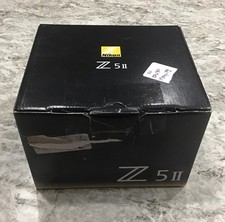
Compare · 2 products compared
Nikon Z5IIvsNikon Z6III: Which Z Should You Buy?
Both are 24.5MP full-frame Nikon Z bodies with in-body stabilization, dual card slots and the same subject-detection list, so the everyday stills look similar. The split is speed and video: the Z6III shoots faster, records 6K and offers a sharper viewfinder, while the Z5II costs far less and packs smaller.
eBay prices refresh hourly — check the listing before you buy. We may earn a commission.
 Nikon
NikonBest for Value-focused stills shooters and casual 4K video users
5of 15 specs better- MOST WINSNikon
Best for Action, wildlife and hybrid video shooters who need speed and formats
10of 15 specs better
Biggest differences
Continuous shooting (electronic)
Nikon Z6III leads
2×
higher is better
- Nikon Z5II30 fps
- Nikon Z6III60 fps
Viewfinder resolution
Nikon Z6III leads
+56%
higher is better
- Nikon Z5II3.69 M dots
- Nikon Z6III5.76 M dots
4K max frame rate
Nikon Z6III leads
2×
higher is better
- Nikon Z5II60 fps
- Nikon Z6III120 fps
4K max frame rate (full width)
Nikon Z6III leads
2×
higher is better
- Nikon Z5II30 fps
- Nikon Z6III60 fps
Where each one wins
Nikon Z5II
- Launch price
- Weight
- Width
- Height
- Depth
Nikon Z6III
- In-body image stabilization
- Continuous shooting (mechanical)
- Continuous shooting (electronic)
- Max video resolution
- 4K max frame rate
- 4K max frame rate (full width)
- Viewfinder resolution
- Battery life
- Minimum operating temperature
- HDMI port type
What both have
- Lens mountNikon Z
- High resolution pixel-shift mode✓
- Effective pixels24.5 MP
- Sensor formatFull-frame
- Native ISO maximum64,000 ISO
- Sensor typePartially-stacked CMOS
- Max mechanical shutter speed8,000 1/s
- AF subject detectionHuman, animal, bird, car, train, airplane, motorcycle
- Raw video recordingInternal
- Video bit depth10 bit
- Log profile support✓
- Viewfinder magnification0.8 x
- Screen size3.2 in
- Screen articulationFully articulated
- Rear screen resolution2.1 M dots
- Memory card slots2 slots
- Weather sealingDust and drip resistant
- USB charging & power delivery✓
- Headphone port✓
Every spec
Red marks the better value in each row.
| Spec | Nikon Z5II | Nikon Z6III |
|---|---|---|
| Overview | ||
| Release date | 2025-04 | 2024-06 |
| Launch price | 1,696.95 USD | 2,499.95 USD |
| Lens mount | Nikon Z | Nikon Z |
| High resolution pixel-shift mode | Yes1 | Yes2 |
| Sensor & Image | ||
| Effective pixels | 24.5 MP | 24.5 MP |
| Sensor format | Full-frame | Full-frame |
| Native ISO maximum | 64,000 ISO | 64,000 ISO |
| In-body image stabilization | 7.5 stops | 8 stops3 |
| Sensor readout speed | Not published | 14.3 ms |
| Sensor type | Partially-stacked CMOS | Partially-stacked CMOS |
| Aspect ratios | — | 3:2, 1:1, 16:9 |
| Lens & Autofocus | ||
| Continuous shooting (mechanical) | 7.8 fps | 14 fps |
| Continuous shooting (electronic) | 30 fps | 60 fps4 |
| Max mechanical shutter speed | 8,000 1/s | 8,000 1/s |
| Pre-burst capture duration | Not published | 1 s5 |
| AF subject detection | Human, animal, bird, car, train, airplane, motorcycle | Human, animal, bird, car, train, airplane, motorcycle |
| Video | ||
| Max video resolution | 4K | 6K |
| 4K max frame rate | 60 fps | 120 fps |
| Video codecs | H.264, HEVC, N-RAW | H.264, HEVC, ProRes 422 HQ, ProRes RAW, N-RAW |
| 4K max frame rate (full width) | 30 fps | 60 fps |
| Raw video recording | Internal | Internal |
| Video bit depth | 10 bit | 10 bit |
| Log profile support | Yes | Yes |
| Video dynamic range (log) | Not published | 13 stops6 |
| Viewfinder & Screen | ||
| Viewfinder resolution | 3.69 M dots | 5.76 M dots |
| Viewfinder magnification | 0.8 x | 0.8 x |
| Screen size | 3.2 in | 3.2 in |
| Screen articulation | Fully articulated | Fully articulated |
| Rear screen resolution | 2.1 M dots | 2.1 M dots |
| Handling & Power | ||
| Battery life | 350 shots | 390 shots |
| Memory card slots | 2 slots | 2 slots |
| Weather sealing | Dust and drip resistant | Dust and drip resistant |
| Weight | 700 g | 760 g |
| Width | 134 mm | 138.5 mm |
| Height | 100.5 mm | 101.5 mm |
| Depth | 72 mm | 74 mm |
| USB charging & power delivery | Yes | Yes7 |
| Minimum operating temperature | 0 °C | -10 °C |
| Headphone port | Yes | Yes |
| HDMI port type | Micro | Full-size |
Notes on 7 values — test conditions and caveats
- 1Nikon Z5II, High resolution pixel-shift mode: Pixel-shift composite raises resolution to 96MP, but images must be combined in NX Studio on a computer.
- 2Nikon Z6III, High resolution pixel-shift mode: Pixel-shift frames are merged on a computer in NX Studio, not in the camera.
- 3Nikon Z6III, In-body image stabilization: CIPA figure measured with the non-VR NIKKOR Z 24-120mm f/4 S at 120mm.
- 4Nikon Z6III, Continuous shooting (electronic): 60 fps is full-resolution JPEG only; Raw bursts top out at 20 fps, and 120 fps uses a DX crop.
- 5Nikon Z6III, Pre-burst capture duration: Pre-Release Capture records JPEG only.
- 6Nikon Z6III, Video dynamic range (log): Nikon states "13+ stops" for N-Log in H.265 10-bit at ISO 800.
- 7Nikon Z6III, USB charging & power delivery: In-camera charging and USB power need a USB-PD source such as Nikon's EH-8P.
Price and size
The Nikon Z5II lands at $1,696.95 against $2,499.95 for the Nikon Z6III, and the cheaper body is also the smaller one: 700 g versus 760 g, and a few millimeters tighter in every dimension. That gap is roughly $800 toward a lens, a card or a tripod.
The Z6III's extra cash buys capability, not build. Both are dust- and drip-resistant with two card slots and USB charging, so the Z5II's savings do not come out of ruggedness.
Speed and autofocus
The Z6III is the action body: 14 fps with the mechanical shutter against 7.8 fps, and 60 fps electronically at full resolution, though that mode is JPEG only and Raw bursts stop at 20 fps. It also records a one-second pre-burst, so shots taken before you press the shutter survive, in JPEG.
The Z5II still hits 30 fps electronically, which covers casual movement and family sports. Choose the Z6III only if you regularly photograph fast, unpredictable subjects and want those frames in Raw.
Video
The Z6III shoots 6K and 4K at up to 120 fps, while the Z5II tops out at 4K/60p. Full-width 4K separates them further: 60 fps on the Z6III versus 30 fps on the Z5II, and the Z6III adds ProRes 422 HQ and ProRes RAW alongside the N-RAW both bodies offer internally.
If you crop in post or shoot slow motion, the Z6III's headroom matters; note that its 120 fps uses a DX crop. The Z5II's 10-bit log footage is enough for straightforward 4K work.
Viewfinder and handling
The Z6III's electronic viewfinder resolves 5.76M dots against 3.69M on the Z5II, at the same 0.8x magnification. That is a visible difference when manually focusing or tracking a subject against busy backgrounds.
The Z6III also brings a full-size HDMI port instead of micro, which avoids fragile adapters on a rig, and keeps working down to -10°C rather than 0°C for winter shooting. Both use the same fully articulated 3.2-inch screen.
Battery and stabilization
Battery life is close: 390 shots on the Z6III versus 350 on the Z5II, about a tenth more frames per charge and rarely the deciding factor. Stabilization is similarly tight at 8 stops against 7.5, with the Z6III's figure measured with a non-VR 24-120mm lens.
Neither number changes what you can hand-hold in any meaningful way. Treat both as good enough for slow shutter speeds and stable handheld video.
The Verdict
Buy the Nikon Z5II if you want full-frame stills and solid 4K/60p video for the least money and the smallest bag. Buy the Nikon Z6III if you shoot fast action, need 6K or ProRes, or want a sharper viewfinder and a full-size HDMI port. The Z5II is the better value for most hobbyists; the Z6III is the better tool for working photographers who will use its speed. Neither is a mistake — the question is whether your work needs the extra frames and formats.
Where to buy
Nikon Z5II
Best for Value-focused stills shooters and casual 4K video users
Nikon Z6III
Best for Action, wildlife and hybrid video shooters who need speed and formats
FAQ
Do the Nikon Z5II and Z6III use the same lenses?
Yes. Both use the Nikon Z mount, so any Z-mount lens works on either body, including the same stabilization figures measured with NIKKOR Z glass.
Can both cameras do pixel-shift high-resolution shots?
Yes, but the composite is built on a computer in NX Studio for both, not in-camera. The Z5II's mode raises resolution to 96MP.
Which has the better electronic viewfinder?
The Z6III, at 5.76M dots versus 3.69M on the Z5II. Magnification is identical at 0.8x, so the gain is sharpness and detail, not size.
Do both record raw video internally?
Yes. Both record internal N-RAW at 10-bit; the Z6III adds ProRes 422 HQ and ProRes RAW on top.
Is the Z6III worth the extra money?
Only if you need its speed or video formats. For portraits, landscapes and everyday shooting, the Z5II delivers comparable image quality for far less.
Spotted something wrong? Tap the next to any section or spec group to let us know. Every report is read.