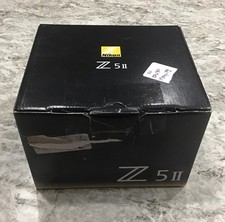
Compare · 2 products compared
Nikon Z5IIvsCanon EOS R50: Full-Frame Meets Budget APS-C
Both cameras shoot 24MP stills and 4K video through fully articulated screens, so the split comes down to what you shoot with them. The Nikon Z5II carries a full-frame sensor and in-body stabilization; the Canon EOS R50 is a fraction of the size and price. The rest of the difference follows from that.
eBay prices refresh hourly — check the listing before you buy. We may earn a commission.
- MOST WINS
 Nikon
NikonBest for Low-light shooters and hybrid video creators who want full-frame depth and stabilization
17of 25 specs better - Canon
Best for Beginners and travelers who want a light, inexpensive body with strong battery life
8of 25 specs better
Biggest differences
Launch price
Canon EOS R50 leads
2.5×
lower is better
- Nikon Z5II1,696.95 USD
- Canon EOS R50679.99 USD
Continuous shooting (electronic)
Nikon Z5II leads
2×
higher is better
- Nikon Z5II30 fps
- Canon EOS R5015 fps
Memory card slots
Nikon Z5II leads
2×
higher is better
- Nikon Z5II2 slots
- Canon EOS R501 slots
Weight
Canon EOS R50 leads
−46%
lower is better
- Nikon Z5II700 g
- Canon EOS R50375 g
Features not all of them have
Log profile support
- Nikon Z5II✓
- Canon EOS R50✕
Headphone port
- Nikon Z5II✓
- Canon EOS R50✕
Where each one wins
Nikon Z5II
- Effective pixels
- Sensor format
- Native ISO maximum
- In-body image stabilization
- Sensor type
- Continuous shooting (electronic)
- Max mechanical shutter speed
- 4K max frame rate
- 4K max frame rate (full width)
- Raw video recording
- Log profile support
- Viewfinder resolution
- Screen size
- Rear screen resolution
- Memory card slots
- Weather sealing
- Headphone port
Canon EOS R50
- Launch price
- Continuous shooting (mechanical)
- Viewfinder magnification
- Battery life
- Weight
- Width
- Height
- Depth
What both have
- Max video resolution4K
- Video bit depth10 bit
- Screen articulationFully articulated
- USB charging & power delivery✓
- Minimum operating temperature0 °C
- HDMI port typeMicro
Every spec
Red marks the better value in each row.
| Spec | Nikon Z5II | Canon EOS R50 |
|---|---|---|
| Overview | ||
| Release date | 2025-04 | Not published |
| Launch price | 1,696.95 USD | 679.99 USD1 |
| Lens mount | Nikon Z | Canon RF |
| High resolution pixel-shift mode | Yes2 | Not published |
| Sensor & Image | ||
| Effective pixels | 24.5 MP | 24.2 MP |
| Sensor format | Full-frame | APS-C |
| Native ISO maximum | 64,000 ISO | 32,000 ISO |
| In-body image stabilization | 7.5 stops | 0 stops3 |
| Sensor readout speed | Not published | Not published |
| Sensor type | Partially-stacked CMOS | CMOS |
| Aspect ratios | — | 3:2, 4:3, 1:1, 16:9 |
| Lens & Autofocus | ||
| Continuous shooting (mechanical) | 7.8 fps | 12 fps |
| Continuous shooting (electronic) | 30 fps | 15 fps |
| Max mechanical shutter speed | 8,000 1/s | 4,000 1/s |
| Pre-burst capture duration | Not published | 0 s4 |
| AF subject detection | Human, animal, bird, car, train, airplane, motorcycle | Human, animal, bird, vehicle |
| Video | ||
| Max video resolution | 4K | 4K |
| 4K max frame rate | 60 fps | 29.97 fps |
| Video codecs | H.264, HEVC, N-RAW | H.264, HEVC |
| 4K max frame rate (full width) | 30 fps | 29.97 fps |
| Raw video recording | Internal | None5 |
| Video bit depth | 10 bit | 10 bit6 |
| Log profile support | Yes | No7 |
| Video dynamic range (log) | Not published | Not published |
| Viewfinder & Screen | ||
| Viewfinder resolution | 3.69 M dots | 2.36 M dots |
| Viewfinder magnification | 0.8 x | 0.95 x |
| Screen size | 3.2 in | 2.95 in |
| Screen articulation | Fully articulated | Fully articulated |
| Rear screen resolution | 2.1 M dots | 1.62 M dots |
| Handling & Power | ||
| Battery life | 350 shots | 440 shots8 |
| Memory card slots | 2 slots | 1 slots |
| Weather sealing | Dust and drip resistant | None9 |
| Weight | 700 g | 375 g10 |
| Width | 134 mm | 116.3 mm |
| Height | 100.5 mm | 85.5 mm |
| Depth | 72 mm | 68.8 mm |
| USB charging & power delivery | Yes | Yes11 |
| Minimum operating temperature | 0 °C | 0 °C12 |
| Headphone port | Yes | No13 |
| HDMI port type | Micro | Micro |
Notes on 13 values — test conditions and caveats
- 1Canon EOS R50, Launch price: US RRP at launch as listed by Trusted Reviews; the page does not state whether it is body-only.
- 2Nikon Z5II, High resolution pixel-shift mode: Pixel-shift composite raises resolution to 96MP, but images must be combined in NX Studio on a computer.
- 3Canon EOS R50, In-body image stabilization: No in-body stabilisation; shake control relies on lens IS or Movie Digital IS.
- 4Canon EOS R50, Pre-burst capture duration: No pre-capture mode appears anywhere in Canon's official R50 specifications, so it is treated as absent.
- 5Canon EOS R50, Raw video recording: Canon lists only MP4 recording with H.264 or HEVC; no raw video is offered internally or externally.
- 6Canon EOS R50, Video bit depth: Standard Rec.709 recording is 8-bit; 10-bit output requires HDR PQ to be switched on.
- 7Canon EOS R50, Log profile support: No Canon Log profile; HDR PQ (a PQ gamma curve) is available instead, which is not a log curve.
- 8Canon EOS R50, Battery life: CIPA test with the supplied LP-E17 in power-saving mode; viewfinder shooting is rated at about 310 shots.
- 9Canon EOS R50, Weather sealing: Canon's own spec sheet also lists water/dust resistance as not provided, so treat the body as unsealed.
- 10Canon EOS R50, Weight: Black body with battery and card per CIPA; the white version is 376 g with battery and card.
- 11Canon EOS R50, USB charging & power delivery: USB-C charging works with the supplied LP-E17; unauthenticated third-party batteries may not charge.
- 12Canon EOS R50, Minimum operating temperature: Rated operating range is 0–40 °C at up to 85% humidity.
- 13Canon EOS R50, Headphone port: Canon's full port list covers USB-C, mic-in, HDMI micro and the shoe only — no headphone jack.
Sensor and low light
The Nikon Z5II's full-frame sensor is roughly twice the area of the APS-C chip in the Canon EOS R50, and its native ISO ceiling reaches double (64,000 vs 32,000). In practice that means cleaner files indoors, at dusk, and in any situation where you can't add light. The R50 has to work harder for the same shot and will show more noise sooner.
That advantage carries real weight and cost. The Z5II body is 700 g versus 375 g for the R50 — you feel the difference by the end of a walk. If most of your shooting happens in good light or with flash, the smaller sensor's penalty shrinks and the R50's portability becomes the more useful spec.
Stabilization and handling
Nikon builds 7.5 stops of in-body stabilization into the Z5II. That means sharp handheld shots at shutter speeds you'd normally need a tripod for, and smoother handheld video without a gimbal. The Canon EOS R50 has no in-body stabilization; it relies on lens IS or Movie Digital IS, so handheld video and low-light stills demand more care.
The Z5II also brings two card slots, dust and drip sealing, a higher-resolution viewfinder and a bigger rear screen — all the things that separate a working body from a casual one. The R50 counters with 12 fps mechanical burst versus 7.8 fps, which matters more than it sounds for fast action. Neither has published sensor readout speed, so rolling-shutter behavior can't be compared from specs alone.
Video and audio
Both record 4K, but the Nikon Z5II reaches 60 fps where the Canon EOS R50 tops out at 29.97 fps — that's the difference between usable slow motion and none. The Z5II also records internal raw and supports a log profile, giving colorists real latitude in post. The R50 offers HDR PQ instead of log, which is a gamma curve, not a log curve, and its 10-bit output only engages when HDR PQ is switched on.
The headphone jack is the quieter dealbreaker. Nikon includes one; Canon's port list stops at USB-C, mic-in and micro HDMI. Anyone recording dialogue on the R50 is monitoring by ear in the room, not through the camera.
Battery and portability
The Canon EOS R50 shoots 440 frames per charge in power-saving mode (about 310 through the viewfinder) against 350 for the Z5II. That's a day of casual shooting versus most of one. The R50 is also smaller in every dimension and roughly half the weight, which changes whether you bring it at all.
Both charge over USB-C, and both are rated down to 0 °C, so neither gives you a cold-weather edge. The R50's caveat is that unauthenticated third-party batteries may refuse to charge — pack the supplied LP-E17 or a genuine spare.
Which is best for sports and wildlife?
The Canon EOS R50 fires faster mechanically at 12 fps versus 7.8, and its subject detection covers humans, animals, birds and vehicles. Nikon's list is longer — cars, trains, airplanes and motorcycles join the same core set — which helps if your subjects are motorized. On the sensor side, the Z5II's electronic shutter reaches 30 fps, double the R50's 15 fps.
Neither camera has a pre-capture mode; the R50's is treated as absent since Canon's specs don't list one, and Nikon doesn't publish a duration. For field sports, the Z5II's stabilization and sealing make it the more durable choice; for casual action on a budget, the R50's mechanical burst is genuinely quick.
The Verdict
Buy the Nikon Z5II if you shoot in low light, want stabilized handheld video, need 4K at 60 fps, or want a second card slot and weather sealing. Buy the Canon EOS R50 if budget, weight and battery life outweigh sensor size, and you're happy working in good light. The Z5II is the more capable camera; the R50 is the one you're more likely to carry. Pick based on which of those two sentences describes your shooting.
Where to buy
Nikon Z5II
Best for Low-light shooters and hybrid video creators who want full-frame depth and stabilization
Canon EOS R50
Best for Beginners and travelers who want a light, inexpensive body with strong battery life
FAQ
Can the Nikon Z5II shoot in the rain?
Yes, within limits. Nikon rates the body as dust and drip resistant, which covers incidental exposure. The Canon EOS R50 carries no sealing at all — Canon's own spec sheet lists water and dust resistance as not provided.
Does the Canon EOS R50 have a headphone jack?
No. Canon's port list covers USB-C, mic-in, micro HDMI and the shoe only. The Nikon Z5II includes a headphone jack, which matters if you're monitoring audio while recording.
How many memory cards can each camera take?
The Nikon Z5II has two card slots; the Canon EOS R50 has one. For paid work or events, the second slot lets you back up as you shoot — a real safety net the R50 can't offer.
Which camera has a higher-resolution viewfinder?
The Nikon Z5II, at 3.69M dots versus 2.36M on the Canon EOS R50. Canon's viewfinder does magnify more at 0.95x versus 0.8x, so the R50's image looks larger even though it's less detailed.
Do both cameras record 10-bit video?
Yes, but on different terms. The Nikon Z5II records 10-bit directly. The Canon EOS R50 records standard footage at 8-bit — reaching 10-bit requires switching on HDR PQ mode.
Spotted something wrong? Tap the next to any section or spec group to let us know. Every report is read.