Compare · 2 products compared
Canon EOS R8vsSony RX100 VII: Which to Buy?
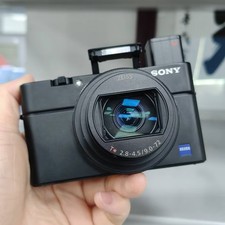
The Canon EOS R8 and Sony RX100 VII are both compact cameras, but they solve different problems. The Canon EOS R8 offers a full-frame sensor, 4K 60p video, and 40 fps electronic burst shooting. The Sony RX100 VII is a pocketable camera with a fixed lens, 4-stops of stabilization, and a much smaller body.
eBay prices refresh hourly — check the listing before you buy. We may earn a commission.
- MOST WINS
 Canon
CanonBest for Buyers who prioritize image quality, video frame rates, and battery life.
11of 18 specs better - Sony
Best for Buyers who need a compact, lightweight camera with stabilization for travel or everyday carry.
7of 18 specs better
Biggest differences
Native ISO maximum
Canon EOS R8 leads
8×
higher is better
- Canon EOS R8102,400 ISO
- Sony RX100 VII12,800 ISO
Continuous shooting (electronic)
Canon EOS R8 leads
2×
higher is better
- Canon EOS R840 fps
- Sony RX100 VII20 fps
Weight
Sony RX100 VII leads
−34%
lower is better
- Canon EOS R8461 g
- Sony RX100 VII302 g
Max mechanical shutter speed
Canon EOS R8 leads
2×
higher is better
- Canon EOS R84,000 1/s
- Sony RX100 VII2,000 1/s
Where each one wins
Canon EOS R8
- Effective pixels
- Sensor format
- Native ISO maximum
- Continuous shooting (electronic)
- Max mechanical shutter speed
- 4K max frame rate
- 4K max frame rate (full width)
- Viewfinder magnification
- Screen articulation
- Rear screen resolution
- Battery life
Sony RX100 VII
- In-body image stabilization
- Sensor type
- Continuous shooting (mechanical)
- Weight
- Width
- Height
- Depth
What both have
- Aspect ratios3:2, 4:3, 1:1, 16:9
- Max video resolution4K
- Raw video recordingNone
- Log profile support✓
- Viewfinder resolution2.36 M dots
- Screen size3 in
- USB charging & power delivery✓
- Minimum operating temperature0 °C
- HDMI port typeMicro
Every spec
Red marks the better value in each row.
| Spec | Canon EOS R8 | Sony RX100 VII |
|---|---|---|
| Overview | ||
| Release date | Not published | Not published |
| Launch price | Not published | Not published |
| Lens mount | Canon RF | Fixed lens |
| High resolution pixel-shift mode | No | Not published |
| Sensor & Image | ||
| Effective pixels | 24.2 MP | 20.1 MP |
| Sensor format | Full-frame | 1-inch |
| Native ISO maximum | 102,400 ISO | 12,800 ISO |
| In-body image stabilization | 0 stops | 4 stops1 |
| Sensor readout speed | Not published | Not published |
| Sensor type | CMOS | Stacked CMOS |
| Aspect ratios | 3:2, 4:3, 1:1, 16:9 | 3:2, 4:3, 1:1, 16:92 |
| Lens & Autofocus | ||
| Continuous shooting (mechanical) | 6 fps | 10 fps3 |
| Continuous shooting (electronic) | 40 fps | 20 fps4 |
| Max mechanical shutter speed | 4,000 1/s | 2,000 1/s |
| Pre-burst capture duration | 0.5 s | Not published |
| AF subject detection | Human, animal, bird, car, train, airplane, motorcycle | Human, animal5 |
| Video | ||
| Max video resolution | 4K | 4K |
| 4K max frame rate | 60 fps | 30 fps |
| Video codecs | H.264, HEVC | H.2646 |
| 4K max frame rate (full width) | 60 fps | 30 fps |
| Raw video recording | None | None7 |
| Video bit depth | 10 bit | Not published |
| Log profile support | Yes | Yes8 |
| Video dynamic range (log) | Not published | Not published |
| Viewfinder & Screen | ||
| Viewfinder resolution | 2.36 M dots | 2.36 M dots |
| Viewfinder magnification | 0.7 x | 0.59 x |
| Screen size | 3 in | 3 in |
| Screen articulation | Fully articulated | Tilting9 |
| Rear screen resolution | 1.62 M dots | 0.92 M dots |
| Handling & Power | ||
| Battery life | 370 shots | 260 shots10 |
| Memory card slots | 1 slots | Not published |
| Weather sealing | Dust and drip resistant | Not published |
| Weight | 461 g | 302 g |
| Width | 132.5 mm | 101.6 mm |
| Height | 86.1 mm | 58.1 mm |
| Depth | 70 mm | 42.8 mm |
| USB charging & power delivery | Yes | Yes11 |
| Minimum operating temperature | 0 °C | 0 °C |
| Headphone port | Yes | Not published |
| HDMI port type | Micro | Micro |
Notes on 11 values — test conditions and caveats
- 1Sony RX100 VII, In-body image stabilization: Sony rates the optical (lens-shift) SteadyShot at 4.0 stops at the 200 mm telephoto end, not a body-only CIPA figure.
- 2Sony RX100 VII, Aspect ratios: 4:3, 16:9 and 1:1 sizes are in-camera crop modes over the native 3:2 sensor area.
- 3Sony RX100 VII, Continuous shooting (mechanical): The 'Hi' burst setting is electronic-shutter only; 10 fps ('Mid') is the fastest mechanical-shutter continuous rate.
- 4Sony RX100 VII, Continuous shooting (electronic): Blackout-free 20 fps continuous includes AF/AE tracking; the separate 'Single Burst' mode takes 7 shots at up to 90 fps.
- 5Sony RX100 VII, AF subject detection: Maker names only human and animal recognition (Eye AF / Real-time Tracking); no bird or vehicle categories are listed.
- 6Sony RX100 VII, Video codecs: Both XAVC S and AVCHD recording use MPEG-4 AVC/H.264; there is no HEVC/H.265 option.
- 7Sony RX100 VII, Raw video recording: Sony's movie-format list contains only XAVC S (H.264) and AVCHD; no raw video output is offered.
- 8Sony RX100 VII, Log profile support: S-Log2, S-Log3 and HLG log gammas are selectable via Picture Profile presets PP1–PP10.
- 9Sony RX100 VII, Screen articulation: Screen tilts up about 180° for selfies and down about 90°; it does not swing outward like a fully articulated display.
- 10Sony RX100 VII, Battery life: 260 shots assume default monitor settings; Sony also lists 310 shots when 'Auto Monitor Off' is set to 2 s.
- 11Sony RX100 VII, USB charging & power delivery: In-body USB charging and power supply work over the Multi/Micro-USB (USB 2.0) terminal — not USB-C.
Sensor and Image Quality
The Canon EOS R8 has a full-frame 24.2 MP CMOS sensor, while the Sony RX100 VII uses a 1-inch 20.1 MP stacked CMOS sensor. The larger full-frame sensor in the Canon gives it a massive advantage in low light and dynamic range, with a native ISO maximum of 102,400 compared to the Sony's 12,800. If you shoot in dim conditions or want cleaner files for editing, the Canon is the clear choice.
The Sony's stacked sensor design, however, typically allows for faster readout speeds, which reduces rolling shutter in video and enables blackout-free continuous shooting. While neither camera's sensor readout speed is published, the Sony's stacked architecture is a key reason it can shoot at 20 fps with AF/AE tracking without blackout, a feature the Canon does not offer in the same way.
Size, Weight, and Stabilization
The Sony RX100 VII is dramatically smaller and lighter, weighing 302 g and measuring 101.6 x 58.1 x 42.8 mm. The Canon EOS R8 weighs 461 g and measures 132.5 x 86.1 x 70 mm. If you need a camera that fits in a jacket pocket or you want to carry it all day without noticing, the Sony wins easily.
The Sony also has a major advantage in stabilization: it offers 4 stops of optical SteadyShot (lens-shift) at the 200 mm telephoto end, while the Canon EOS R8 has 0 stops of in-body image stabilization. For handheld video or low-light stills, the Sony's stabilization is a real benefit, though it is rated at the telephoto end and not a body-only CIPA figure.
Video and Burst Shooting
The Canon EOS R8 is the better video tool. It shoots 4K at up to 60 fps from full-width oversampling, and supports 10-bit color with Canon Log 3. The Sony RX100 VII is limited to 4K at 30 fps and records only in 8-bit H.264. If you want high-frame-rate 4K or more grading flexibility, the Canon is the one to get.
For stills, the story is split. The Canon shoots at 40 fps with the electronic shutter, but only 6 fps with the mechanical shutter. The Sony shoots at 20 fps with the electronic shutter (blackout-free with AF/AE tracking) and 10 fps with the mechanical shutter. The Sony's mechanical burst is faster, but the Canon's electronic burst is twice as fast. If you rely on the mechanical shutter to avoid rolling shutter, the Sony is faster; if you want the absolute highest frame rate, the Canon wins.
Battery and Everyday Handling
The Canon EOS R8 has a battery life rating of 370 shots, while the Sony RX100 VII is rated at 260 shots (or 310 shots with the Auto Monitor Off setting at 2 s). The Canon lasts significantly longer per charge, which matters if you shoot all day or forget to bring a spare. Both cameras support USB charging, though the Sony uses a Micro-USB terminal rather than USB-C.
The Canon also has a higher-resolution rear screen (1.62 M dots vs 0.92 M dots) and a fully articulated display, while the Sony's screen only tilts. The Canon's viewfinder has a larger magnification (0.7x vs 0.59x). These small handling details make the Canon more pleasant to use for framing and reviewing shots, but they come at the cost of size and weight.
The Verdict
Buy the Canon EOS R8 if you want full-frame image quality, 4K 60p video, and long battery life, and you do not mind a larger body. Buy the Sony RX100 VII if you need a truly pocketable camera with built-in stabilization and a faster mechanical burst, and you can accept a smaller sensor and lower video specs.
Where to buy
Canon EOS R8
Best for Buyers who prioritize image quality, video frame rates, and battery life.
Sony RX100 VII
Best for Buyers who need a compact, lightweight camera with stabilization for travel or everyday carry.
FAQ
Does the Canon EOS R8 have in-body image stabilization?
No. The Canon EOS R8 has 0 stops of in-body image stabilization, so you rely on lens-based stabilization if available. The Sony RX100 VII offers 4 stops of optical SteadyShot at the 200 mm telephoto end.
Can the Sony RX100 VII shoot 4K at 60 fps?
No. The Sony RX100 VII maxes out at 4K 30 fps. The Canon EOS R8 can shoot 4K at 60 fps with full-width oversampling.
Which camera has better autofocus subject detection?
The Canon EOS R8 detects humans, animals, birds, cars, trains, airplanes, and motorcycles. The Sony RX100 VII only detects humans and animals.
Is the Canon EOS R8 weather-sealed?
Yes, the Canon EOS R8 is dust and drip resistant. Weather sealing for the Sony RX100 VII is not published.
Which camera is better for low light?
The Canon EOS R8 is better for low light thanks to its full-frame sensor and native ISO maximum of 102,400 ISO. The Sony RX100 VII has a smaller 1-inch sensor with a native ISO maximum of 12,800 ISO.
Spotted something wrong? Tap the next to any section or spec group to let us know. Every report is read.