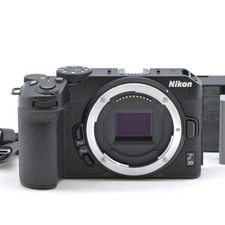
Compare · 2 products compared
Canon EOS R8vsNikon Z 30: Which Camera to Buy
Both the Canon EOS R8 and the Nikon Z 30 shoot 4K, use a single card slot, and offer a fully articulating touchscreen. The deciding split is sensor size and body design: the Canon is a full-frame camera with an electronic viewfinder, while the Nikon is a compact APS-C body you compose on the rear screen alone.
eBay prices refresh hourly — check the listing before you buy. We may earn a commission.
- MOST WINS
 Canon
CanonBest for Low-light, video, and action shooters who want a viewfinder
8of 14 specs better - Nikon
Best for Travelers and casual creators who want the lightest kit
6of 14 specs better
Biggest differences
Native ISO maximum
Canon EOS R8 leads
2×
higher is better
- Canon EOS R8102,400 ISO
- Nikon Z 3051,200 ISO
4K max frame rate
Canon EOS R8 leads
2×
higher is better
- Canon EOS R860 fps
- Nikon Z 3030 fps
4K max frame rate (full width)
Canon EOS R8 leads
2×
higher is better
- Canon EOS R860 fps
- Nikon Z 3030 fps
Continuous shooting (mechanical)
Nikon Z 30 leads
+83%
higher is better
- Canon EOS R86 fps
- Nikon Z 3011 fps
Where each one wins
Canon EOS R8
- Effective pixels
- Sensor format
- Native ISO maximum
- 4K max frame rate
- 4K max frame rate (full width)
- Viewfinder resolution
- Rear screen resolution
- Battery life
Nikon Z 30
- Continuous shooting (mechanical)
- Weight
- Width
- Height
- Depth
- HDMI port type
What both have
- Sensor typeCMOS
- Max mechanical shutter speed4,000 1/s
- Max video resolution4K
- Screen size3 in
- Screen articulationFully articulated
- Memory card slots1 slots
- USB charging & power delivery✓
- Minimum operating temperature0 °C
Every spec
Red marks the better value in each row.
| Spec | Canon EOS R8 | Nikon Z 30 |
|---|---|---|
| Overview | ||
| Release date | Not published | Not published |
| Launch price | Not published | Not published |
| Lens mount | Canon RF | Nikon Z |
| High resolution pixel-shift mode | No | Not published |
| Sensor & Image | ||
| Effective pixels | 24.2 MP | 20.9 MP |
| Sensor format | Full-frame | APS-C1 |
| Native ISO maximum | 102,400 ISO | 51,200 ISO2 |
| In-body image stabilization | 0 stops | Not published |
| Sensor readout speed | Not published | Not published |
| Sensor type | CMOS | CMOS |
| Aspect ratios | 3:2, 4:3, 1:1, 16:9 | 3:2, 1:1, 16:93 |
| Lens & Autofocus | ||
| Continuous shooting (mechanical) | 6 fps | 11 fps4 |
| Continuous shooting (electronic) | 40 fps | Not published |
| Max mechanical shutter speed | 4,000 1/s | 4,000 1/s |
| Pre-burst capture duration | 0.5 s | Not published |
| AF subject detection | Human, animal, bird, car, train, airplane, motorcycle | — |
| Video | ||
| Max video resolution | 4K | 4K |
| 4K max frame rate | 60 fps | 30 fps |
| Video codecs | H.264, HEVC | H.264 |
| 4K max frame rate (full width) | 60 fps | 30 fps |
| Raw video recording | None | Not published |
| Video bit depth | 10 bit | Not published |
| Log profile support | Yes | Not published |
| Video dynamic range (log) | Not published | Not published |
| Viewfinder & Screen | ||
| Viewfinder resolution | 2.36 M dots | 0 M dots5 |
| Viewfinder magnification | 0.7 x | Not published |
| Screen size | 3 in | 3 in |
| Screen articulation | Fully articulated | Fully articulated |
| Rear screen resolution | 1.62 M dots | 1.04 M dots |
| Handling & Power | ||
| Battery life | 370 shots | 330 shots6 |
| Memory card slots | 1 slots | 1 slots |
| Weather sealing | Dust and drip resistant | Not published |
| Weight | 461 g | 405 g |
| Width | 132.5 mm | 128 mm |
| Height | 86.1 mm | 73.5 mm |
| Depth | 70 mm | 59.5 mm |
| USB charging & power delivery | Yes | Yes7 |
| Minimum operating temperature | 0 °C | 0 °C |
| Headphone port | Yes | Not published |
| HDMI port type | Micro | Mini |
Notes on 7 values — test conditions and caveats
- 1Nikon Z 30, Sensor format: DX format is Nikon's name for its APS-C-size sensor (23.5 x 15.7 mm).
- 2Nikon Z 30, Native ISO maximum: Settings above ISO 51200 (102400, 204800) are expanded, not native.
- 3Nikon Z 30, Aspect ratios: Native DX ratio is 3:2; 1:1 and 16:9 are in-camera crop modes.
- 4Nikon Z 30, Continuous shooting (mechanical): Nikon's in-house measured maximum; the rate is approximate.
- 5Nikon Z 30, Viewfinder resolution: The Z 30 has no electronic viewfinder; compose on the rear LCD.
- 6Nikon Z 30, Battery life: Figure is for the EN-EL25 battery; shot count differs with EN-EL25a.
- 7Nikon Z 30, USB charging & power delivery: In-camera USB charging/power needs Nikon's optional EH-7P or EH-8P adapter.
Sensor size and low light
The Canon EOS R8 uses a 24.2 MP full-frame sensor; the Nikon Z 30 uses a 20.9 MP APS-C sensor, which Nikon calls DX. A larger sensor gathers more light at the same aperture and framing, so the Canon holds detail better in dim rooms and at dusk, and gives shallower depth of field for portraits. The pixel gap is small and rarely visible in normal prints.
The Canon also reaches a higher native ISO ceiling, which matters when you would rather raise sensitivity than slow the shutter. The Nikon's ceiling is lower, and settings above it are expanded rather than native. For available-light work indoors or after sunset, the Canon is the easier camera to shoot handheld.
Video
Both cameras cap out at 4K resolution, but the Canon EOS R8 records 4K at up to 60 fps and the Nikon Z 30 stops at 30 fps. That extra headroom lets the Canon halve motion in-camera, so panning shots and moving subjects stay smooth without slowing footage in post. The Canon also records in HEVC alongside H.264 and captures 10-bit color with a log profile, which gives more room to grade.
The Nikon records in H.264 and does not publish bit depth or log support. If you shoot casual clips for social media, the Nikon's 4K 30p is entirely usable. If you deliver graded footage or want slow motion straight from the camera, the Canon is the clear pick.
Viewfinder and framing
The Canon EOS R8 has a 2.36 M-dot electronic viewfinder, so you can hold the camera to your eye, brace it against your face, and frame in bright sun where an LCD washes out. The Nikon Z 30 has no viewfinder at all, which means every shot is composed on the rear screen.
That design keeps the Nikon small, but it changes how you shoot. Outdoors in daylight you will shade the screen or guess at framing, and holding the camera away from your body is less stable at slow shutter speeds. The Canon's rear screen is also the sharper of the two, which helps when checking focus on the Nikon only.
Speed and autofocus
The Nikon Z 30 fires faster on the mechanical shutter, and that advantage is worth having for bursts of moving subjects. The Canon EOS R8 counters with a much faster electronic burst and a pre-burst mode that keeps a short buffer of frames from before you press the button, which is genuinely useful for timing a jump or a serve.
The bigger gap is subject detection. The Canon recognizes people, animals, birds, cars, trains, planes, and motorcycles, so it tracks and holds focus on its own. The Nikon publishes no equivalent list. For sports, wildlife, or chasing a toddler, the Canon does more of the work.
Size, weight, and battery
The Nikon Z 30 is the smaller and lighter camera on every dimension, and the difference is large enough to feel on a strap all day. It is the better choice if the camera needs to disappear into a bag or you shoot one-handed for long stretches. The Canon is bulkier but adds dust and drip resistance, which the Nikon does not publish.
Battery life tilts the other way. The Canon is rated for more shots per charge, though the Nikon's figure is measured with the EN-EL25 battery and changes with the EN-EL25a. Both charge over USB, but the Nikon needs an optional adapter for in-camera charging and power.
Mounts, ports, and lenses
The Canon uses the RF mount and the Nikon uses the Z mount, so lens choice is settled by whichever system you already own or plan to build. Neither mount takes the other's glass. The Canon's full-frame sensor also means RF lenses designed for full frame will render at their intended field of view, while the Nikon's DX sensor crops them.
The Nikon offers a full-size HDMI port, which is sturdier for a monitor or recorder cable than the Canon's micro connector. The Canon includes a headphone port for monitoring audio; the Nikon does not publish one. If you record to an external device, that HDMI difference is worth weighing.
The Verdict
Buy the Canon EOS R8 if you shoot in low light, want a viewfinder, need 4K 60p or log footage, or rely on subject-tracking autofocus. Buy the Nikon Z 30 if you want the smallest, lightest body in this pair and mostly shoot 4K 30p in good light. The Canon is the more capable camera; the Nikon is the one you will actually carry. Neither is wrong, but they suit different shooters.
Where to buy
Canon EOS R8
Best for Low-light, video, and action shooters who want a viewfinder
Nikon Z 30
Best for Travelers and casual creators who want the lightest kit
FAQ
Does the Nikon Z 30 have a viewfinder?
No. The Z 30 has no electronic viewfinder, so you compose everything on its 3-inch fully articulating rear screen.
Is the Canon EOS R8 full frame?
Yes. The EOS R8 uses a 24.2 MP full-frame CMOS sensor on the Canon RF mount, while the Z 30 uses an APS-C sensor on the Nikon Z mount.
Can the Nikon Z 30 shoot 4K at 60fps?
No. Its 4K maximum is 30 fps, both overall and at full sensor width. The Canon EOS R8 reaches 4K 60 fps.
Do both cameras have image stabilization?
Neither offers in-body stabilization. The EOS R8 is listed at 0 stops of IBIS and Nikon does not publish an IBIS figure for the Z 30, so stabilization depends on the lens.
Which camera is lighter?
The Nikon Z 30 at 405 g, against 461 g for the Canon EOS R8. The Z 30 is also narrower, shorter, and thinner.
Spotted something wrong? Tap the next to any section or spec group to let us know. Every report is read.