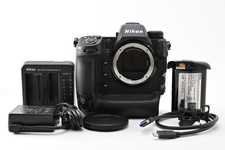
Compare · 2 products compared
Nikon Z9vsCanon EOS R8: Flagship or Lightweight?
Both are full-frame mirrorless cameras with dust-and-drip sealing, USB charging, a headphone port, Log profiles and the same subject-detection list. The Nikon Z9 is a 45.7 MP flagship that shoots 8K; the Canon EOS R8 is a 24.2 MP body that weighs a third as much. Pick by how much camera you want to carry.
eBay prices refresh hourly — check the listing before you buy. We may earn a commission.
- MOST WINS
 Nikon
NikonBest for Working professionals who need 8K, raw video, stabilization and dual-card backup
16of 24 specs better - Canon
Best for Enthusiasts and travelers who want full-frame speed in a 461 g body
8of 24 specs better
Biggest differences
Weight
Canon EOS R8 leads
2.91×
lower is better
- Nikon Z91,340 g
- Canon EOS R8461 g
Max mechanical shutter speed
Nikon Z9 leads
8×
higher is better
- Nikon Z932,000 1/s
- Canon EOS R84,000 1/s
Native ISO maximum
Canon EOS R8 leads
4×
higher is better
- Nikon Z925,600 ISO
- Canon EOS R8102,400 ISO
Continuous shooting (electronic)
Canon EOS R8 leads
2×
higher is better
- Nikon Z920 fps
- Canon EOS R840 fps
Where each one wins
Nikon Z9
- Effective pixels
- In-body image stabilization
- Sensor type
- Max mechanical shutter speed
- Pre-burst capture duration
- Max video resolution
- 4K max frame rate
- Raw video recording
- Viewfinder resolution
- Viewfinder magnification
- Screen size
- Rear screen resolution
- Battery life
- Memory card slots
- Minimum operating temperature
- HDMI port type
Canon EOS R8
- Native ISO maximum
- Continuous shooting (electronic)
- 4K max frame rate (full width)
- Screen articulation
- Weight
- Width
- Height
- Depth
What both have
- Sensor formatFull-frame
- AF subject detectionHuman, animal, bird, car, train, airplane, motorcycle
- Video bit depth10 bit
- Log profile support✓
- Weather sealingDust and drip resistant
- USB charging & power delivery✓
- Headphone port✓
Every spec
Red marks the better value in each row.
| Spec | Nikon Z9 | Canon EOS R8 |
|---|---|---|
| Overview | ||
| Release date | 2021-12 | Not published |
| Launch price | 5,500 USD | Not published |
| Lens mount | Nikon Z | Canon RF |
| High resolution pixel-shift mode | No | No |
| Sensor & Image | ||
| Effective pixels | 45.7 MP | 24.2 MP |
| Sensor format | Full-frame | Full-frame |
| Native ISO maximum | 25,600 ISO | 102,400 ISO |
| In-body image stabilization | 6 stops1 | 0 stops |
| Sensor readout speed | Not published | Not published |
| Sensor type | Stacked CMOS | CMOS |
| Aspect ratios | — | 3:2, 4:3, 1:1, 16:9 |
| Lens & Autofocus | ||
| Continuous shooting (mechanical) | Not published | 6 fps |
| Continuous shooting (electronic) | 20 fps | 40 fps |
| Max mechanical shutter speed | 32,000 1/s | 4,000 1/s |
| Pre-burst capture duration | 1 s2 | 0.5 s |
| AF subject detection | Human, animal, bird, car, train, airplane, motorcycle | Human, animal, bird, car, train, airplane, motorcycle |
| Video | ||
| Max video resolution | 8K | 4K |
| 4K max frame rate | 120 fps | 60 fps |
| Video codecs | H.264, HEVC, ProRes 422 HQ, ProRes RAW, N-RAW | H.264, HEVC |
| 4K max frame rate (full width) | 30 fps | 60 fps |
| Raw video recording | Internal | None |
| Video bit depth | 10 bit | 10 bit |
| Log profile support | Yes | Yes |
| Video dynamic range (log) | Not published | Not published |
| Viewfinder & Screen | ||
| Viewfinder resolution | 3.69 M dots | 2.36 M dots |
| Viewfinder magnification | 0.8 x | 0.7 x |
| Screen size | 3.2 in | 3 in |
| Screen articulation | Tilting | Fully articulated |
| Rear screen resolution | 2.1 M dots | 1.62 M dots |
| Handling & Power | ||
| Battery life | 740 shots | 370 shots |
| Memory card slots | 2 slots | 1 slots |
| Weather sealing | Dust and drip resistant | Dust and drip resistant |
| Weight | 1,340 g | 461 g |
| Width | 149 mm | 132.5 mm |
| Height | 149.5 mm | 86.1 mm |
| Depth | 90.5 mm | 70 mm |
| USB charging & power delivery | Yes | Yes |
| Minimum operating temperature | -10 °C | 0 °C |
| Headphone port | Yes | Yes |
| HDMI port type | Full-size | Micro |
Notes on 2 values — test conditions and caveats
- 1Nikon Z9, In-body image stabilization: The 6.0-stop rating requires Synchro VR, combining in-body 5-axis VR with 2-axis lens VR on compatible lenses.
- 2Nikon Z9, Pre-burst capture duration: Pre-Release Capture is only available in the C30 and C120 high-speed frame capture modes.
Resolution and image quality
The Z9's 45.7 MP sensor captures roughly twice the pixels of the R8's 24.2 MP chip, which matters if you crop hard, print large, or shoot landscapes where fine detail sells the frame. Its stacked CMOS design also reads out faster, which is the architecture behind its burst and video headroom.
The R8 counters with a higher native ISO ceiling, 102,400 against 25,600. That is a real advantage for dim venues where you would rather not push into extended settings. Neither camera offers a pixel-shift mode, so resolution is fixed at capture.
Video
The Z9 records 8K and reaches 120 fps in 4K, and it can write ProRes RAW and N-RAW internally. For anyone delivering to a client who asks for raw footage, that is the difference between a workable file and a rented external recorder. It also gives you full-width 4K at 30 fps.
The R8 tops out at 4K, but it manages 60 fps at full width — double the Z9's full-width 4K frame rate. If slow-motion 4K without a crop is the whole job, the cheaper body is the faster one. Both shoot 10-bit and both offer a Log profile. Neither publishes a log dynamic-range figure.
Speed and autofocus
Subject detection is identical: people, animals, birds, cars, trains, planes and motorcycles on both. The split is in burst and shutter. The R8 fires 40 fps electronically and 6 fps mechanically, which is remarkable at its size.
The Z9's 20 fps electronic is slower on paper, but its pre-burst window is twice as long — a full second of frames before you press the button, and only in its high-speed capture modes. That second is often the difference between catching a takeoff and missing it.
Stabilization and viewfinder
The Z9 has in-body stabilization rated at 6 stops, though that figure requires Synchro VR pairing body and lens stabilization on compatible glass. The R8 has none. Handheld shooting in low light, or video without a gimbal, strongly favors the Nikon.
The Z9 also wins on the viewfinder: larger magnification and a higher-resolution panel, plus a bigger rear screen. The R8's screen is fully articulated where the Nikon's only tilts, which matters for vlogging and odd angles. That is the R8's one clear handling win here.
Battery, cards and size
The Z9 is rated for 740 shots and carries two card slots; the R8 is rated for 370 shots with a single slot. Double the battery and a backup slot are practical advantages on a paid shoot — no swapping mid-ceremony, no losing everything to one failed card.
None of that comes free. The Nikon weighs 1,340 g against the R8's 461 g and is larger in every dimension. The R8 is a camera you carry all day without noticing; the Z9 is one you plan around. The Z9 also keeps working to -10 °C, while the R8 is rated only to 0 °C.
Which is better for sports and wildlife?
Both cover the same subject types and both seal against dust and drips, so the choice comes down to how the camera behaves when the action is fast. The Z9's longer pre-burst window, deep buffer via two slots and in-body stabilization make it the more forgiving tool when the light drops and the subject will not sit still.
The R8's 40 fps is genuinely faster and its autofocus recognizes the same subjects. A hobbyist shooting weekend games in good light will get plenty of keepers from the smaller body. The gap shows up on long lenses, in rain, and on days when you cannot change a battery.
The Verdict
Buy the Nikon Z9 if you shoot professionally — 8K and internal raw video, stabilization, dual cards and a 740-shot battery are the reasons. Buy the Canon EOS R8 if you want full-frame reach and speed in a body light enough to carry everywhere. Choose the Z9 when the work must not fail; choose the R8 when you would rather it just come along.
Where to buy
Nikon Z9
Best for Working professionals who need 8K, raw video, stabilization and dual-card backup
Canon EOS R8
Best for Enthusiasts and travelers who want full-frame speed in a 461 g body
FAQ
Does the Canon EOS R8 have in-body image stabilization?
No. The R8 has 0 stops of in-body stabilization, so stabilization depends entirely on the lens. The Nikon Z9 has in-body stabilization rated at 6 stops when paired with a compatible lens.
Can the Nikon Z9 record 4K at 60 fps at full width?
No. The Z9's full-width 4K tops out at 30 fps, though it can reach 120 fps in 4K at reduced width. The Canon EOS R8 does 4K at 60 fps at full width.
Does either camera offer a pixel-shift high-resolution mode?
Neither does. The Nikon Z9 has no high-resolution pixel-shift mode, and neither does the Canon EOS R8, so maximum resolution is set purely by the sensor.
Which camera has more card slots?
The Nikon Z9, with 2 slots against 1 on the Canon EOS R8. Two slots let you write a backup copy or keep shooting when one card fills.
Do both cameras detect the same autofocus subjects?
Yes. Both list human, animal, bird, car, train, airplane and motorcycle subject detection, so AF subject coverage is not a deciding factor between them.
Spotted something wrong? Tap the next to any section or spec group to let us know. Every report is read.