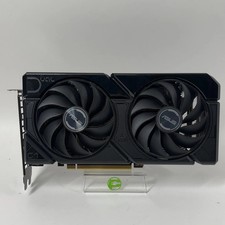
Compare · 2 products compared
AMD Radeon RX 9060 XT 16GBvsNVIDIA GeForce RTX 4070 Super
The AMD Radeon RX 9060 XT 16GB and NVIDIA GeForce RTX 4070 Super are both dedicated desktop graphics cards built on different architectures. Choosing between them comes down to a trade-off between lower power consumption with more video memory and higher raw compute capability.
eBay prices refresh hourly — check the listing before you buy. We may earn a commission.
 AMD
AMDBest for Budget-conscious builders wanting lower power draw and 16GB VRAM
8of 17 specs better- MOST WINSNVIDIA
Best for Users needing higher compute performance and faster memory bandwidth
9of 17 specs better
Biggest differences
Shader cores
NVIDIA GeForce RTX 4070 Super leads
3.5×
higher is better
- AMD Radeon RX 9060 XT 16GB2,048 cores
- NVIDIA GeForce RTX 4070 Super7,168 cores
Launch price
AMD Radeon RX 9060 XT 16GB leads
−42%
lower is better
- AMD Radeon RX 9060 XT 16GB349 USD
- NVIDIA GeForce RTX 4070 Super599 USD
Memory bandwidth
NVIDIA GeForce RTX 4070 Super leads
+57%
higher is better
- AMD Radeon RX 9060 XT 16GB320 GB/s
- NVIDIA GeForce RTX 4070 Super504 GB/s
Memory bus width
NVIDIA GeForce RTX 4070 Super leads
+50%
higher is better
- AMD Radeon RX 9060 XT 16GB128 bit
- NVIDIA GeForce RTX 4070 Super192 bit
Where each one wins
AMD Radeon RX 9060 XT 16GB
- Launch price
- Boost clock
- Video memory
- Board power
- Recommended PSU
- PCIe version
- HDMI version
- DisplayPort version
NVIDIA GeForce RTX 4070 Super
- Shader cores
- FP32 compute
- Memory type
- Memory bus width
- Memory bandwidth
- Memory speed
- Last-level cache
- DisplayPort outputs
- Max displays
What both have
- PCIe lanes16 lanes
- HDMI outputs1 ports
Every spec
Red marks the better value in each row.
| Spec | AMD Radeon RX 9060 XT 16GB | NVIDIA GeForce RTX 4070 Super |
|---|---|---|
| Overview | ||
| Release date | 2025-06 | 2024-01 |
| Launch price | 349 USD1 | 599 USD |
| Graphics chip | ||
| Architecture | Rdna 4 | Ada lovelace |
| Shader cores | 2,048 cores | 7,168 cores |
| Boost clock | 3,130 MHz | 2,475 MHz |
| Base clock | Not published | 1,980 MHz |
| FP32 compute | 25.6 TFLOPS | 35.5 TFLOPS |
| Memory | ||
| Video memory | 16 GB | 12 GB |
| Memory type | Gddr6 | Gddr6x |
| Memory bus width | 128 bit | 192 bit |
| Memory bandwidth | 320 GB/s | 504 GB/s |
| Memory speed | 20 Gbps | 21 Gbps |
| Last-level cache | 32 MB | 48 MB |
| Power | ||
| Board power | 160 W | 220 W |
| Recommended PSU | 450 W | 600 W |
| Power connectors | 8-pin | 12V-2x62 |
| Interface | ||
| PCIe version | 5.0 | 4.0 |
| PCIe lanes | 16 lanes | 16 lanes |
| Display outputs | ||
| HDMI version | 2.1b | 2.1 |
| DisplayPort version | 2.1a | 1.4a |
| HDMI outputs | 1 ports3 | 1 ports |
| DisplayPort outputs | 2 ports4 | 3 ports |
| Max displays | 3 displays | 4 displays |
| Video engine | ||
| Hardware encode | H.264, HEVC, AV1 | AV1 |
| Video encoders | Not published | Not published |
| Size | ||
| Card length | Not published | Not published |
| Card height | Not published | Not published |
| Slot width | Not published | Not published |
Notes on 4 values — test conditions and caveats
- 1AMD Radeon RX 9060 XT 16GB, Launch price: Launch MSRP was $349, but most 16GB models initially sold higher; Tom's Hardware saw them starting at $389.
- 2NVIDIA GeForce RTX 4070 Super, Power connectors: Nvidia's 16-pin header is the 12V-2x6 variant; an adapter cable for non-ATX 3.0 power supplies ships with the card.
- 3AMD Radeon RX 9060 XT 16GB, HDMI outputs: AMD sells no reference card; this is the reference-design I/O. Partner cards can differ (Sapphire Pulse: 2 HDMI, 1 DP).
- 4AMD Radeon RX 9060 XT 16GB, DisplayPort outputs: AMD sells no reference card; this is the reference-design I/O. Partner cards can differ (Sapphire Pulse: 2 HDMI, 1 DP).
Performance and Compute
The GeForce RTX 4070 Super relies on 7,168 shader cores to drive its 35.5 TFLOPS of FP32 compute power, outperforming the AMD alternative in pure parallel math tasks. Meanwhile, the Radeon RX 9060 XT achieves a higher 3,130 MHz boost clock while maintaining a much lower board power requirement of 160 W.
For buyers, the NVIDIA card delivers heavier number-crunching power at the expense of a 220 W board power draw and a required 600 W power supply. The AMD card keeps system heat down and runs on a modest 450 W power supply.
Memory and Bandwidth
The Radeon card equips 16 GB of GDDR6 video memory over a 128-bit bus, offering a 320 GB/s bandwidth and a 32 MB last-level cache. In comparison, the GeForce card provides 12 GB of faster GDDR6X memory across a 192-bit bus, reaching a 504 GB/s bandwidth with a 48 MB cache.
Buyers working with large texture assets or high-resolution frame buffers benefit from the extra capacity on the AMD option. Those prioritizing rapid memory transactions will find the higher bandwidth and GDDR6X type on the NVIDIA option more advantageous.
Connectivity and Efficiency
The AMD card advances interface standards by featuring PCIe 5.0 and DisplayPort 2.1a connectivity. The NVIDIA card relies on PCIe 4.0 and DisplayPort 1.4a, though it supports up to four maximum displays compared to the three on the Radeon competitor.
System builders matching modern motherboards gain future-ready interface speeds with the Radeon model. Multi-monitor setups gain extra flexibility from the extra display output capacity on the GeForce model.
The Verdict
Buy the AMD Radeon RX 9060 XT 16GB if you want lower power draw, PCIe 5.0 support, and 16 GB of video memory for a lower launch price. Buy the NVIDIA GeForce RTX 4070 Super if you need higher FP32 compute performance and faster GDDR6X memory bandwidth.
Where to buy
AMD Radeon RX 9060 XT 16GB
Best for Budget-conscious builders wanting lower power draw and 16GB VRAM
NVIDIA GeForce RTX 4070 Super
Best for Users needing higher compute performance and faster memory bandwidth
FAQ
What power supply do these graphics cards require?
The AMD card requires a 450 W power supply, while the NVIDIA card requires a 600 W power supply.
Which card has better video encoding support?
The AMD card supports H.264, HEVC, and AV1 hardware encoding, whereas the NVIDIA card lists hardware encode support only for AV1.
What power connectors do they use?
The AMD card uses a single 8-pin connector, while the NVIDIA card uses a 12V-2x6 16-pin header.
Spotted something wrong? Tap the next to any section or spec group to let us know. Every report is read.