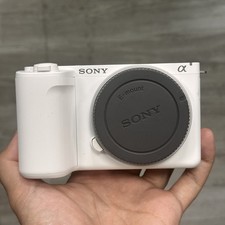
Compare · 2 products compared
Sony ZV-E10 IIvsSony a6700: Which to Buy?
These two Sony APS-C bodies share a 26 MP sensor, E-mount, 10-bit 4K video and the same 3-inch fully articulated screen. The a6700 separates itself with in-body stabilization, a viewfinder and 4K at 120 fps, while the ZV-E10 II undercuts it in weight, battery life and price.
eBay prices refresh hourly — check the listing before you buy. We may earn a commission.
- MOST WINS
 Sony
SonyBest for Vloggers and travelers who want a light body, long battery life and 4K 60p
6of 9 specs better - Sony
Best for Hybrid shooters who need IBIS, an EVF and 4K 120p slow motion
3of 9 specs better
Biggest differences
Max mechanical shutter speed
Sony ZV-E10 II leads
2×
higher is better
- Sony ZV-E10 II8,000 1/s
- Sony a67004,000 1/s
4K max frame rate
Sony a6700 leads
2×
higher is better
- Sony ZV-E10 II60 fps
- Sony a6700120 fps
Weight
Sony ZV-E10 II leads
−24%
lower is better
- Sony ZV-E10 II377 g
- Sony a6700493 g
Viewfinder resolution
Sony a6700 leads
+2.36 M dots
higher is better
- Sony ZV-E10 II0 M dots
- Sony a67002.36 M dots
Where each one wins
Sony ZV-E10 II
- Max mechanical shutter speed
- Battery life
- Weight
- Width
- Height
- Depth
Sony a6700
- 4K max frame rate
- Viewfinder resolution
- Rear screen resolution
What both have
- Lens mountSony E
- Effective pixels26 MP
- Sensor formatAPS-C
- Native ISO maximum32,000 ISO
- Sensor typeCMOS
- Continuous shooting (electronic)11 fps
- Max video resolution4K
- Video codecsH.264, HEVC
- 4K max frame rate (full width)60 fps
- Raw video recordingNone
- Video bit depth10 bit
- Log profile support✓
- Screen size3 in
- Screen articulationFully articulated
- Memory card slots1 slots
- USB charging & power delivery✓
- Minimum operating temperature0 °C
- Headphone port✓
- HDMI port typeMicro
Every spec
Red marks the better value in each row.
| Spec | Sony ZV-E10 II | Sony a6700 |
|---|---|---|
| Overview | ||
| Release date | 2024-07 | Not published |
| Launch price | 999 USD | Not published |
| Lens mount | Sony E | Sony E |
| High resolution pixel-shift mode | No | No |
| Sensor & Image | ||
| Effective pixels | 26 MP | 26 MP |
| Sensor format | APS-C | APS-C |
| Native ISO maximum | 32,000 ISO | 32,000 ISO |
| In-body image stabilization | Not published | 5 stops |
| Sensor readout speed | Not published | Not published |
| Sensor type | CMOS | CMOS |
| Aspect ratios | Not published | Not published |
| Lens & Autofocus | ||
| Continuous shooting (mechanical) | Not published | 11 fps |
| Continuous shooting (electronic) | 11 fps | 11 fps |
| Max mechanical shutter speed | 8,000 1/s | 4,000 1/s |
| Pre-burst capture duration | Not published | Not published |
| AF subject detection | Human, animal, bird | Human, animal, bird, insect, car, train, airplane |
| Video | ||
| Max video resolution | 4K | 4K |
| 4K max frame rate | 60 fps | 120 fps |
| Video codecs | H.264, HEVC | H.264, HEVC |
| 4K max frame rate (full width) | 60 fps | 60 fps1 |
| Raw video recording | None | None |
| Video bit depth | 10 bit | 10 bit |
| Log profile support | Yes | Yes |
| Video dynamic range (log) | Not published | 14 stops |
| Viewfinder & Screen | ||
| Viewfinder resolution | 0 M dots | 2.36 M dots |
| Viewfinder magnification | Not published | 0.7 x |
| Screen size | 3 in | 3 in |
| Screen articulation | Fully articulated | Fully articulated |
| Rear screen resolution | 1.037 M dots | 1.04 M dots |
| Handling & Power | ||
| Battery life | 610 shots | 570 shots |
| Memory card slots | 1 slots | 1 slots |
| Weather sealing | Not published | Not published |
| Weight | 377 g | 493 g |
| Width | 114.8 mm | 122 mm |
| Height | 67.5 mm | 69 mm |
| Depth | 54.2 mm | 75.1 mm |
| USB charging & power delivery | Yes | Yes |
| Minimum operating temperature | 0 °C | 0 °C |
| Headphone port | Yes | Yes |
| HDMI port type | Micro | Micro |
Notes on 1 value — test conditions and caveats
- 1Sony a6700, 4K max frame rate (full width): Full-width 4K tops out at 60p; 120p 4K uses a crop.
Video
Both cameras record 4K at 60 fps in 10-bit with H.264 or HEVC, and both offer a log profile for grading. The a6700 stretches to 4K 120 fps, but only with a crop — full-width 4K still tops out at 60p. That 120p mode is the difference for anyone shooting slow-motion B-roll or action, since a crop narrows your framing and changes the field of view you built the shot around.
Neither camera records raw video, so the 120p ceiling is the real dividing line. If slow motion matters, the a6700 is the only one of the two that can do it. If you mostly shoot 4K 60p, the ZV-E10 II matches the a6700 frame for frame.
Stabilization and viewfinder
The a6700 has 5 stops of in-body image stabilization; Sony does not publish an IBIS figure for the ZV-E10 II. That matters for handheld shooting: without stabilization, the ZV-E10 II leans on lens-based stabilization or a gimbal to keep footage and slow-shutter stills clean.
The a6700 also has a 2.36 M-dot electronic viewfinder with 0.7x magnification, while the ZV-E10 II has none — you frame from the rear screen. An EVF helps in bright sun where an LCD washes out, and it steadies long-lens shooting against your face. The ZV-E10 II's rear screen is marginally lower in resolution, a difference too small to notice in practice.
Autofocus subject detection
Both detect humans, animals and birds. The a6700 adds insects, cars, trains and airplanes to its subject list, which helps when you shoot vehicles, aircraft or macro subjects and want the camera to lock on without you repositioning the AF point by hand.
For portraits, pets and wildlife, the two behave the same on paper. The a6700's longer list is a real advantage only if you shoot the extra subjects.
Battery and size
The ZV-E10 II is the smaller, lighter camera: 377 g against 493 g, and noticeably slimmer front to back — 54.2 mm versus 75.1 mm. That difference decides whether a body disappears in a bag or rides on a gimbal comfortably. It also lasts longer per charge at 610 shots versus 570, so a day of stills is less likely to need a spare.
Both charge and run over USB, both have a headphone port and a micro HDMI output, and both have one card slot. Neither has a published weather-sealing rating, so plan on shelter in rain for either.
Shutter and speed
Burst rates match at 11 fps electronic. The ZV-E10 II lists a faster top shutter speed of 1/8000 s against the a6700's 1/4000 s, useful for wide-aperture shooting in bright light without a neutral density filter.
Sony does not publish a mechanical continuous rate for the ZV-E10 II, and the a6700 lists 11 fps mechanical. In practice the electronic rates are what most buyers will use.
Which is best for sports and action?
The a6700, on two counts: 4K 120p for slow motion (accepting the crop) and the wider subject-detection list that includes cars and airplanes. The EVF also helps track fast subjects under bright light where the rear screen struggles.
The ZV-E10 II can still shoot 11 fps and 4K 60p, so casual action is fine. For serious sports, aviation or motorsport work, the a6700's extra modes are the reason to pay more.
The Verdict
Buy the Sony ZV-E10 II if you want the lightest, longest-lasting body for vlogging, travel and handheld 4K 60p, and don't need an EVF or IBIS. Buy the Sony a6700 if you need in-body stabilization, a viewfinder and 4K 120p slow motion, and don't mind the extra weight and size.
Where to buy
Sony ZV-E10 II
Best for Vloggers and travelers who want a light body, long battery life and 4K 60p
Sony a6700
Best for Hybrid shooters who need IBIS, an EVF and 4K 120p slow motion
FAQ
Does the Sony ZV-E10 II have in-body image stabilization?
No. Sony has not published an IBIS rating for the ZV-E10 II, so stabilization depends on the lens. The a6700 offers 5 stops of in-body stabilization.
Which camera has a viewfinder?
Only the Sony a6700. It has a 2.36 M-dot EVF with 0.7x magnification; the ZV-E10 II has none and relies on its rear screen.
Can either camera shoot 4K 120p?
The a6700 can, but 120p 4K uses a crop. Full-width 4K on both cameras tops out at 60p.
Do both record 10-bit video and log profiles?
Yes. Both shoot 10-bit 4K with H.264 or HEVC and support a log profile. Neither records raw video.
Which one is lighter and lasts longer per charge?
The Sony ZV-E10 II at 377 g and 610 shots, against the a6700 at 493 g and 570 shots.
Spotted something wrong? Tap the next to any section or spec group to let us know. Every report is read.