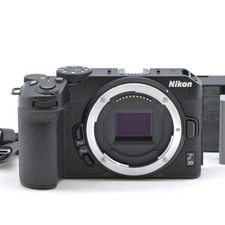
Compare · 2 products compared
Nikon Z 30vsSony a6700: Which APS-C Camera?
Both are APS-C mirrorless bodies built around a fully articulated screen and a single card slot. The Sony a6700 pulls ahead on video frame rates, subject-detection autofocus and in-body stabilization. The Nikon Z 30 counters with less weight and a smaller footprint.
eBay prices refresh hourly — check the listing before you buy. We may earn a commission.
 Nikon
NikonBest for Vloggers and casual shooters who want the lightest, smallest APS-C body
4of 11 specs better- MOST WINSSony
Best for Hybrid stills and video shooters who need 4K120p, a viewfinder and strong autofocus
7of 11 specs better
Biggest differences
4K max frame rate
Sony a6700 leads
4×
higher is better
- Nikon Z 3030 fps
- Sony a6700120 fps
Battery life
Sony a6700 leads
+73%
higher is better
- Nikon Z 30330 shots
- Sony a6700570 shots
4K max frame rate (full width)
Sony a6700 leads
2×
higher is better
- Nikon Z 3030 fps
- Sony a670060 fps
Native ISO maximum
Nikon Z 30 leads
+60%
higher is better
- Nikon Z 3051,200 ISO
- Sony a670032,000 ISO
Where each one wins
Nikon Z 30
- Native ISO maximum
- Weight
- Depth
- HDMI port type
Sony a6700
- Effective pixels
- 4K max frame rate
- 4K max frame rate (full width)
- Viewfinder resolution
- Battery life
- Width
- Height
What both have
- Sensor formatAPS-C
- Sensor typeCMOS
- Continuous shooting (mechanical)11 fps
- Max mechanical shutter speed4,000 1/s
- Max video resolution4K
- Screen size3 in
- Screen articulationFully articulated
- Rear screen resolution1.04 M dots
- Memory card slots1 slots
- USB charging & power delivery✓
- Minimum operating temperature0 °C
Every spec
Red marks the better value in each row.
| Spec | Nikon Z 30 | Sony a6700 |
|---|---|---|
| Overview | ||
| Release date | Not published | Not published |
| Launch price | Not published | Not published |
| Lens mount | Nikon Z | Sony E |
| High resolution pixel-shift mode | Not published | No |
| Sensor & Image | ||
| Effective pixels | 20.9 MP | 26 MP |
| Sensor format | APS-C1 | APS-C |
| Native ISO maximum | 51,200 ISO2 | 32,000 ISO |
| In-body image stabilization | Not published | 5 stops |
| Sensor readout speed | Not published | Not published |
| Sensor type | CMOS | CMOS |
| Aspect ratios | 3:2, 1:1, 16:93 | Not published |
| Lens & Autofocus | ||
| Continuous shooting (mechanical) | 11 fps4 | 11 fps |
| Continuous shooting (electronic) | Not published | 11 fps |
| Max mechanical shutter speed | 4,000 1/s | 4,000 1/s |
| Pre-burst capture duration | Not published | Not published |
| AF subject detection | — | Human, animal, bird, insect, car, train, airplane |
| Video | ||
| Max video resolution | 4K | 4K |
| 4K max frame rate | 30 fps | 120 fps |
| Video codecs | H.264 | H.264, HEVC |
| 4K max frame rate (full width) | 30 fps | 60 fps5 |
| Raw video recording | Not published | None |
| Video bit depth | Not published | 10 bit |
| Log profile support | Not published | Yes |
| Video dynamic range (log) | Not published | 14 stops |
| Viewfinder & Screen | ||
| Viewfinder resolution | 0 M dots6 | 2.36 M dots |
| Viewfinder magnification | Not published | 0.7 x |
| Screen size | 3 in | 3 in |
| Screen articulation | Fully articulated | Fully articulated |
| Rear screen resolution | 1.04 M dots | 1.04 M dots |
| Handling & Power | ||
| Battery life | 330 shots7 | 570 shots |
| Memory card slots | 1 slots | 1 slots |
| Weather sealing | Not published | Not published |
| Weight | 405 g | 493 g |
| Width | 128 mm | 122 mm |
| Height | 73.5 mm | 69 mm |
| Depth | 59.5 mm | 75.1 mm |
| USB charging & power delivery | Yes8 | Yes |
| Minimum operating temperature | 0 °C | 0 °C |
| Headphone port | Not published | Yes |
| HDMI port type | Mini | Micro |
Notes on 8 values — test conditions and caveats
- 1Nikon Z 30, Sensor format: DX format is Nikon's name for its APS-C-size sensor (23.5 x 15.7 mm).
- 2Nikon Z 30, Native ISO maximum: Settings above ISO 51200 (102400, 204800) are expanded, not native.
- 3Nikon Z 30, Aspect ratios: Native DX ratio is 3:2; 1:1 and 16:9 are in-camera crop modes.
- 4Nikon Z 30, Continuous shooting (mechanical): Nikon's in-house measured maximum; the rate is approximate.
- 5Sony a6700, 4K max frame rate (full width): Full-width 4K tops out at 60p; 120p 4K uses a crop.
- 6Nikon Z 30, Viewfinder resolution: The Z 30 has no electronic viewfinder; compose on the rear LCD.
- 7Nikon Z 30, Battery life: Figure is for the EN-EL25 battery; shot count differs with EN-EL25a.
- 8Nikon Z 30, USB charging & power delivery: In-camera USB charging/power needs Nikon's optional EH-7P or EH-8P adapter.
Sensor and low light
The Sony a6700 carries a 26 MP sensor against the Z 30's 20.9 MP, so the Sony gives you more room to crop and still print large. That extra resolution is the main reason to pay more if you shoot stills and crop often.
The Z 30 reaches a higher native ISO ceiling — 51,200 versus 32,000 on the Sony. Settings above that ceiling are expanded on both, so the Nikon's advantage is real but narrow. In practice the Sony's in-body stabilization, rated at 5 stops, matters more for handheld low-light work than the ISO gap does.
Video
This is the widest gap between the two. The Sony a6700 shoots 4K at up to 120 fps, though that top rate uses a crop; full-width 4K tops out at 60 fps. The Nikon Z 30 stops at 30 fps in 4K. If you want slow motion or smoother motion at normal speed, the Sony is the only real option here.
The Sony also records 10-bit video with HEVC codec support and a log profile rated at 14 stops of dynamic range. The Z 30 records H.264 only, and Nikon does not publish bit depth or log support for it. For anyone grading footage or protecting highlights, that difference is decisive.
Autofocus and burst shooting
Both cameras fire at 11 fps with the mechanical shutter, so stills burst speed is a tie. The difference is what the autofocus can lock onto. The Sony a6700 detects humans, animals, birds, insects, cars, trains and airplanes. Nikon does not publish subject detection for the Z 30.
For wildlife, pets or motorsport, that subject library is a practical advantage — the camera finds and holds the eye or the vehicle while you frame. For portraits and everyday shooting, the Z 30's contrast and phase-detect system still gets the job done.
Viewfinder
The Z 30 has no electronic viewfinder at all. You compose on the 3-inch rear screen, which is fully articulated on both cameras. That is fine for vlogging and casual shooting at arm's length, but it is a real limitation in bright sun and for eye-level shooting with long lenses.
The Sony a6700 has a 2.36 M dot viewfinder with 0.7x magnification. If you shoot handheld with your eye to the camera — sports, wildlife, portraits outdoors — the Sony is the more comfortable tool. If you shoot from the screen, the Nikon's lack of a finder costs you nothing.
Battery and size
The Sony a6700 is rated for 570 shots on a charge; the Nikon Z 30 is rated for 330, and that figure assumes the EN-EL25 battery — the count differs with the EN-EL25a. Nearly double the battery life means fewer spares and less mid-shoot swapping on the Sony.
The Z 30 is the smaller and lighter body: 405 g versus 493 g, and it is wider and taller but noticeably shallower. Carried all day or mounted on a gimbal, that 88 g difference is the Nikon's clearest win.
Ports and accessories
The Sony a6700 has a headphone port; Nikon does not publish one for the Z 30. If you monitor audio while recording, that alone can decide the choice. The Z 30 uses a Mini HDMI connector, which is more robust than the Sony's Micro HDMI — fewer bent or broken plugs on set.
Both support USB charging and power delivery, though the Nikon needs an optional EH-7P or EH-8P adapter for it. Both have a single card slot and neither publishes weather sealing or a minimum operating temperature above 0 °C.
The Verdict
Buy the Sony a6700 if you shoot video seriously, need a viewfinder, want subject-detection autofocus, or shoot handheld in low light. Buy the Nikon Z 30 if you shoot stills or casual video, work from the rear screen, and want the lightest, most compact body. The Sony costs more and weighs more, but it covers the video and autofocus ground the Nikon does not. The Nikon wins on size and weight for anyone who does not need the Sony's extras.
Where to buy
Nikon Z 30
Best for Vloggers and casual shooters who want the lightest, smallest APS-C body
Sony a6700
Best for Hybrid stills and video shooters who need 4K120p, a viewfinder and strong autofocus
FAQ
Does the Nikon Z 30 have in-body image stabilization?
Nikon does not publish IBIS for the Z 30, and its specs describe no such system. The Sony a6700 has IBIS rated at 5 stops, which is a meaningful advantage for handheld shooting.
Can the Sony a6700 shoot 4K at 120 fps?
Yes, but only with a crop. Full-width 4K on the a6700 tops out at 60 fps. The Nikon Z 30 caps at 30 fps in 4K with no slower-motion option.
Which camera has better battery life?
The Sony a6700, rated at 570 shots versus 330 for the Nikon Z 30 on the EN-EL25 battery. That is close to double the frames per charge.
Does the Nikon Z 30 have a viewfinder?
No. The Z 30 has no electronic viewfinder, so you compose on the 3-inch rear screen. The Sony a6700 has a 2.36 M dot EVF with 0.7x magnification.
Which one is better for shooting in low light?
The Z 30 reaches a higher native ISO ceiling, but the Sony a6700's 5-stop IBIS lets you use slower shutter speeds handheld, which usually matters more in dim conditions.
Spotted something wrong? Tap the next to any section or spec group to let us know. Every report is read.