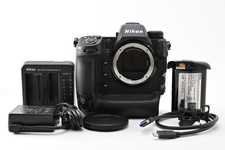
Compare · 2 products compared
Nikon Z9vsSony a6700: Flagship or Compact?
Both cameras shoot 4K120p, 10-bit log video and 11 fps-class bursts, but they sit in different worlds. The Nikon Z9 is a 45.7 MP full-frame flagship with 8K and internal raw; the Sony a6700 is a 26 MP APS-C body small enough to carry all day.
eBay prices refresh hourly — check the listing before you buy. We may earn a commission.
- MOST WINS
 Nikon
NikonBest for Pro sports, wildlife and 8K raw video shooters who need speed and a second card slot.
16of 23 specs better - Sony
Best for Travel, vlog and hybrid shooters who want a small body with full-width 4K60.
7of 23 specs better
Biggest differences
Weight
Sony a6700 leads
2.72×
lower is better
- Nikon Z91,340 g
- Sony a6700493 g
Max mechanical shutter speed
Nikon Z9 leads
8×
higher is better
- Nikon Z932,000 1/s
- Sony a67004,000 1/s
Memory card slots
Nikon Z9 leads
2×
higher is better
- Nikon Z92 slots
- Sony a67001 slots
Continuous shooting (electronic)
Nikon Z9 leads
+82%
higher is better
- Nikon Z920 fps
- Sony a670011 fps
Where each one wins
Nikon Z9
- Effective pixels
- Sensor format
- In-body image stabilization
- Sensor type
- Continuous shooting (electronic)
- Max mechanical shutter speed
- Max video resolution
- Raw video recording
- Viewfinder resolution
- Viewfinder magnification
- Screen size
- Rear screen resolution
- Battery life
- Memory card slots
- Minimum operating temperature
- HDMI port type
Sony a6700
- Native ISO maximum
- 4K max frame rate (full width)
- Screen articulation
- Weight
- Width
- Height
- Depth
What both have
- 4K max frame rate120 fps
- Video bit depth10 bit
- Log profile support✓
- USB charging & power delivery✓
- Headphone port✓
Every spec
Red marks the better value in each row.
| Spec | Nikon Z9 | Sony a6700 |
|---|---|---|
| Overview | ||
| Release date | 2021-12 | Not published |
| Launch price | 5,500 USD | Not published |
| Lens mount | Nikon Z | Sony E |
| High resolution pixel-shift mode | No | No |
| Sensor & Image | ||
| Effective pixels | 45.7 MP | 26 MP |
| Sensor format | Full-frame | APS-C |
| Native ISO maximum | 25,600 ISO | 32,000 ISO |
| In-body image stabilization | 6 stops1 | 5 stops |
| Sensor readout speed | Not published | Not published |
| Sensor type | Stacked CMOS | CMOS |
| Aspect ratios | — | Not published |
| Lens & Autofocus | ||
| Continuous shooting (mechanical) | Not published | 11 fps |
| Continuous shooting (electronic) | 20 fps | 11 fps |
| Max mechanical shutter speed | 32,000 1/s | 4,000 1/s |
| Pre-burst capture duration | 1 s2 | Not published |
| AF subject detection | Human, animal, bird, car, train, airplane, motorcycle | Human, animal, bird, insect, car, train, airplane |
| Video | ||
| Max video resolution | 8K | 4K |
| 4K max frame rate | 120 fps | 120 fps |
| Video codecs | H.264, HEVC, ProRes 422 HQ, ProRes RAW, N-RAW | H.264, HEVC |
| 4K max frame rate (full width) | 30 fps | 60 fps3 |
| Raw video recording | Internal | None |
| Video bit depth | 10 bit | 10 bit |
| Log profile support | Yes | Yes |
| Video dynamic range (log) | Not published | 14 stops |
| Viewfinder & Screen | ||
| Viewfinder resolution | 3.69 M dots | 2.36 M dots |
| Viewfinder magnification | 0.8 x | 0.7 x |
| Screen size | 3.2 in | 3 in |
| Screen articulation | Tilting | Fully articulated |
| Rear screen resolution | 2.1 M dots | 1.04 M dots |
| Handling & Power | ||
| Battery life | 740 shots | 570 shots |
| Memory card slots | 2 slots | 1 slots |
| Weather sealing | Dust and drip resistant | Not published |
| Weight | 1,340 g | 493 g |
| Width | 149 mm | 122 mm |
| Height | 149.5 mm | 69 mm |
| Depth | 90.5 mm | 75.1 mm |
| USB charging & power delivery | Yes | Yes |
| Minimum operating temperature | -10 °C | 0 °C |
| Headphone port | Yes | Yes |
| HDMI port type | Full-size | Micro |
Notes on 3 values — test conditions and caveats
- 1Nikon Z9, In-body image stabilization: The 6.0-stop rating requires Synchro VR, combining in-body 5-axis VR with 2-axis lens VR on compatible lenses.
- 2Nikon Z9, Pre-burst capture duration: Pre-Release Capture is only available in the C30 and C120 high-speed frame capture modes.
- 3Sony a6700, 4K max frame rate (full width): Full-width 4K tops out at 60p; 120p 4K uses a crop.
Which sensor do you actually need?
The Nikon Z9's full-frame 45.7 MP sensor gives you more resolution and cleaner low-light files than the Sony a6700's 26 MP APS-C chip. That matters for big prints, heavy cropping, and dim venues where you cannot add light.
The Sony's smaller sensor is the trade-off that buys its size and its extra reach with telephoto glass, and its native ISO ceiling is slightly higher. Pick it when portability and long-lens reach beat absolute image quality.
Video
The Z9 shoots 8K and records raw internally in ProRes RAW and N-RAW, which is what you want for heavy color grading or future-proof masters. The a6700 stops at 4K and cannot record raw at all.
But the Sony delivers full-width 4K at 60p, while the Z9 only hits 60p and 120p with a crop. If you shoot wide 4K slow motion on a gimbal or in tight spaces, the a6700 is easier to frame.
Speed and autofocus
The Z9's stacked sensor and 20 fps electronic burst make it the action camera here, and its 1/32,000 s top shutter speed freezes motion in bright sun. The a6700 tops out at 11 fps and 1/4,000 s, though it also offers 11 fps with a mechanical shutter.
Subject detection differs: the Sony recognizes insects, the Nikon recognizes motorcycles. Both cover people, animals, birds, cars, trains and planes, so choose on the one subject you shoot most.
Handling, battery and size
The Z9 packs two card slots, a bigger brighter viewfinder, a larger rear screen, 740-shot battery life and dust/drip resistance. It also keeps working down to -10 °C, which matters for winter sports and cold-weather fieldwork. The trade is 1,340 g.
The a6700 weighs 493 g and is far smaller in every dimension, with a fully articulated screen that flips forward for vlogging. You give up the second card slot and the weather rating, and you get 570 shots per charge.
Which is best for sports and wildlife?
The Nikon Z9. Its stacked sensor, 20 fps burst, 1/32,000 s shutter and pre-release capture in high-speed modes give you a real edge on fast, unpredictable subjects. Sports and wildlife shooters will feel the difference on every burst.
Choose the a6700 instead if wildlife means hiking long distances with a telephoto lens. Its crop factor extends reach, and its 493 g body is what actually gets carried up the trail.
The Verdict
Buy the Nikon Z9 if you shoot professionally, need 8K, internal raw or top-tier autofocus speed, and can carry a 1,340 g body. Buy the Sony a6700 if you want a light everyday camera with full-width 4K60, a flippy screen and telephoto reach from a crop sensor. Neither replaces the other—they solve different jobs.
Where to buy
Nikon Z9
Best for Pro sports, wildlife and 8K raw video shooters who need speed and a second card slot.
Sony a6700
Best for Travel, vlog and hybrid shooters who want a small body with full-width 4K60.
FAQ
Does the Nikon Z9 have a mechanical shutter?
No. The Z9 relies on its electronic shutter, which is why its mechanical burst speed is listed as not published and its electronic rate reaches 20 fps.
Can the Sony a6700 record raw video?
No. It records H.264 and HEVC internally, while the Z9 adds ProRes 422 HQ, ProRes RAW and N-RAW internally.
How many memory card slots does each camera have?
The Z9 has two; the a6700 has one. Two slots let you shoot to both cards at once or keep backups separate from overflow.
Which has the better viewfinder?
The Z9. Its 3.69 M-dot finder at 0.8x magnification is bigger and sharper than the a6700's 2.36 M-dot, 0.7x unit.
Does either camera have in-body stabilization?
Yes, both do. The Z9 is rated at 6 stops with Synchro VR on compatible lenses, and the a6700 at 5 stops.
Spotted something wrong? Tap the next to any section or spec group to let us know. Every report is read.