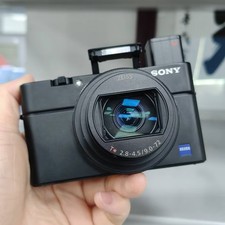
Compare · 4 products compared
Canon EOS R8vs3 rivals: specs compared
4 digital cameras lined up on the specs we could confirm from the makers' pages and independent reviews.
eBay prices refresh hourly — check the listing before you buy. We may earn a commission.
- MOST WINS×
 Canon
CanonBest for Sensor format and Continuous shooting (electronic)
11of 23 specs better - ×Fujifilm
Best for Effective pixels and In-body image stabilization
7of 23 specs better - ×Sony
Best for Battery life and Continuous shooting (mechanical)
8of 23 specs better - ×Sony
Best for Weight and Sensor type
5of 23 specs better
Biggest differences
Continuous shooting (electronic)
Canon EOS R8 leads
3.64×
higher is better
- Canon EOS R840 fps
- Fujifilm X100VI13 fps
- Sony a670011 fps
- Sony RX100 VII20 fps
Native ISO maximum
Canon EOS R8 leads
8×
higher is better
- Canon EOS R8102,400 ISO
- Fujifilm X100VI12,800 ISO
- Sony a670032,000 ISO
- Sony RX100 VII12,800 ISO
Battery life
Sony a6700 leads
2.19×
higher is better
- Canon EOS R8370 shots
- Fujifilm X100VI320 shots
- Sony a6700570 shots
- Sony RX100 VII260 shots
Effective pixels
Fujifilm X100VI leads
2×
higher is better
- Canon EOS R824.2 MP
- Fujifilm X100VI40.2 MP
- Sony a670026 MP
- Sony RX100 VII20.1 MP
Features not all of them have
Headphone port
- ✓
- ✕
- ✓
- ?
Where each one wins
Canon EOS R8
- Sensor format
- Native ISO maximum
- Continuous shooting (electronic)
- Max mechanical shutter speed
- Pre-burst capture duration
- 4K max frame rate (full width)
- Viewfinder magnification
- Screen articulation
- Rear screen resolution
- Weather sealing
- Headphone port
Fujifilm X100VI
- Effective pixels
- In-body image stabilization
- Continuous shooting (mechanical)
- Max mechanical shutter speed
- Max video resolution
- Viewfinder resolution
- Rear screen resolution
Sony a6700
- Continuous shooting (mechanical)
- Max mechanical shutter speed
- 4K max frame rate
- 4K max frame rate (full width)
- Viewfinder magnification
- Screen articulation
- Battery life
- Headphone port
Sony RX100 VII
- Sensor type
- Weight
- Width
- Height
- Depth
What all 4 have
- Log profile support✓
- Screen size3 in
- USB charging & power delivery✓
- Minimum operating temperature0 °C
- HDMI port typeMicro
Every spec
Red marks the better value in each row.
Overview
Release date
- Not published
- Not published
- Not published
- Not published
Launch price
- Not published
- Not published
- Not published
- Not published
Lens mount
- Canon RF
- Fixed lens
- Sony E
- Fixed lens
High resolution pixel-shift mode
- No
- —
- No
- Not published
Sensor & Image
Effective pixels
- 24.2 MP
- 40.2 MP
- 26 MP
- 20.1 MP
Sensor format
- Full-frame
- APS-C
- APS-C
- 1-inch
Native ISO maximum
- 102,400 ISO
- 12,800 ISO
- 32,000 ISO
- 12,800 ISO
Sensor readout speed
- Not published
- Not published
- Not published
- Not published
Sensor type
- CMOS
- CMOS
- CMOS
- Stacked CMOS
Aspect ratios
- 3:2, 4:3, 1:1, 16:9
- 3:2, 4:3, 1:1, 16:9
- Not published
- 3:2, 4:3, 1:1, 16:93
Lens & Autofocus
Continuous shooting (mechanical)
- 6 fps
- 11 fps
- 11 fps
- 10 fps4
Continuous shooting (electronic)
- 40 fps
- 13 fps
- 11 fps
- 20 fps5
Max mechanical shutter speed
- 4,000 1/s
- 4,000 1/s
- 4,000 1/s
- 2,000 1/s
Pre-burst capture duration
- 0.5 s
- 0 s6
- Not published
- Not published
AF subject detection
- Human, animal, bird, car, train, airplane, motorcycle
- Human, animal, bird, car, train, airplane, motorcycle
- Human, animal, bird, insect, car, train, airplane
- Human, animal7
Video
Max video resolution
- 4K
- 6K
- 4K
- 4K
4K max frame rate
- 60 fps
- 59.94 fps
- 120 fps
- 30 fps
Video codecs
- H.264, HEVC
- H.264, HEVC
- H.264, HEVC
- H.2648
4K max frame rate (full width)
- 60 fps
- —
- 60 fps9
- 30 fps
Raw video recording
- None
- —
- None
- None10
Video bit depth
- 10 bit
- 10 bit
- 10 bit
- Not published
Log profile support
- Yes
- Yes
- Yes
- Yes11
Video dynamic range (log)
- Not published
- Not published
- 14 stops
- Not published
Viewfinder & Screen
Viewfinder resolution
- 2.36 M dots
- 3.69 M dots
- 2.36 M dots
- 2.36 M dots
Viewfinder magnification
- 0.7 x
- 0.66 x
- 0.7 x
- 0.59 x
Screen size
- 3 in
- 3 in
- 3 in
- 3 in
Screen articulation
- Fully articulated
- Tilting
- Fully articulated
- Tilting12
Rear screen resolution
- 1.62 M dots
- 1.62 M dots
- 1.04 M dots
- 0.92 M dots
Handling & Power
Battery life
- 370 shots
- 320 shots
- 570 shots
- 260 shots13
Memory card slots
- 1 slots
- 1 slots
- 1 slots
- Not published
Weather sealing
- Dust and drip resistant
- None14
- Not published
- Not published
Weight
- 461 g
- 521 g
- 493 g
- 302 g
Width
- 132.5 mm
- 128 mm
- 122 mm
- 101.6 mm
Height
- 86.1 mm
- 74.8 mm
- 69 mm
- 58.1 mm
Depth
- 70 mm
- 55.3 mm
- 75.1 mm
- 42.8 mm
USB charging & power delivery
- Yes
- Yes
- Yes
- Yes15
Minimum operating temperature
- 0 °C
- 0 °C
- 0 °C
- 0 °C
Headphone port
- Yes
- No
- Yes
- Not published
HDMI port type
- Micro
- Micro
- Micro
- Micro
Notes on 15 values — test conditions and caveats
- 1Fujifilm X100VI, In-body image stabilization: 6.0 stops of shake compensation is achieved when using the LCD or EVF.
- 2Sony RX100 VII, In-body image stabilization: Sony rates the optical (lens-shift) SteadyShot at 4.0 stops at the 200 mm telephoto end, not a body-only CIPA figure.
- 3Sony RX100 VII, Aspect ratios: 4:3, 16:9 and 1:1 sizes are in-camera crop modes over the native 3:2 sensor area.
- 4Sony RX100 VII, Continuous shooting (mechanical): The 'Hi' burst setting is electronic-shutter only; 10 fps ('Mid') is the fastest mechanical-shutter continuous rate.
- 5Sony RX100 VII, Continuous shooting (electronic): Blackout-free 20 fps continuous includes AF/AE tracking; the separate 'Single Burst' mode takes 7 shots at up to 90 fps.
- 6Fujifilm X100VI, Pre-burst capture duration: Pre-shot buffers frames while the shutter is half-pressed (e.g., 20 frames at 20fps = 1 second), not a fixed seconds setting.
- 7Sony RX100 VII, AF subject detection: Maker names only human and animal recognition (Eye AF / Real-time Tracking); no bird or vehicle categories are listed.
- 8Sony RX100 VII, Video codecs: Both XAVC S and AVCHD recording use MPEG-4 AVC/H.264; there is no HEVC/H.265 option.
- 9Sony a6700, 4K max frame rate (full width): Full-width 4K tops out at 60p; 120p 4K uses a crop.
- 10Sony RX100 VII, Raw video recording: Sony's movie-format list contains only XAVC S (H.264) and AVCHD; no raw video output is offered.
- 11Sony RX100 VII, Log profile support: S-Log2, S-Log3 and HLG log gammas are selectable via Picture Profile presets PP1–PP10.
- 12Sony RX100 VII, Screen articulation: Screen tilts up about 180° for selfies and down about 90°; it does not swing outward like a fully articulated display.
- 13Sony RX100 VII, Battery life: 260 shots assume default monitor settings; Sony also lists 310 shots when 'Auto Monitor Off' is set to 2 s.
- 14Fujifilm X100VI, Weather sealing: The camera body itself isn't weather-sealed; weather resistance requires the optional AR-X100 adapter ring and PRF-49 filter.
- 15Sony RX100 VII, USB charging & power delivery: In-body USB charging and power supply work over the Multi/Micro-USB (USB 2.0) terminal — not USB-C.
Continuous shooting (electronic)
Canon EOS R8 leads here (3.64× between best and worst; higher is better).
Canon EOS R8: 40 fps · Fujifilm X100VI: 13 fps · Sony a6700: 11 fps · Sony RX100 VII: 20 fps
Native ISO maximum
Canon EOS R8 leads here (8× between best and worst; higher is better).
Canon EOS R8: 102,400 ISO · Fujifilm X100VI: 12,800 ISO · Sony a6700: 32,000 ISO · Sony RX100 VII: 12,800 ISO
Battery life
Sony a6700 leads here (2.19× between best and worst; higher is better).
Canon EOS R8: 370 shots · Fujifilm X100VI: 320 shots · Sony a6700: 570 shots · Sony RX100 VII: 260 shots
Effective pixels
Fujifilm X100VI leads here (2× between best and worst; higher is better).
Canon EOS R8: 24.2 MP · Fujifilm X100VI: 40.2 MP · Sony a6700: 26 MP · Sony RX100 VII: 20.1 MP
4K max frame rate
Sony a6700 leads here (4× between best and worst; higher is better).
Canon EOS R8: 60 fps · Fujifilm X100VI: 59.94 fps · Sony a6700: 120 fps · Sony RX100 VII: 30 fps
Features not all of them have
Headphone port: Canon EOS R8 and Sony a6700.
Where each one wins
Canon EOS R8 wins on Sensor format, Continuous shooting (electronic), Weather sealing, Native ISO maximum and Pre-burst capture duration.
Fujifilm X100VI wins on Effective pixels, In-body image stabilization, Max video resolution, Viewfinder resolution and Continuous shooting (mechanical).
Sony a6700 wins on Battery life, Continuous shooting (mechanical), 4K max frame rate, 4K max frame rate (full width) and Viewfinder magnification.
Sony RX100 VII wins on Weight, Sensor type, Width, Height and Depth.
The Verdict
On the specs we can rank, Canon EOS R8 wins most often (10). Pick Fujifilm X100VI for Effective pixels, Sony a6700 for Battery life and Sony RX100 VII for Weight.
Where to buy
Canon EOS R8
Best for Sensor format and Continuous shooting (electronic)
Fujifilm X100VI
Best for Effective pixels and In-body image stabilization
Sony a6700
Best for Battery life and Continuous shooting (mechanical)
Sony RX100 VII
Best for Weight and Sensor type
FAQ
Which is best on Continuous shooting (electronic)?
Canon EOS R8 (40 fps).
Which is best on Native ISO maximum?
Canon EOS R8 (102,400 ISO).
Spotted something wrong? Tap the next to any section or spec group to let us know. Every report is read.