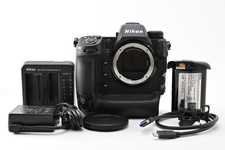
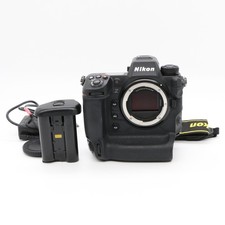
Compare · 2 products compared
Canon EOS R5 Mark IIvsNikon Z9: Which to Buy?
Both cameras are full-frame, stacked-CMOS bodies with 45-megapixel sensors, subject-detecting autofocus for the same seven subject types and 8K video. The choice comes down to two things: the Canon is smaller and faster to shoot, while the Nikon lasts longer per charge and keeps a deeper buffer before you press the shutter.
eBay prices refresh hourly — check the listing before you buy. We may earn a commission.
- MOST WINS
 Canon
CanonBest for Handheld action and hybrid shooters who want a lighter body with the fastest bursts
8of 15 specs better - Nikon
Best for Event, wildlife and cold-weather shooters who need battery life and a deeper pre-burst buffer
7of 15 specs better
Biggest differences
Max mechanical shutter speed
Nikon Z9 leads
4×
higher is better
- Canon EOS R5 Mark II8,000 1/s
- Nikon Z932,000 1/s
Weight
Canon EOS R5 Mark II leads
−44%
lower is better
- Canon EOS R5 Mark II746 g
- Nikon Z91,340 g
Viewfinder resolution
Canon EOS R5 Mark II leads
+56%
higher is better
- Canon EOS R5 Mark II5.76 M dots
- Nikon Z93.69 M dots
Continuous shooting (electronic)
Canon EOS R5 Mark II leads
+50%
higher is better
- Canon EOS R5 Mark II30 fps
- Nikon Z920 fps
Where each one wins
Canon EOS R5 Mark II
- In-body image stabilization
- Continuous shooting (electronic)
- 4K max frame rate (full width)
- Viewfinder resolution
- Screen articulation
- Weight
- Width
- Height
Nikon Z9
- Effective pixels
- Max mechanical shutter speed
- Pre-burst capture duration
- Viewfinder magnification
- Battery life
- Depth
- Minimum operating temperature
What both have
- Sensor formatFull-frame
- Sensor typeStacked CMOS
- AF subject detectionHuman, animal, bird, car, train, airplane, motorcycle
- Max video resolution8K
- Raw video recordingInternal
- Video bit depth10 bit
- Log profile support✓
- Rear screen resolution2.1 M dots
- Memory card slots2 slots
- Weather sealingDust and drip resistant
- USB charging & power delivery✓
- Headphone port✓
- HDMI port typeFull-size
Every spec
Red marks the better value in each row.
| Spec | Canon EOS R5 Mark II | Nikon Z9 |
|---|---|---|
| Overview | ||
| Release date | 2024-08 | 2021-12 |
| Launch price | Not published | 5,500 USD |
| Lens mount | Canon RF | Nikon Z |
| High resolution pixel-shift mode | Not published | No |
| Sensor & Image | ||
| Effective pixels | 45 MP | 45.7 MP |
| Sensor format | Full-frame | Full-frame |
| Native ISO maximum | Not published | 25,600 ISO |
| In-body image stabilization | 8.5 stops | 6 stops1 |
| Sensor readout speed | Not published | Not published |
| Sensor type | Stacked CMOS | Stacked CMOS |
| Aspect ratios | 3:2, 4:3, 1:1, 16:9 | — |
| Lens & Autofocus | ||
| Continuous shooting (mechanical) | 12 fps | Not published |
| Continuous shooting (electronic) | 30 fps | 20 fps |
| Max mechanical shutter speed | 8,000 1/s | 32,000 1/s |
| Pre-burst capture duration | 0.5 s2 | 1 s3 |
| AF subject detection | Human, animal, bird, car, train, airplane, motorcycle | Human, animal, bird, car, train, airplane, motorcycle |
| Video | ||
| Max video resolution | 8K | 8K |
| 4K max frame rate | — | 120 fps |
| Video codecs | HEVC, ProRes RAW, Cinema RAW Light, XF-AVC4 | H.264, HEVC, ProRes 422 HQ, ProRes RAW, N-RAW |
| 4K max frame rate (full width) | 59.94 fps | 30 fps |
| Raw video recording | Internal | Internal |
| Video bit depth | 10 bit | 10 bit |
| Log profile support | Yes | Yes |
| Video dynamic range (log) | Not published | Not published |
| Viewfinder & Screen | ||
| Viewfinder resolution | 5.76 M dots | 3.69 M dots |
| Viewfinder magnification | 0.76 x | 0.8 x |
| Screen size | Not published | 3.2 in |
| Screen articulation | Fully articulated | Tilting |
| Rear screen resolution | 2.1 M dots | 2.1 M dots |
| Handling & Power | ||
| Battery life | 630 shots | 740 shots |
| Memory card slots | 2 slots | 2 slots |
| Weather sealing | Dust and drip resistant | Dust and drip resistant |
| Weight | 746 g | 1,340 g |
| Width | 138.5 mm | 149 mm |
| Height | 101.2 mm | 149.5 mm |
| Depth | 93.5 mm | 90.5 mm |
| USB charging & power delivery | Yes | Yes |
| Minimum operating temperature | 0 °C | -10 °C |
| Headphone port | Yes | Yes |
| HDMI port type | Full-size | Full-size |
Notes on 4 values — test conditions and caveats
- 1Nikon Z9, In-body image stabilization: The 6.0-stop rating requires Synchro VR, combining in-body 5-axis VR with 2-axis lens VR on compatible lenses.
- 2Canon EOS R5 Mark II, Pre-burst capture duration: Up to 15 shots can be buffered before you fully press the shutter, which is about half a second at 30 fps.
- 3Nikon Z9, Pre-burst capture duration: Pre-Release Capture is only available in the C30 and C120 high-speed frame capture modes.
- 4Canon EOS R5 Mark II, Video codecs: Internal codecs are XF-HEVC S, XF-AVC S and H.264 MP4; ProRes RAW is recorded via HDMI to an external recorder.
Image quality and stabilization
Resolution is effectively a tie: 45 megapixels on the Canon EOS R5 Mark II against 45.7 on the Nikon Z9, a difference no one will see in a print. Both use stacked full-frame sensors, so readout is quick and rolling-shutter distortion is kept down in electronic mode. Neither maker publishes a readout figure, and neither publishes a log dynamic-range rating, so there is nothing to separate them on paper there either.
Handheld shooting is where the Canon pulls ahead. Its in-body stabilization is rated at 8.5 stops, and the Nikon's 6-stop figure only applies with Synchro VR, meaning a compatible lens that adds its own 2-axis VR on top of the body's 5-axis system. If you shoot long lenses or slow shutter speeds without a tripod, the Canon gives you more margin on every frame.
Speed and shooting
The Canon shoots electronic bursts at 30 fps, the Nikon at 20 fps. If you photograph birds, sprinting athletes or any fast, unpredictable action, that extra third of a second of coverage per second is real: more frames of the peak moment, and more chances one of them is sharp. The Nikon's mechanical-shutter figure is not published because the Z9 has no mechanical shutter at all, so its 20 fps electronic number is the only one that applies.
Pre-burst favors the Nikon. It buffers a full second before you press the shutter, against roughly half a second on the Canon, and that only works in the Z9's C30 and C120 capture modes. Pre-burst is a timing tool: the longer window means fewer missed launches, jumps and reactions. The Canon's edge is the slower mechanical shutter ceiling versus the Nikon's 1/32,000 s, which only matters in bright light at wide apertures.
Video
Both record 8K internally and both do raw internally, which is the headline. The practical split is frame rate at full sensor width. The Canon manages 4K at 59.94 fps across the full width of the sensor, while the Nikon drops to 30 fps at full width and reaches 120 fps in 4K only by cropping or subsampling in the mode that provides it. For anyone shooting 4K for slow-motion or for a 60p deliverable, the Canon is the simpler camera to work with.
The Nikon counters with ProRes 422 HQ and N-RAW alongside H.264, HEVC and ProRes RAW, so if your post pipeline is built around ProRes or Nikon's raw format, the Z9 fits without a transcode step. Canon's internal codecs are XF-HEVC S, XF-AVC S and H.264 MP4, with ProRes RAW routed out over HDMI to an external recorder. Both are 10-bit and both offer log profiles.
Viewfinder, screen and handling
The Canon's viewfinder is noticeably denser at 5.76 M dots against 3.69 M dots, which makes manual focusing and checking fine detail easier before you shoot. The Nikon's finder is slightly larger at 0.8x against 0.76x, a comfort difference rather than a detail one. Rear screens match on resolution, but the Canon's is fully articulated and the Nikon's tilts, and that is a genuine workflow choice: the Canon flips to face you for vlogging and low-angle verticals, the Nikon is quicker to pull out for waist-level stills.
Size and weight are the other everyday factor. The Canon is 746 g and clearly smaller in width and height, so it is the one you carry all day without noticing. The Nikon is 1,340 g and 149 mm tall, a body that balances long glass but punishes a light bag. Both are dust and drip resistant, both have two card slots, both charge and power over USB, and both give you a full-size HDMI port.
Battery and cold weather
The Nikon is rated for 740 shots against the Canon's 630, roughly one extra card's worth of shooting before a swap. On a long event day that is the difference between changing a battery and not. Neither figure accounts for video, where both drain far faster than the stills rating suggests.
The Nikon also keeps working down to -10 °C, while the Canon is rated only to 0 °C. If you shoot winter sports, night skies or anything else in genuine cold, the Nikon is the body rated to keep going when the temperature drops below freezing.
The Verdict
Buy the Canon EOS R5 Mark II if you want the lighter, faster-shooting body with stronger stabilization and full-width 4K at 60p. Buy the Nikon Z9 if you want the longest battery life, the deeper pre-burst buffer and cold-weather headroom, and you do not mind the size. Neither has a resolution advantage worth choosing over the other.
Where to buy
Canon EOS R5 Mark II
Best for Handheld action and hybrid shooters who want a lighter body with the fastest bursts
Nikon Z9
Best for Event, wildlife and cold-weather shooters who need battery life and a deeper pre-burst buffer
FAQ
Is the Nikon Z9 heavier than the Canon EOS R5 Mark II?
Yes, substantially. The Z9 weighs 1,340 g against 746 g for the Canon, and it is also taller and wider, so it is the harder camera to carry for a full day.
Does the Canon EOS R5 Mark II have a mechanical shutter?
Yes. It has a mechanical shutter rated to 1/8,000 s and shoots 12 fps with it, while the Z9 has no mechanical shutter and its published burst figure is electronic only.
Which has the higher-resolution electronic viewfinder?
The Canon EOS R5 Mark II at 5.76 M dots, against 3.69 M dots on the Nikon Z9. The Nikon's viewfinder is slightly larger at 0.8x magnification.
Do both cameras charge over USB?
Yes. Both support USB charging and power delivery, and both have a full-size HDMI port and a headphone jack.
Can the Canon EOS R5 Mark II shoot 4K at 120 fps?
No figure is published for that. The Canon's documented full-width 4K rate is 59.94 fps, and its listed maximum video resolution is 8K. The Nikon Z9 is the one with a published 4K 120 fps figure.
Spotted something wrong? Tap the next to any section or spec group to let us know. Every report is read.