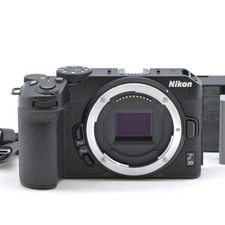
Compare · 2 products compared
Canon EOS R5 Mark IIvsNikon Z 30: Which Should You Buy?
Both cameras use fully articulated rear screens, shoot 4K video, charge over USB and take a single brand's mirrorless lenses. The choice comes down to a full-frame 45 MP stacked sensor with in-body stabilization versus an APS-C body that weighs barely half as much and has no viewfinder.
eBay prices refresh hourly — check the listing before you buy. We may earn a commission.
- MOST WINS
 Canon
CanonBest for Working and enthusiast shooters who need resolution, stabilization, speed and serious video
12of 16 specs better - Nikon
Best for Casual creators and travelers who want a light, compact body for stills and 4K/30p video
4of 16 specs better
Biggest differences
Effective pixels
Canon EOS R5 Mark II leads
2.15×
higher is better
- Canon EOS R5 Mark II45 MP
- Nikon Z 3020.9 MP
Memory card slots
Canon EOS R5 Mark II leads
2×
higher is better
- Canon EOS R5 Mark II2 slots
- Nikon Z 301 slots
Battery life
Canon EOS R5 Mark II leads
+91%
higher is better
- Canon EOS R5 Mark II630 shots
- Nikon Z 30330 shots
Weight
Nikon Z 30 leads
−46%
lower is better
- Canon EOS R5 Mark II746 g
- Nikon Z 30405 g
Where each one wins
Canon EOS R5 Mark II
- Effective pixels
- Sensor format
- Sensor type
- Continuous shooting (mechanical)
- Max mechanical shutter speed
- Max video resolution
- 4K max frame rate (full width)
- Viewfinder resolution
- Rear screen resolution
- Battery life
- Memory card slots
- HDMI port type
Nikon Z 30
- Weight
- Width
- Height
- Depth
What both have
- Screen articulationFully articulated
- USB charging & power delivery✓
- Minimum operating temperature0 °C
Every spec
Red marks the better value in each row.
| Spec | Canon EOS R5 Mark II | Nikon Z 30 |
|---|---|---|
| Overview | ||
| Release date | 2024-08 | Not published |
| Launch price | Not published | Not published |
| Lens mount | Canon RF | Nikon Z |
| High resolution pixel-shift mode | Not published | Not published |
| Sensor & Image | ||
| Effective pixels | 45 MP | 20.9 MP |
| Sensor format | Full-frame | APS-C1 |
| Native ISO maximum | Not published | 51,200 ISO2 |
| In-body image stabilization | 8.5 stops | Not published |
| Sensor readout speed | Not published | Not published |
| Sensor type | Stacked CMOS | CMOS |
| Aspect ratios | 3:2, 4:3, 1:1, 16:9 | 3:2, 1:1, 16:93 |
| Lens & Autofocus | ||
| Continuous shooting (mechanical) | 12 fps | 11 fps4 |
| Continuous shooting (electronic) | 30 fps | Not published |
| Max mechanical shutter speed | 8,000 1/s | 4,000 1/s |
| Pre-burst capture duration | 0.5 s5 | Not published |
| AF subject detection | Human, animal, bird, car, train, airplane, motorcycle | — |
| Video | ||
| Max video resolution | 8K | 4K |
| 4K max frame rate | — | 30 fps |
| Video codecs | HEVC, ProRes RAW, Cinema RAW Light, XF-AVC6 | H.264 |
| 4K max frame rate (full width) | 59.94 fps | 30 fps |
| Raw video recording | Internal | Not published |
| Video bit depth | 10 bit | Not published |
| Log profile support | Yes | Not published |
| Video dynamic range (log) | Not published | Not published |
| Viewfinder & Screen | ||
| Viewfinder resolution | 5.76 M dots | 0 M dots7 |
| Viewfinder magnification | 0.76 x | Not published |
| Screen size | Not published | 3 in |
| Screen articulation | Fully articulated | Fully articulated |
| Rear screen resolution | 2.1 M dots | 1.04 M dots |
| Handling & Power | ||
| Battery life | 630 shots | 330 shots8 |
| Memory card slots | 2 slots | 1 slots |
| Weather sealing | Dust and drip resistant | Not published |
| Weight | 746 g | 405 g |
| Width | 138.5 mm | 128 mm |
| Height | 101.2 mm | 73.5 mm |
| Depth | 93.5 mm | 59.5 mm |
| USB charging & power delivery | Yes | Yes9 |
| Minimum operating temperature | 0 °C | 0 °C |
| Headphone port | Yes | Not published |
| HDMI port type | Full-size | Mini |
Notes on 9 values — test conditions and caveats
- 1Nikon Z 30, Sensor format: DX format is Nikon's name for its APS-C-size sensor (23.5 x 15.7 mm).
- 2Nikon Z 30, Native ISO maximum: Settings above ISO 51200 (102400, 204800) are expanded, not native.
- 3Nikon Z 30, Aspect ratios: Native DX ratio is 3:2; 1:1 and 16:9 are in-camera crop modes.
- 4Nikon Z 30, Continuous shooting (mechanical): Nikon's in-house measured maximum; the rate is approximate.
- 5Canon EOS R5 Mark II, Pre-burst capture duration: Up to 15 shots can be buffered before you fully press the shutter, which is about half a second at 30 fps.
- 6Canon EOS R5 Mark II, Video codecs: Internal codecs are XF-HEVC S, XF-AVC S and H.264 MP4; ProRes RAW is recorded via HDMI to an external recorder.
- 7Nikon Z 30, Viewfinder resolution: The Z 30 has no electronic viewfinder; compose on the rear LCD.
- 8Nikon Z 30, Battery life: Figure is for the EN-EL25 battery; shot count differs with EN-EL25a.
- 9Nikon Z 30, USB charging & power delivery: In-camera USB charging/power needs Nikon's optional EH-7P or EH-8P adapter.
Sensor and image quality
The Canon EOS R5 Mark II pairs a 45 MP stacked full-frame sensor with 8.5 stops of in-body stabilization. That combination is what lets you hand-hold slow shutter speeds in dim rooms and still crop deeply into a file without it falling apart. The Nikon Z 30 carries a 20.9 MP APS-C sensor with no published stabilization figure, so every shot depends on lens stabilization or a steady hand.
If you print large, crop hard, or shoot indoors without flash, the Canon's extra pixels and stabilization are worth real money. The Z 30's smaller sensor is easier to design compact lenses for, which is exactly why the whole kit stays small.
Video
The Canon records 8K and hits 59.94 fps in 4K at full sensor width, with 10-bit color and a log profile for grading. It also does internal raw recording, and ProRes RAW goes out over HDMI to an external recorder [ProRes RAW is recorded via HDMI to an external recorder]. That matters if you deliver to clients who want latitude in post.
The Nikon tops out at 4K/30p in H.264 with no published bit depth, log support or raw output. For vlogging, casual YouTube uploads and social clips, that is entirely adequate. For anything that needs heavy color work or high frame rates, the Canon is the only one of the two that gets you there.
Speed and autofocus
The Canon shoots 12 fps with the mechanical shutter and 30 fps electronically, and it can buffer up to 15 shots before you fully press the shutter, roughly half a second of pre-capture at 30 fps [Up to 15 shots can be buffered before you fully press the shutter]. Subject detection covers people, animals, birds, cars, trains, airplanes and motorcycles.
The Nikon manages 11 fps mechanically by its own measurement, with no published electronic rate and no published subject-detection list. For birds, sports or any moving subject where the first frame is often too late, the Canon's pre-burst and stacked sensor give it a clear edge. The Z 30 is a fine everyday camera but not a burst-shooting tool.
Viewfinder, battery and body
The Canon has a 5.76 M-dot electronic viewfinder, two card slots, dust and drip resistance, a full-size HDMI port and a headphone jack. Its 630-shot battery rating means a full day of stills without swapping cells. It weighs 746 g before you add a lens.
The Nikon has no viewfinder at all, so you compose on the 3-inch rear screen [The Z 30 has no electronic viewfinder; compose on the rear LCD]. It gives you one card slot, a mini HDMI port, no published headphone jack and a 330-shot rating [Figure is for the EN-EL25 battery; shot count differs with EN-EL25a]. In exchange it weighs 405 g and is smaller in every dimension. USB charging on the Nikon also needs an optional adapter [In-camera USB charging/power needs Nikon's optional EH-7P or EH-8P adapter].
Which is best for travel and everyday carry?
The Nikon Z 30 wins this one outright. At 405 g and 59.5 mm deep it slips into a bag in a way the 746 g Canon never will, and the missing viewfinder is one less thing to break or drain power. For walking around a city, shooting family events or recording yourself talking to camera, that size advantage is the whole reason to pick it.
What you give up is low-light headroom, reach when cropping, weather sealing and a viewfinder for bright outdoor days. If your shooting happens mostly in good light and you rarely push files hard in editing, that trade costs you little.
The Verdict
Buy the Canon EOS R5 Mark II if you shoot professionally or seriously, need crop headroom, high frame rates, 8K or raw video, and can carry the weight. Buy the Nikon Z 30 if you want the smallest possible body for casual stills and 4K/30p clips and do not need a viewfinder. Neither is the wrong answer, but they are aimed at buyers with very different days.
Where to buy
Canon EOS R5 Mark II
Best for Working and enthusiast shooters who need resolution, stabilization, speed and serious video
Nikon Z 30
Best for Casual creators and travelers who want a light, compact body for stills and 4K/30p video
FAQ
Does the Nikon Z 30 have a viewfinder?
No. The Z 30 has no electronic viewfinder, so you compose everything on the 3-inch fully articulated rear screen. The Canon EOS R5 Mark II has a 5.76 M-dot viewfinder, which is a major practical difference on bright days.
Can I use my existing lenses on these cameras?
Only native-mount glass without an adapter. The Canon takes Canon RF lenses and the Nikon takes Nikon Z lenses. The two mounts are not cross-compatible.
Which camera has better battery life?
The Canon EOS R5 Mark II is rated at 630 shots, nearly double the Nikon's 330 shots. The Nikon's figure also varies with which EN-EL25-series battery you use.
Does the Nikon Z 30 charge over USB?
Yes, but in-camera USB charging and power delivery require Nikon's optional EH-7P or EH-8P adapter. The Canon supports USB charging and power delivery as-is.
Which is better for video, the Canon EOS R5 Mark II or the Nikon Z 30?
The Canon, decisively, for anything demanding. It records 8K, 4K at up to 59.94 fps full width, 10-bit color with a log profile and internal raw; the Nikon caps at 4K/30p in H.264.
Spotted something wrong? Tap the next to any section or spec group to let us know. Every report is read.