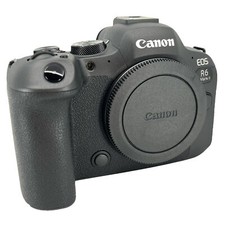
Compare · 2 products compared
Canon EOS R5 Mark IIvsCanon EOS R6 Mark II: Which to Buy
Both cameras share the Canon RF mount, full-frame sensors, in-body stabilization and the same subject-detection autofocus, so the choice comes down to resolution and video ambition versus speed and cost. The R5 Mark II is the high-resolution, 8K-capable body; the R6 Mark II is the faster-bursting, lighter, more affordable one.
eBay prices refresh hourly — check the listing before you buy. We may earn a commission.
- MOST WINS
 Canon
CanonBest for High-resolution stills and 8K or internal-raw video work
8of 15 specs better - Canon
Best for Action shooters and hybrid creators who want speed and value
7of 15 specs better
Biggest differences
Effective pixels
Canon EOS R5 Mark II leads
+86%
higher is better
- Canon EOS R5 Mark II45 MP
- Canon EOS R6 Mark II24.2 MP
Viewfinder resolution
Canon EOS R5 Mark II leads
+56%
higher is better
- Canon EOS R5 Mark II5.76 M dots
- Canon EOS R6 Mark II3.69 M dots
Continuous shooting (electronic)
Canon EOS R6 Mark II leads
+33%
higher is better
- Canon EOS R5 Mark II30 fps
- Canon EOS R6 Mark II40 fps
Battery life
Canon EOS R6 Mark II leads
+21%
higher is better
- Canon EOS R5 Mark II630 shots
- Canon EOS R6 Mark II760 shots
Where each one wins
Canon EOS R5 Mark II
- Effective pixels
- In-body image stabilization
- Sensor type
- Max video resolution
- Raw video recording
- Viewfinder resolution
- Rear screen resolution
- HDMI port type
Canon EOS R6 Mark II
- Continuous shooting (electronic)
- 4K max frame rate (full width)
- Battery life
- Weight
- Width
- Height
- Depth
What both have
- Lens mountCanon RF
- Sensor formatFull-frame
- Aspect ratios3:2, 4:3, 1:1, 16:9
- Continuous shooting (mechanical)12 fps
- Max mechanical shutter speed8,000 1/s
- Pre-burst capture duration0.5 s
- AF subject detectionHuman, animal, bird, car, train, airplane, motorcycle
- Video bit depth10 bit
- Log profile support✓
- Viewfinder magnification0.76 x
- Screen articulationFully articulated
- Memory card slots2 slots
- Weather sealingDust and drip resistant
- USB charging & power delivery✓
- Minimum operating temperature0 °C
- Headphone port✓
Every spec
Red marks the better value in each row.
| Spec | Canon EOS R5 Mark II | Canon EOS R6 Mark II |
|---|---|---|
| Overview | ||
| Release date | 2024-08 | Not published |
| Launch price | Not published | 2,499 USD |
| Lens mount | Canon RF | Canon RF |
| High resolution pixel-shift mode | Not published | Not published |
| Sensor & Image | ||
| Effective pixels | 45 MP | 24.2 MP |
| Sensor format | Full-frame | Full-frame |
| Native ISO maximum | Not published | 102,400 ISO1 |
| In-body image stabilization | 8.5 stops | 8 stops2 |
| Sensor readout speed | Not published | Not published |
| Sensor type | Stacked CMOS | CMOS |
| Aspect ratios | 3:2, 4:3, 1:1, 16:9 | 3:2, 4:3, 1:1, 16:9 |
| Lens & Autofocus | ||
| Continuous shooting (mechanical) | 12 fps | 12 fps |
| Continuous shooting (electronic) | 30 fps | 40 fps |
| Max mechanical shutter speed | 8,000 1/s | 8,000 1/s |
| Pre-burst capture duration | 0.5 s3 | 0.5 s4 |
| AF subject detection | Human, animal, bird, car, train, airplane, motorcycle | Human, animal, bird, car, train, airplane, motorcycle |
| Video | ||
| Max video resolution | 8K | 4K |
| 4K max frame rate | — | 60 fps |
| Video codecs | HEVC, ProRes RAW, Cinema RAW Light, XF-AVC5 | H.264, HEVC6 |
| 4K max frame rate (full width) | 59.94 fps | 60 fps |
| Raw video recording | Internal | External7 |
| Video bit depth | 10 bit | 10 bit8 |
| Log profile support | Yes | Yes |
| Video dynamic range (log) | Not published | Not published |
| Viewfinder & Screen | ||
| Viewfinder resolution | 5.76 M dots | 3.69 M dots |
| Viewfinder magnification | 0.76 x | 0.76 x |
| Screen size | Not published | 3 in |
| Screen articulation | Fully articulated | Fully articulated |
| Rear screen resolution | 2.1 M dots | 1.62 M dots |
| Handling & Power | ||
| Battery life | 630 shots | 760 shots9 |
| Memory card slots | 2 slots | 2 slots |
| Weather sealing | Dust and drip resistant | Dust and drip resistant10 |
| Weight | 746 g | 670 g |
| Width | 138.5 mm | 138.4 mm |
| Height | 101.2 mm | 98.4 mm |
| Depth | 93.5 mm | 88.4 mm |
| USB charging & power delivery | Yes | Yes11 |
| Minimum operating temperature | 0 °C | 0 °C12 |
| Headphone port | Yes | Yes |
| HDMI port type | Full-size | Micro |
Notes on 12 values — test conditions and caveats
- 1Canon EOS R6 Mark II, Native ISO maximum: ISO 204800 (H) is an expanded setting; the native range tops out at ISO 102400.
- 2Canon EOS R6 Mark II, In-body image stabilization: The 8-stop rating combines lens optical IS with in-body IS; results vary by lens.
- 3Canon EOS R5 Mark II, Pre-burst capture duration: Up to 15 shots can be buffered before you fully press the shutter, which is about half a second at 30 fps.
- 4Canon EOS R6 Mark II, Pre-burst capture duration: Pre-release capture works in RAW burst mode and buffers up to 0.5s of action before full shutter press.
- 5Canon EOS R5 Mark II, Video codecs: Internal codecs are XF-HEVC S, XF-AVC S and H.264 MP4; ProRes RAW is recorded via HDMI to an external recorder.
- 6Canon EOS R6 Mark II, Video codecs: Movies record H.264 by default; H.265/HEVC is used when Canon Log 3 or HDR PQ is enabled.
- 7Canon EOS R6 Mark II, Raw video recording: 6K ProRes RAW requires an external Atomos Ninja V+ recorder connected over HDMI.
- 8Canon EOS R6 Mark II, Video bit depth: Standard profiles record 8-bit 4:2:0; 10-bit 4:2:2 requires Canon Log 3 or HDR PQ.
- 9Canon EOS R6 Mark II, Battery life: 760 shots is the CIPA power-saving rating with the rear LCD; Canon's smooth-mode rating is 580 shots.
- 10Canon EOS R6 Mark II, Weather sealing: Sealed dust- and water-resistant build, not IP-rated; Canon cautions ingress cannot be fully prevented.
- 11Canon EOS R6 Mark II, USB charging & power delivery: In-body USB charging and power supply require Canon's optional PD-E1 USB power adapter.
- 12Canon EOS R6 Mark II, Minimum operating temperature: Canon's product manual rates 0–40°C; regional Canon spec sheets list a 2°C minimum.
Resolution and detail
The R5 Mark II's 45MP sensor captures roughly double the pixels of the R6 Mark II's 24.2MP chip. That matters if you crop heavily, print large, or shoot landscapes and studio work where fine detail is the point. Files are bigger and demand more storage and processing.
The R5 Mark II also uses a stacked CMOS design, which generally means faster sensor readout — useful for reducing rolling-shutter distortion in electronic shutter mode. Canon has not published a readout figure for either body, so that advantage is architectural rather than a number you can compare.
Speed and autofocus
Mechanical burst rates match at 12 fps, but with the electronic shutter the R6 Mark II pulls ahead at 40 fps versus the R5 Mark II's 30 fps. For fast action — birds, sports, unpredictable movement — that extra frame rate raises your odds of catching the decisive instant.
Both bodies offer the same pre-burst buffer of about half a second, and both detect the same subjects: people, animals, birds, cars, trains, planes and motorcycles. Autofocus is a wash; the speed edge belongs to the R6 Mark II.
Video
The R5 Mark II shoots 8K and records raw video internally, which suits filmmakers who want maximum resolution and grading flexibility without external gear. It also has a full-size HDMI port, a practical plus for rigging.
The R6 Mark II tops out at 4K but matches full-width 4K at 60 fps, and its raw recording requires an external recorder over HDMI. If 4K60 is enough for your delivery, the R6 Mark II covers it. If you need 8K or internal raw, only the R5 Mark II will do.
Battery, size and handling
The R6 Mark II is the lighter camera at 670 g versus 746 g and is slightly smaller in every dimension, which adds up over a long day of handheld shooting. It also has the better battery rating — 760 shots versus 630 — though Canon's own smooth-mode figure for the R6 II drops to 580.
Both have dual card slots, dust- and drip-resistant sealing, USB charging and a headphone port. The R5 Mark II counters with a higher-resolution viewfinder and rear screen, which helps when manually focusing or checking critical detail.
Weather sealing and operating limits
Neither body is IP-rated; Canon describes both as dust- and drip-resistant and cautions that ingress cannot be fully prevented. Both are rated down to 0 °C, so cold-weather shooting below freezing is outside the spec for either camera. If you regularly shoot in rain or extreme cold, plan on protection for both.
The Verdict
Buy the Canon EOS R5 Mark II if you need 45MP stills, 8K video, internal raw recording or the sharper viewfinder. Buy the Canon EOS R6 Mark II if you want faster electronic bursts, a lighter body, longer battery life and a lower entry price at 24MP and 4K.
Where to buy
Canon EOS R5 Mark II
Best for High-resolution stills and 8K or internal-raw video work
Canon EOS R6 Mark II
Best for Action shooters and hybrid creators who want speed and value
FAQ
Does the R6 Mark II have a stacked sensor like the R5 Mark II?
No. The R5 Mark II uses a stacked CMOS sensor, while the R6 Mark II uses a conventional CMOS design. Canon has not published readout speeds for either, but stacked sensors typically clear the sensor faster.
Can either camera record raw video internally?
Only the R5 Mark II records raw video internally. The R6 Mark II needs an external recorder over HDMI for raw capture.
Which camera has the better electronic viewfinder?
The R5 Mark II, at 5.76 million dots versus 3.69 million on the R6 Mark II. Both share the same 0.76x magnification.
Do both cameras charge over USB?
Yes, but Canon requires its optional PD-E1 USB power adapter for in-body charging and power delivery on both bodies.
Is the R6 Mark II good enough for professional video?
It depends on your delivery. It offers full-width 4K at up to 60 fps and 10-bit recording with Canon Log 3 or HDR PQ, but it stops short of the R5 Mark II's 8K and internal raw.
Spotted something wrong? Tap the next to any section or spec group to let us know. Every report is read.