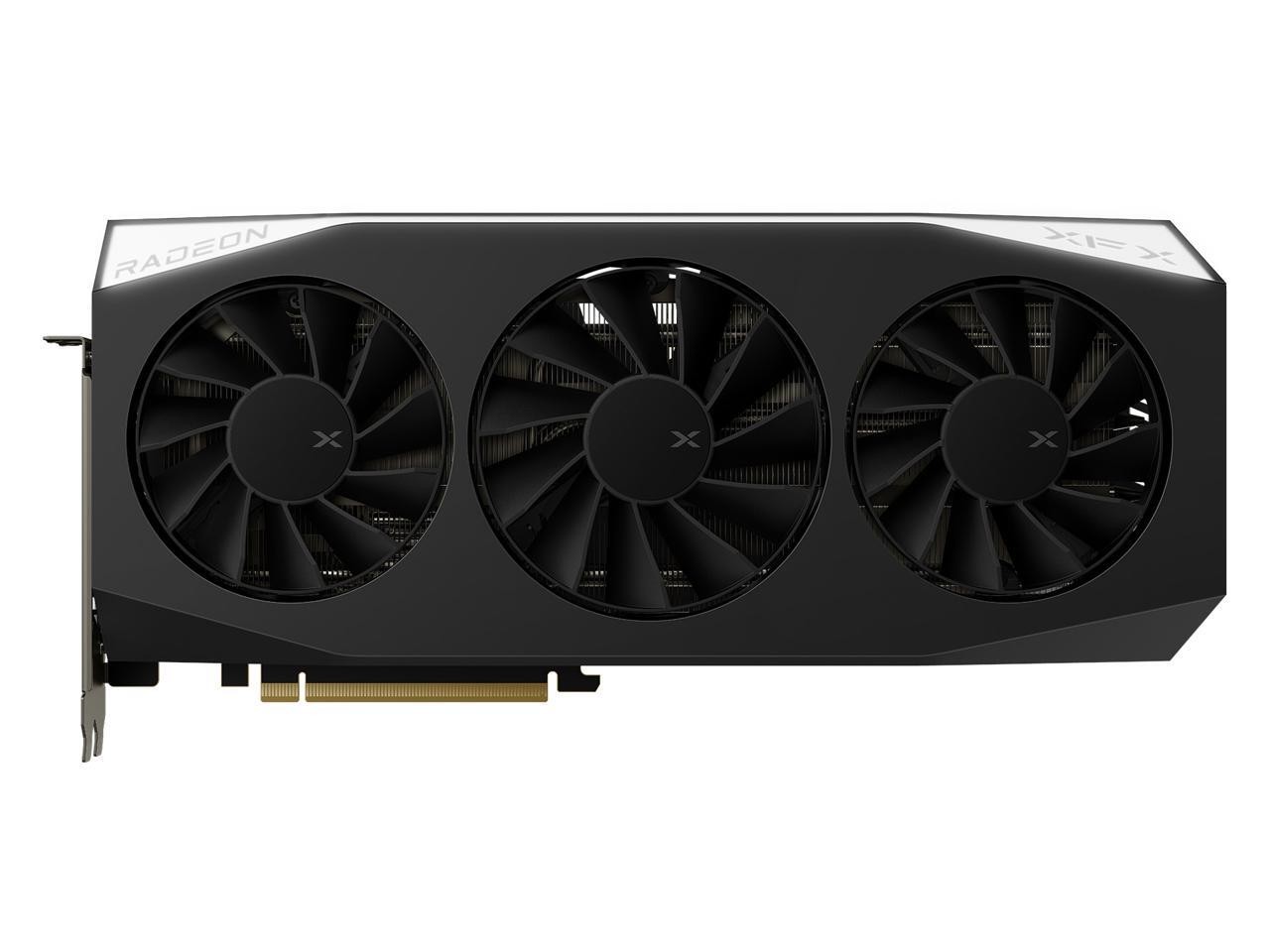
AMD
AMD Radeon RX 9070 XT
Released in March 2025, the AMD Radeon RX 9070 XT is a high-end graphics card built for demanding desktop gaming and content creation setups. It brings advanced Rdna 4 architecture to enthusiasts looking for strong rasterization and ray tracing capabilities.
- Release date
- 2025-03
- Launch price
- 599 USD
- Shader cores
- 4,096 cores
- Video memory
- 16 GB
- Memory type
- Gddr6
- Memory bus width
- 256 bit
Compute and Performance
Powered by 4,096 shader cores and an Rdna 4 architecture, the card delivers 48.7 TFLOPS of FP32 compute power. The 2,970 MHz boost clock pushes processing speeds higher, though buyers should note that TechSpot lists a 2,400 MHz game clock figure for the chip.
This high compute output ensures smooth frame rates in heavy 1440p and 4K titles. It gives creators rendering complex scenes the muscle they need to cut down render times.
Memory and Bandwidth
The board features 16 GB of Gddr6 video memory paired with a 256-bit bus width. This combination achieves a memory bandwidth of 640 GB/s at a 20 Gbps speed, backed by a 64 MB last-level cache.
Ample video memory prevents stuttering in modern games that load high-resolution texture packs. It allows players to turn up texture settings without running into capacity bottlenecks.
Power and System Requirements
Running this hardware requires managing a 304 W board power draw and a recommended 750 W power supply unit. Most partner cards rely on two 8-pin connectors, though Corsair notes that a few partner 90-series models use a single 12V-2x6 connection.
Buyers must check their current power supply before purchasing to ensure it meets the wattage demands. An adequate power setup keeps the system stable during heavy gaming sessions.
Connectivity and Expansion
Interface capabilities include PCIe 5.0 across 16 lanes for fast data transfer speeds with compatible motherboards. Display connectivity covers three DisplayPort 2.1a ports running on UHBR13.5 standards, alongside a single HDMI 2.1b port.
These modern display outputs support high-refresh-rate monitors at top resolutions. Hardware encode support for H.264, HEVC, and AV1 also streamlines video streaming and recording tasks.
Full specs
Overview
- Release date
- 2025-03
- Launch price
- 599 USD
TechSpot reports AMD subsidizes this MSRP with a $50 retailer rebate, so street prices often run higher.
Graphics chip
- Architecture
- Rdna 4
- Shader cores
- 4,096 cores
- Boost clock
- 2,970 MHz
TechSpot's 2400 MHz figure is AMD's 'game' clock; the boost rating is 2970 MHz.
- Base clock
- Not published
- FP32 compute
- 48.7 TFLOPS
Memory
- Video memory
- 16 GB
- Memory type
- Gddr6
- Memory bus width
- 256 bit
- Memory bandwidth
- 640 GB/s
- Memory speed
- 20 Gbps
- Last-level cache
- 64 MB
Power
- Board power
- 304 W
- Recommended PSU
- 750 W
- Power connectors
- 8-pin
Corsair notes a few partner 90-series cards use 12V-2x6; the vast majority use 2x 8-pin.
Interface
- PCIe version
- 5.0
- PCIe lanes
- 16 lanes
Display outputs
- HDMI version
- 2.1b
- DisplayPort version
- 2.1a
TechPowerUp specifies the DisplayPort outputs as UHBR13.5.
- HDMI outputs
- 1 ports
- DisplayPort outputs
- 3 ports
- Max displays
- Not published
Video engine
- Hardware encode
- H.264, HEVC, AV1
- Video encoders
- Not published
Size
- Card length
- Not published
- Card height
- Not published
- Slot width
- Not published
The Verdict
The AMD Radeon RX 9070 XT suits gamers and creators who need modern graphics horsepower and robust video memory for high-resolution workflows. Launch pricing sits at $599, though street prices may run higher due to a $50 retailer rebate reported by TechSpot. Anyone with an older power supply or a strict budget should verify total upgrade costs before buying.
FAQ
How much video memory does the card have?
It features 16 GB of Gddr6 video memory.
What is the launch price?
The launch price is $599, though street prices often run higher due to a retailer rebate.
What power supply is recommended?
A 750 W power supply is recommended to handle the 304 W board power.
Which video encoding formats are supported?
It includes hardware encode support for H.264, HEVC, and AV1.
Spotted something wrong? Tap the next to any section or spec group to let us know. Every report is read.