Compare · 2 products compared
NVIDIA GeForce RTX 5060 Ti 8GBvsAMD Radeon RX 9070 XT: Spec Comparison
The NVIDIA GeForce RTX 5060 Ti 8GB and the AMD Radeon RX 9070 XT are modern graphics cards built on the Blackwell and Rdna 4 architectures respectively. They target different price brackets and power envelopes, making the choice hinge on your budget, power supply limits, and memory requirements.
eBay prices refresh hourly — check the listing before you buy. We may earn a commission.

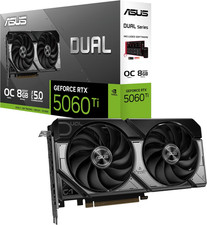
NVIDIA GeForce RTX 5060 Ti 8GB
Best for Budget-conscious builders needing low power draw
Wins7 / 14
Best for Enthusiasts wanting high VRAM and compute power
Wins7 / 14
Biggest differences
Video memory
AMD Radeon RX 9070 XT leads
2×
higher is better
- NVIDIA GeForce RTX 5060 Ti 8GB8 GB
- AMD Radeon RX 9070 XT16 GB
Memory bus width
AMD Radeon RX 9070 XT leads
2×
higher is better
- NVIDIA GeForce RTX 5060 Ti 8GB128 bit
- AMD Radeon RX 9070 XT256 bit
PCIe lanes
AMD Radeon RX 9070 XT leads
2×
higher is better
- NVIDIA GeForce RTX 5060 Ti 8GB8 lanes
- AMD Radeon RX 9070 XT16 lanes
Board power
NVIDIA GeForce RTX 5060 Ti 8GB leads
−41%
lower is better
- NVIDIA GeForce RTX 5060 Ti 8GB180 W
- AMD Radeon RX 9070 XT304 W
Where each one wins
NVIDIA GeForce RTX 5060 Ti 8GB
- Launch price
- Shader cores
- Memory type
- Memory speed
- Board power
- Recommended PSU
- DisplayPort version
AMD Radeon RX 9070 XT
- Boost clock
- FP32 compute
- Video memory
- Memory bus width
- Memory bandwidth
- Last-level cache
- PCIe lanes
What both have
- Power connectors8-pin
- PCIe version5.0
- HDMI version2.1b
- HDMI outputs1 ports
- DisplayPort outputs3 ports
- Hardware encodeH.264, HEVC, AV1
Every spec
Red marks the better value in each row.
| Spec | NVIDIA GeForce RTX 5060 Ti 8GB | AMD Radeon RX 9070 XT |
|---|---|---|
| Overview | ||
| Release date | 2025-04 | 2025-03 |
| Launch price | 379 USD1 | 599 USD2 |
| Graphics chip | ||
| Architecture | Blackwell | Rdna 4 |
| Shader cores | 4,608 cores | 4,096 cores |
| Boost clock | 2,572 MHz | 2,970 MHz3 |
| Base clock | 2,407 MHz | Not published |
| FP32 compute | 23.7 TFLOPS | 48.7 TFLOPS |
| Memory | ||
| Video memory | 8 GB | 16 GB |
| Memory type | Gddr7 | Gddr6 |
| Memory bus width | 128 bit | 256 bit |
| Memory bandwidth | 448 GB/s | 640 GB/s |
| Memory speed | 28 Gbps | 20 Gbps |
| Last-level cache | 32 MB | 64 MB |
| Power | ||
| Board power | 180 W | 304 W |
| Recommended PSU | 600 W | 750 W |
| Power connectors | 8-pin4 | 8-pin5 |
| Interface | ||
| PCIe version | 5.0 | 5.0 |
| PCIe lanes | 8 lanes6 | 16 lanes |
| Display outputs | ||
| HDMI version | 2.1b | 2.1b |
| DisplayPort version | 2.1b7 | 2.1a8 |
| HDMI outputs | 1 ports | 1 ports |
| DisplayPort outputs | 3 ports | 3 ports |
| Max displays | 4 displays | Not published |
| Video engine | ||
| Hardware encode | H.264, HEVC, AV1 | H.264, HEVC, AV1 |
| Video encoders | 1 encoders | Not published |
| Size | ||
| Card length | Not published | Not published |
| Card height | Not published | Not published |
| Slot width | Not published | Not published |
Notes on 8 values — test conditions and caveats
- 1NVIDIA GeForce RTX 5060 Ti 8GB, Launch price: NVIDIA sells no Founders Edition of this card; $379 is the starting MSRP for partner cards.
- 2AMD Radeon RX 9070 XT, Launch price: TechSpot reports AMD subsidizes this MSRP with a $50 retailer rebate, so street prices often run higher.
- 3AMD Radeon RX 9070 XT, Boost clock: TechSpot's 2400 MHz figure is AMD's 'game' clock; the boost rating is 2970 MHz.
- 4NVIDIA GeForce RTX 5060 Ti 8GB, Power connectors: No Founders Edition exists; most partner cards use one 8-pin socket, a few use a 16-pin 12V-2x6 instead.
- 5AMD Radeon RX 9070 XT, Power connectors: Corsair notes a few partner 90-series cards use 12V-2x6; the vast majority use 2x 8-pin.
- 6NVIDIA GeForce RTX 5060 Ti 8GB, PCIe lanes: Only 8 lanes: on a PCIe 4.0 or 3.0 board it gets half or a quarter of the PCIe 5.0 bandwidth.
- 7NVIDIA GeForce RTX 5060 Ti 8GB, DisplayPort version: DisplayPort 2.1b at the full UHBR20 rate.
- 8AMD Radeon RX 9070 XT, DisplayPort version: TechPowerUp specifies the DisplayPort outputs as UHBR13.5.
Performance and Compute
The AMD card delivers significantly higher raw compute power at 48.7 TFLOPS compared to the NVIDIA option's 23.7 TFLOPS. This higher compute output benefits heavy calculation workloads and demanding rendering tasks.
The NVIDIA competitor relies on 4,608 shader cores and reaches a boost clock of 2,572 MHz. Meanwhile, the AMD rival pushes up to a 2,970 MHz boost clock, providing swift processing speeds for gaming and creative software.
Memory and Bandwidth
VRAM capacity differs sharply between these two components. The AMD Radeon RX 9070 XT features 16 GB of GDDR6 memory over a 256-bit bus, achieving 640 GB/s of memory bandwidth alongside a 64 MB last-level cache.
In contrast, the NVIDIA GeForce RTX 5060 Ti 8GB provides 8 GB of GDDR7 memory. While it uses a narrower 128-bit bus and offers 448 GB/s of bandwidth, its GDDR7 memory runs at a faster 28 Gbps and uses a 32 MB cache.
Power and System Requirements
Power consumption creates a clear division for system builders. The NVIDIA card requires a board power of 180 W and a modest 600 W recommended power supply unit, utilizing an 8-pin connector on most partner builds.
Conversely, the AMD option demands a heftier 304 W board power and a 750 W recommended power supply unit. Most partner cards for the AMD entry rely on dual 8-pin power connectors.
Connectivity and Display Outputs
Both graphics cards support PCIe 5.0 interfaces, but they differ in lane allocation. The AMD entrant features 16 PCIe lanes, whereas the NVIDIA model is limited to 8 lanes, which can restrict bandwidth on older PCIe 3.0 or 4.0 motherboards.
For display outputs, both options include one HDMI 2.1b port and three DisplayPort outputs. However, the NVIDIA card supports DisplayPort 2.1b at the full UHBR20 rate, while the AMD alternative implements DisplayPort 2.1a at the UHBR13.5 rate.
The Verdict
Buy the NVIDIA GeForce RTX 5060 Ti 8GB if you want a lower price tag and a modest 180 W power draw. Buy the AMD Radeon RX 9070 XT if you need 16 GB of VRAM and higher raw compute performance.
Where to buy
NVIDIA GeForce RTX 5060 Ti 8GB
Best for Budget-conscious builders needing low power draw
AMD Radeon RX 9070 XT
Best for Enthusiasts wanting high VRAM and compute power
FAQ
What is the launch price difference between these two graphics cards?
The NVIDIA GeForce RTX 5060 Ti 8GB starts at $379 for partner cards, while the AMD Radeon RX 9070 XT launches at $599, though retailer rebates can affect street pricing.
Do both cards support AV1 hardware encoding?
Yes, both graphics cards feature hardware encoding capabilities for H.264, HEVC, and AV1.
What power supply unit is recommended for each GPU?
The NVIDIA card recommends a 600 W power supply unit, whereas the AMD card requires a 750 W power supply unit.
Spotted something wrong? Tap the next to any section or spec group to let us know. Every report is read.