Compare · 2 products compared
Sony a7 VvsCanon EOS R100: Which is Better?
The Sony a7 V and the Canon EOS R100 both capture 4K resolution images and videos. However, they target completely different photographers through contrasting sensor formats, stabilization capabilities, and body designs.
eBay prices refresh hourly — check the listing before you buy. We may earn a commission.
- MOST WINS

Best for Professional creators needing top-tier autofocus, video specs, and in-body stabilization
Wins23 / 27 - CanonEOS R100
Best for Beginners looking for a lightweight, budget-friendly entry into interchangeable lens cameras
Wins4 / 27
Biggest differences
4K max frame rate
Sony a7 V leads
4.8×
higher is better
- Sony a7 V119.88 fps
- Canon EOS R10025 fps
Native ISO maximum
Sony a7 V leads
4×
higher is better
- Sony a7 V51,200 ISO
- Canon EOS R10012,800 ISO
Memory card slots
Sony a7 V leads
2×
higher is better
- Sony a7 V2 slots
- Canon EOS R1001 slots
Weight
Canon EOS R100 leads
1.95×
lower is better
- Sony a7 V695 g
- Canon EOS R100356 g
Features not all of them have
Log profile support
- Sony a7 V✓
- Canon EOS R100✕
USB charging & power delivery
- Sony a7 V✓
- Canon EOS R100✕
Headphone port
- Sony a7 V✓
- Canon EOS R100✕
Where each one wins
Sony a7 V
- Effective pixels
- Sensor format
- Native ISO maximum
- In-body image stabilization
- Sensor type
- Continuous shooting (mechanical)
- Continuous shooting (electronic)
- Max mechanical shutter speed
- 4K max frame rate
- 4K max frame rate (full width)
- Video bit depth
- Log profile support
- Viewfinder resolution
- Viewfinder magnification
- Screen size
- Screen articulation
- Rear screen resolution
- Battery life
- Memory card slots
- Weather sealing
- USB charging & power delivery
- Headphone port
- HDMI port type
Canon EOS R100
- Weight
- Width
- Height
- Depth
What both have
- Aspect ratios3:2, 4:3, 1:1, 16:9
- Max video resolution4K
- Raw video recordingNone
- Minimum operating temperature0 °C
Every spec
Red marks the better value in each row.
| Spec | Sony a7 V | Canon EOS R100 |
|---|---|---|
| Overview | ||
| Release date | 2025-12 | Not published |
| Launch price | 2,899 USD | Not published |
| Lens mount | Sony E | Canon RF |
| High resolution pixel-shift mode | No1 | Not published |
| Sensor & Image | ||
| Effective pixels | 33 MP | 24.1 MP |
| Sensor format | Full-frame | APS-C |
| Native ISO maximum | 51,200 ISO2 | 12,800 ISO3 |
| In-body image stabilization | 7.5 stops4 | 0 stops5 |
| Sensor readout speed | 15 ms | Not published |
| Sensor type | Partially-stacked CMOS | CMOS |
| Aspect ratios | 3:2, 4:3, 1:1, 16:9 | 3:2, 4:3, 1:1, 16:9 |
| Lens & Autofocus | ||
| Continuous shooting (mechanical) | 10 fps6 | 6.5 fps |
| Continuous shooting (electronic) | 30 fps7 | 0 fps8 |
| Max mechanical shutter speed | 8,000 1/s | 4,000 1/s |
| Pre-burst capture duration | 1 s | Not published |
| AF subject detection | Human, animal, bird, insect, car, train, airplane | Human |
| Video | ||
| Max video resolution | 4K | 4K |
| 4K max frame rate | 119.88 fps9 | 25 fps |
| Video codecs | H.264, HEVC | H.264 |
| 4K max frame rate (full width) | 60 fps10 | 0 fps11 |
| Raw video recording | None | None |
| Video bit depth | 10 bit | 8 bit |
| Log profile support | Yes | No |
| Video dynamic range (log) | Not published | Not published |
| Viewfinder & Screen | ||
| Viewfinder resolution | 3.69 M dots | 2.36 M dots |
| Viewfinder magnification | 0.78 x12 | 0.59 x13 |
| Screen size | 3.2 in | 3 in |
| Screen articulation | Multi-angle | Fixed |
| Rear screen resolution | 2.1 M dots | 1.04 M dots |
| Handling & Power | ||
| Battery life | 750 shots14 | 430 shots |
| Memory card slots | 2 slots | 1 slots |
| Weather sealing | Dust and drip resistant | None |
| Weight | 695 g | 356 g15 |
| Width | 130.3 mm | 116.3 mm |
| Height | 96.4 mm | 85.5 mm |
| Depth | 72.3 mm16 | 68.8 mm |
| USB charging & power delivery | Yes | No17 |
| Minimum operating temperature | 0 °C | 0 °C |
| Headphone port | Yes | No |
| HDMI port type | Full-size | Micro |
Notes on 17 values — test conditions and caveats
- 1Sony a7 V, High resolution pixel-shift mode: No in-camera pixel shift; Sony's Extended Hi-Res merges burst frames later in its desktop software.
- 2Sony a7 V, Native ISO maximum: Refers to standard still image shooting prior to ISO expansion.
- 3Canon EOS R100, Native ISO maximum: ISO 25600 (H) is an expanded setting, not a native sensitivity.
- 4Sony a7 V, In-body image stabilization: Measured at the center with an FE 50mm F1.2 GM lens mounted per CIPA 2024 standards with long exposure NR off.
- 5Canon EOS R100, In-body image stabilization: No in-body stabilization; shake correction relies on IS lenses or Movie Digital IS.
- 6Sony a7 V, Continuous shooting (mechanical): Maximum continuous shooting speed achieved using mechanical shutter in Hi+ mode.
- 7Sony a7 V, Continuous shooting (electronic): Maximum continuous shooting speed achieved using electronic shutter in Hi+ mode.
- 8Canon EOS R100, Continuous shooting (electronic): The electronic (silent) shutter does not support continuous shooting on this camera.
- 9Sony a7 V, 4K max frame rate: Maximum 4K frame rate is available in XAVC HS 4K 4:2:0 10-bit mode.
- 10Sony a7 V, 4K max frame rate (full width): 4K 120p needs an APS-C/Super 35 crop; the full sensor width tops out at 4K 60p.
- 11Canon EOS R100, 4K max frame rate (full width): All 4K recording uses a ~1.6x centre crop, so no full-width 4K mode exists.
- 12Sony a7 V, Viewfinder magnification: Measured with a 50mm lens focused at infinity at -1 m⁻¹.
- 13Canon EOS R100, Viewfinder magnification: Canon's 0.95x is quoted with a 50mm lens on APS-C; in 35mm-equivalent terms it is 0.59x.
- 14Sony a7 V, Battery life: Measured using the LCD monitor under standard CIPA test conditions.
- 15Canon EOS R100, Weight: CIPA weight: body with battery and memory card, without lens.
- 16Sony a7 V, Depth: Overall maximum depth including the viewfinder eyepiece is 82.4 mm.
- 17Canon EOS R100, USB charging & power delivery: The battery must be charged in the external LC-E17E charger; no USB power delivery.
Image Quality and Sensor
The Sony a7 V features a full-frame, partially-stacked CMOS sensor with 33 MP, allowing for cleaner high-ISO shots up to a native 51,200 ISO. In contrast, the Canon EOS R100 uses a smaller APS-C CMOS sensor with 24.1 MP and maxes out at a native 12,800 ISO.
The Sony also adds 7.5 stops of in-body image stabilization measured at the center with an FE 50mm F1.2 GM lens mounted per CIPA 2024 standards with long exposure NR off. The Canon relies entirely on IS lenses or Movie Digital IS since it has zero stops of in-body stabilization.
Speed and Autofocus
For action and wildlife shooters, the Sony achieves a rapid 30 fps using its electronic shutter in Hi+ mode and offers subject detection across human, animal, bird, insect, car, train, and airplane categories. It also provides a 1-second pre-burst capture duration.
The Canon limits its continuous mechanical shooting to 6.5 fps, lacks continuous shooting on its electronic shutter, and restricts subject detection solely to humans.
Video Capabilities
Videographers get 10-bit color depth, log profile support, and H.264 and HEVC codecs on the Sony, alongside a maximum 4K frame rate of 119.88 fps in XAVC HS 4K 4:2:0 10-bit mode. Note that 4K 120p needs an APS-C/Super 35 crop, while the full sensor width tops out at 4K 60p.
The Canon captures video in 8-bit using the H.264 codec at a maximum of 25 fps, and all 4K recording uses a ~1.6x centre crop with no full-width mode available.
Handling and Design
The Sony offers robust build quality with dust and drip-resistant weather sealing, dual memory card slots, a 3.2-inch multi-angle screen, and a 3.69 M dot viewfinder with 0.78x magnification measured with a 50mm lens focused at infinity at -1 m⁻¹. It delivers 750 shots per battery charge using the LCD monitor under standard CIPA test conditions.
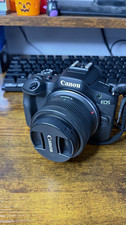
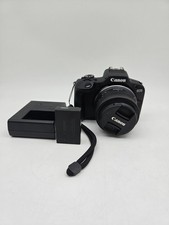
The Canon weighs just 356 g with its battery and memory card without a lens, making it lighter and more compact. It features a single card slot, a fixed 3-inch screen, a 2.36 M dot viewfinder with 0.59x 35mm-equivalent magnification, and yields 430 shots per battery.
The Verdict
Buy the Sony a7 V if you need professional-grade stabilization, rapid burst shooting, and advanced video codecs. Buy the Canon EOS R100 if you want a lightweight, compact body for basic everyday photography.
Where to buy
Sony a7 V
Best for Professional creators needing top-tier autofocus, video specs, and in-body stabilization
Canon EOS R100
Best for Beginners looking for a lightweight, budget-friendly entry into interchangeable lens cameras
FAQ
Does the Canon EOS R100 support USB power delivery or charging?
No, the battery must be charged in the external LC-E17E charger, as the camera lacks USB power delivery.
What kind of ports do these cameras have for audio and video monitoring?
The Sony features a full-size HDMI port and a headphone port, while the Canon uses a micro HDMI port and lacks a headphone port.
Do either of these cameras support high-resolution pixel-shift shooting modes?
The Canon does not publish pixel-shift specs, while the Sony has no in-camera pixel shift and instead relies on its desktop software to merge burst frames via Sony's Extended Hi-Res.
What is the mechanical shutter speed limit on each camera?
The Sony reaches a maximum mechanical shutter speed of 1/8,000s, while the Canon tops out at 1/4,000s.
Spotted something wrong? Tap the next to any section or spec group to let us know. Every report is read.