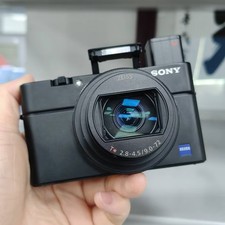
Compare · 2 products compared
Sony a6700vsSony RX100 VII: Which Camera to Buy
Both shoot 4K, both use a 2.36M-dot viewfinder, and both charge over USB. The a6700 carries a much larger APS-C sensor and interchangeable lenses, while the RX100 VII slips into a pocket and fires faster in silent mode. That trade-off decides most purchases.
eBay prices refresh hourly — check the listing before you buy. We may earn a commission.
- MOST WINS
 Sony
SonyBest for Shooters who want room to grow with lenses and the best low-light, video and subject-tracking performance
12of 18 specs better - Sony
Best for Travelers and everyday carriers who need a camera that disappears into a pocket
6of 18 specs better
Biggest differences
Battery life
Sony a6700 leads
2.19×
higher is better
- Sony a6700570 shots
- Sony RX100 VII260 shots
4K max frame rate
Sony a6700 leads
4×
higher is better
- Sony a6700120 fps
- Sony RX100 VII30 fps
Continuous shooting (electronic)
Sony RX100 VII leads
+82%
higher is better
- Sony a670011 fps
- Sony RX100 VII20 fps
Native ISO maximum
Sony a6700 leads
2.5×
higher is better
- Sony a670032,000 ISO
- Sony RX100 VII12,800 ISO
Where each one wins
Sony a6700
- Effective pixels
- Sensor format
- Native ISO maximum
- In-body image stabilization
- Continuous shooting (mechanical)
- Max mechanical shutter speed
- 4K max frame rate
- 4K max frame rate (full width)
- Viewfinder magnification
- Screen articulation
- Rear screen resolution
- Battery life
Sony RX100 VII
- Sensor type
- Continuous shooting (electronic)
- Weight
- Width
- Height
- Depth
What both have
- Max video resolution4K
- Raw video recordingNone
- Log profile support✓
- Viewfinder resolution2.36 M dots
- Screen size3 in
- USB charging & power delivery✓
- Minimum operating temperature0 °C
- HDMI port typeMicro
Every spec
Red marks the better value in each row.
| Spec | Sony a6700 | Sony RX100 VII |
|---|---|---|
| Overview | ||
| Release date | Not published | Not published |
| Launch price | Not published | Not published |
| Lens mount | Sony E | Fixed lens |
| High resolution pixel-shift mode | No | Not published |
| Sensor & Image | ||
| Effective pixels | 26 MP | 20.1 MP |
| Sensor format | APS-C | 1-inch |
| Native ISO maximum | 32,000 ISO | 12,800 ISO |
| In-body image stabilization | 5 stops | 4 stops1 |
| Sensor readout speed | Not published | Not published |
| Sensor type | CMOS | Stacked CMOS |
| Aspect ratios | Not published | 3:2, 4:3, 1:1, 16:92 |
| Lens & Autofocus | ||
| Continuous shooting (mechanical) | 11 fps | 10 fps3 |
| Continuous shooting (electronic) | 11 fps | 20 fps4 |
| Max mechanical shutter speed | 4,000 1/s | 2,000 1/s |
| Pre-burst capture duration | Not published | Not published |
| AF subject detection | Human, animal, bird, insect, car, train, airplane | Human, animal5 |
| Video | ||
| Max video resolution | 4K | 4K |
| 4K max frame rate | 120 fps | 30 fps |
| Video codecs | H.264, HEVC | H.2646 |
| 4K max frame rate (full width) | 60 fps7 | 30 fps |
| Raw video recording | None | None8 |
| Video bit depth | 10 bit | Not published |
| Log profile support | Yes | Yes9 |
| Video dynamic range (log) | 14 stops | Not published |
| Viewfinder & Screen | ||
| Viewfinder resolution | 2.36 M dots | 2.36 M dots |
| Viewfinder magnification | 0.7 x | 0.59 x |
| Screen size | 3 in | 3 in |
| Screen articulation | Fully articulated | Tilting10 |
| Rear screen resolution | 1.04 M dots | 0.92 M dots |
| Handling & Power | ||
| Battery life | 570 shots | 260 shots11 |
| Memory card slots | 1 slots | Not published |
| Weather sealing | Not published | Not published |
| Weight | 493 g | 302 g |
| Width | 122 mm | 101.6 mm |
| Height | 69 mm | 58.1 mm |
| Depth | 75.1 mm | 42.8 mm |
| USB charging & power delivery | Yes | Yes12 |
| Minimum operating temperature | 0 °C | 0 °C |
| Headphone port | Yes | Not published |
| HDMI port type | Micro | Micro |
Notes on 12 values — test conditions and caveats
- 1Sony RX100 VII, In-body image stabilization: Sony rates the optical (lens-shift) SteadyShot at 4.0 stops at the 200 mm telephoto end, not a body-only CIPA figure.
- 2Sony RX100 VII, Aspect ratios: 4:3, 16:9 and 1:1 sizes are in-camera crop modes over the native 3:2 sensor area.
- 3Sony RX100 VII, Continuous shooting (mechanical): The 'Hi' burst setting is electronic-shutter only; 10 fps ('Mid') is the fastest mechanical-shutter continuous rate.
- 4Sony RX100 VII, Continuous shooting (electronic): Blackout-free 20 fps continuous includes AF/AE tracking; the separate 'Single Burst' mode takes 7 shots at up to 90 fps.
- 5Sony RX100 VII, AF subject detection: Maker names only human and animal recognition (Eye AF / Real-time Tracking); no bird or vehicle categories are listed.
- 6Sony RX100 VII, Video codecs: Both XAVC S and AVCHD recording use MPEG-4 AVC/H.264; there is no HEVC/H.265 option.
- 7Sony a6700, 4K max frame rate (full width): Full-width 4K tops out at 60p; 120p 4K uses a crop.
- 8Sony RX100 VII, Raw video recording: Sony's movie-format list contains only XAVC S (H.264) and AVCHD; no raw video output is offered.
- 9Sony RX100 VII, Log profile support: S-Log2, S-Log3 and HLG log gammas are selectable via Picture Profile presets PP1–PP10.
- 10Sony RX100 VII, Screen articulation: Screen tilts up about 180° for selfies and down about 90°; it does not swing outward like a fully articulated display.
- 11Sony RX100 VII, Battery life: 260 shots assume default monitor settings; Sony also lists 310 shots when 'Auto Monitor Off' is set to 2 s.
- 12Sony RX100 VII, USB charging & power delivery: In-body USB charging and power supply work over the Multi/Micro-USB (USB 2.0) terminal — not USB-C.
Image quality and low light
The Sony a6700 uses an APS-C sensor that is far larger than the 1-inch chip in the Sony RX100 VII. That physical gap is the whole story in dim rooms and at dusk: the a6700 gathers more light, holds color better as ISO climbs, and reaches a native ceiling of 32,000 versus 12,800. If most of your shooting happens indoors or after sunset, this alone justifies the bigger body.
One RX100 VII counterpunch is its stacked sensor design. Stacked chips read out faster, which cuts rolling-shutter skew in silent shooting and electronic bursts. The a6700 has no published readout figure, so on paper the RX100 VII holds the edge for fast action captured without a mechanical shutter.
Video
Both cameras record 4K, but the a6700 pulls ahead hard on frame rates. It shoots 4K at up to 120 fps — 60 fps at full width, with 120 fps using a crop — while the RX100 VII tops out at 30 fps. For slow-motion clips and smoother panning footage, the a6700 is the only real option here.
The a6700 also records 10-bit color and supports log profiles rated to 14 stops of dynamic range. The RX100 VII does offer log shooting, but its bit depth and log dynamic range are not published. If you grade your footage, the extra color data and the HEVC codec on the a6700 give you more room to push shadows and highlights before the image falls apart.
Autofocus and burst shooting
Subject detection is the clearest autofocus split. The a6700 recognizes humans, animals, birds, insects, cars, trains and airplanes. The RX100 VII recognizes humans and animals only. Birders and anyone shooting motorsport or aircraft will find the a6700 tracks subjects the RX100 VII simply does not look for.
Burst rates run the other way. The a6700 does 11 fps whether you use the mechanical or electronic shutter. The RX100 VII manages 10 fps mechanically but hits 20 fps electronically with blackout-free viewing and AF/AE tracking. In good light, following a fast subject silently, the compact is the quicker camera.
Handling, screen and controls
The a6700 has the better viewfinder and screen. Its finder magnifies at 0.7x against 0.59x, its rear panel is sharper, and the display is fully articulated rather than merely tilting up or down. Low-angle and vertical shooting are much easier when the screen can swing out to the side.
The RX100 VII still tilts up about 180 degrees for selfies, so casual vlogging works. But the a6700's flexibility, plus its interchangeable Sony E mount, means you can change lenses for a shot instead of working around one fixed zoom. The RX100 VII has no lens mount at all.
Battery and size
Battery life is not close. The a6700 is rated at 570 shots, the RX100 VII at 260 under default monitor settings, or 310 with Auto Monitor Off set to 2 seconds. A full day of shooting on one charge is realistic with the a6700 and a stretch with the compact.
Size and weight swing the other way. The RX100 VII is roughly 302 g and genuinely pocketable, while the a6700 is 493 g before you add a lens. If the camera only comes with you when it fits in a jacket, that 191 g difference and the fixed lens are the deciding factors.
The Verdict
Buy the Sony a6700 if you want the larger sensor, interchangeable lenses, better low light and 4K120p video. Buy the Sony RX100 VII if pocketability and 20 fps blackout-free silent shooting matter more than sensor size. Neither is a compromise for its own buyer — they simply solve different problems.
Where to buy
Sony a6700
Best for Shooters who want room to grow with lenses and the best low-light, video and subject-tracking performance
Sony RX100 VII
Best for Travelers and everyday carriers who need a camera that disappears into a pocket
FAQ
Does the Sony a6700 have in-body image stabilization?
Yes, rated at 5 stops. The RX100 VII uses optical lens-shift stabilization rated at 4.0 stops at the 200 mm telephoto end, which is not a body-only CIPA figure.
Can the Sony RX100 VII shoot 4K at 60p?
No. Its 4K maximum is 30 fps. The a6700 reaches 60 fps at full width and 120 fps with a crop.
Do either of these cameras record raw video?
Neither does. The a6700 offers no raw video mode, and the RX100 VII's movie-format list contains only XAVC S and AVCHD.
Does the Sony RX100 VII have a headphone port?
That is not published. The a6700 does include a headphone port, which the RX100 VII does not list. Both use a Micro HDMI output.
How many memory card slots does each camera have?
The a6700 has 1 slot. The RX100 VII's slot count is not published.
Spotted something wrong? Tap the next to any section or spec group to let us know. Every report is read.