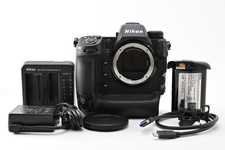
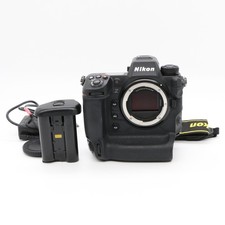
Compare · 2 products compared
Nikon Z8vsNikon Z9: Which Flagship Z Do You Need?
These two Nikon flagship mirrorless cameras share the same 45.7MP stacked full-frame sensor, the same 8K video toolkit and the same dust-and-drip-resistant build. The decision comes down to a smaller, cheaper body with faster electronic bursts versus a bigger, heavier one that trades frame rate for endurance and integrated controls.
eBay prices refresh hourly — check the listing before you buy. We may earn a commission.
- MOST WINS
 Nikon
NikonBest for Hybrid shooters who want fast bursts, compact size and the lower price
10of 11 specs better - Nikon
Best for Pros who need all-day battery life and a built-in vertical grip
1of 11 specs better
Biggest differences
Pre-burst capture duration
Nikon Z8 leads
300×
higher is better
- Nikon Z8300 s
- Nikon Z91 s
4K max frame rate (full width)
Nikon Z8 leads
4×
higher is better
- Nikon Z8120 fps
- Nikon Z930 fps
Continuous shooting (electronic)
Nikon Z8 leads
+50%
higher is better
- Nikon Z830 fps
- Nikon Z920 fps
Weight
Nikon Z8 leads
−32%
lower is better
- Nikon Z8910 g
- Nikon Z91,340 g
Features not all of them have
High resolution pixel-shift mode
- Nikon Z8✓
- Nikon Z9✕
Where each one wins
Nikon Z8
- Launch price
- High resolution pixel-shift mode
- Continuous shooting (electronic)
- Pre-burst capture duration
- 4K max frame rate (full width)
- Screen articulation
- Weight
- Width
- Height
- Depth
Nikon Z9
- In-body image stabilization
What both have
- Lens mountNikon Z
- Effective pixels45.7 MP
- Sensor formatFull-frame
- Native ISO maximum25,600 ISO
- Sensor typeStacked CMOS
- Max video resolution8K
- 4K max frame rate120 fps
- Video codecsH.264, HEVC, ProRes 422 HQ, ProRes RAW, N-RAW
- Raw video recordingInternal
- Video bit depth10 bit
- Log profile support✓
- Viewfinder resolution3.69 M dots
- Viewfinder magnification0.8 x
- Screen size3.2 in
- Rear screen resolution2.1 M dots
- Memory card slots2 slots
- Weather sealingDust and drip resistant
- USB charging & power delivery✓
- Minimum operating temperature-10 °C
- Headphone port✓
- HDMI port typeFull-size
Every spec
Red marks the better value in each row.
| Spec | Nikon Z8 | Nikon Z9 |
|---|---|---|
| Overview | ||
| Release date | 2023-05 | 2021-12 |
| Launch price | 3,999.95 USD | 5,500 USD |
| Lens mount | Nikon Z | Nikon Z |
| High resolution pixel-shift mode | Yes | No |
| Sensor & Image | ||
| Effective pixels | 45.7 MP | 45.7 MP |
| Sensor format | Full-frame | Full-frame |
| Native ISO maximum | 25,600 ISO | 25,600 ISO |
| In-body image stabilization | 5.5 stops1 | 6 stops2 |
| Sensor readout speed | Not published | Not published |
| Sensor type | Stacked CMOS | Stacked CMOS |
| Aspect ratios | 3:2, 1:1, 16:9 | — |
| Lens & Autofocus | ||
| Continuous shooting (mechanical) | Not published | Not published |
| Continuous shooting (electronic) | 30 fps3 | 20 fps |
| Max mechanical shutter speed | Not published | 32,000 1/s |
| Pre-burst capture duration | 300 s4 | 1 s5 |
| AF subject detection | Human, animal, bird, train, airplane, motorcycle, vehicle | Human, animal, bird, car, train, airplane, motorcycle |
| Video | ||
| Max video resolution | 8K | 8K |
| 4K max frame rate | 120 fps | 120 fps |
| Video codecs | H.264, HEVC, ProRes 422 HQ, ProRes RAW, N-RAW | H.264, HEVC, ProRes 422 HQ, ProRes RAW, N-RAW |
| 4K max frame rate (full width) | 120 fps | 30 fps |
| Raw video recording | Internal | Internal |
| Video bit depth | 10 bit | 10 bit |
| Log profile support | Yes | Yes |
| Video dynamic range (log) | Not published | Not published |
| Viewfinder & Screen | ||
| Viewfinder resolution | 3.69 M dots | 3.69 M dots |
| Viewfinder magnification | 0.8 x | 0.8 x |
| Screen size | 3.2 in | 3.2 in |
| Screen articulation | Multi-angle6 | Tilting |
| Rear screen resolution | 2.1 M dots | 2.1 M dots |
| Handling & Power | ||
| Battery life | Not published | 740 shots |
| Memory card slots | 2 slots | 2 slots |
| Weather sealing | Dust and drip resistant | Dust and drip resistant |
| Weight | 910 g | 1,340 g |
| Width | 144 mm | 149 mm |
| Height | 118.5 mm | 149.5 mm |
| Depth | 83 mm | 90.5 mm |
| USB charging & power delivery | Yes | Yes |
| Minimum operating temperature | -10 °C | -10 °C |
| Headphone port | Yes | Yes |
| HDMI port type | Full-size | Full-size |
Notes on 6 values — test conditions and caveats
- 1Nikon Z8, In-body image stabilization: The 6.0-stop figure applies only with Synchro VR-compatible Nikkor Z lenses; the standard body rating is 5.5 stops.
- 2Nikon Z9, In-body image stabilization: The 6.0-stop rating requires Synchro VR, combining in-body 5-axis VR with 2-axis lens VR on compatible lenses.
- 3Nikon Z8, Continuous shooting (electronic): Full-resolution JPEG bursts reach 30 fps; 14-bit RAW bursts top out at 20 fps.
- 4Nikon Z8, Pre-burst capture duration: The 300 s Pre-Release Capture buffer arrived with firmware 2.0; launch firmware allowed 30 s.
- 5Nikon Z9, Pre-burst capture duration: Pre-Release Capture is only available in the C30 and C120 high-speed frame capture modes.
- 6Nikon Z8, Screen articulation: Nikon's 4-axis monitor tilts both vertically and horizontally but does not swing out like a fully articulated screen.
Sensor and image quality
The two cameras use the same chip: a 45.7MP stacked full-frame sensor with a native top ISO of 25,600. Resolution and low-light ceiling are identical, so image quality is not the deciding factor.
The one capture-side extra is the Z8's high-resolution pixel-shift mode, which composites multiple frames into a far larger file for studio and product work. The Z9 has no such mode. If you shoot static subjects on a tripod, that tilts the choice toward the Z8.
Which is better for action and sports?
The Z8 fires full-resolution JPEG bursts at 30 fps, while the Z9 tops out at 20 fps. For a sprinter crossing the line or a bird taking off, that extra ten frames per second means more chances that the decisive moment is in the sequence.
The Z8 also holds a Pre-Release Capture buffer of up to 300 seconds, so frames are recorded before you press the shutter. The Z9's pre-burst is limited to one second and only works in its C30 and C120 high-speed capture modes. Both cameras detect people, animals and birds, but the Z8 adds a distinct vehicle category.
Video: 4K full-width frame rates
Both shoot 8K and record RAW internally with the same codec list and 10-bit depth. The break comes in full-width 4K: the Z8 reaches 120 fps at the full sensor width, while the Z9 manages 30 fps in that mode. Slow-motion 4K without a crop is the Z8's clear advantage.
If your work is mostly interviews, gimbal moves or narrative at normal frame rates, the two are equivalent on video. If you need high-speed 4K for sports or wildlife footage, the Z8 is the body to get.
Handling, size and battery
The Z9 weighs 1,340 g and stands 149.5 mm tall, because its vertical grip is built in. The Z8 is a much smaller 910 g and 118.5 mm tall, so it packs down more easily and balances better on a gimbal or when you carry it all day.
That compact body gives up published battery endurance: the Z9's rating reaches 740 shots, and Nikon does not publish a figure for the Z8. For a long wedding or a full day in the field on one cell, the Z9's grip and larger cell are the practical reason to carry the extra weight.
Screens and stabilization
Stabilization looks close on paper. The Z8's body rates at 5.5 stops; the Z9 reaches 6 stops, but only when Synchro VR pairs the in-body system with a compatible lens's optical VR. With an ordinary lens, both drop to body-only stabilization, so the gap is narrower than the headline numbers suggest.
The screens also differ in use. The Z8's multi-angle monitor tilts vertically and horizontally for low and overhead angles; the Z9's tilting screen handles the same vertical work but not the horizontal flip. Vloggers and anyone composing from odd angles will prefer the Z8's range.
The Verdict
Buy the Nikon Z8 if you want the same sensor and 8K video in a lighter, cheaper body with faster bursts, full-width 4K at 120 fps and a more flexible screen. Buy the Nikon Z9 if you need the published 740-shot battery endurance and a built-in vertical grip for long handheld days. Choose the Z8 for most stills and video work; choose the Z9 when battery life and integrated controls outweigh frame rate.
Where to buy
Nikon Z8
Best for Hybrid shooters who want fast bursts, compact size and the lower price
Nikon Z9
Best for Pros who need all-day battery life and a built-in vertical grip
FAQ
Do the Nikon Z8 and Z9 have the same sensor?
Yes. Both use a 45.7MP stacked full-frame CMOS sensor with a native maximum ISO of 25,600.
Which has better in-body stabilization?
The Z9 is rated at 6 stops, but that figure requires Synchro VR with a compatible lens; the Z8's body rating is 5.5 stops. Without a Synchro VR lens, the two are closer than the numbers imply.
Can both cameras record RAW video internally?
Yes. The Z8 and Z9 both record ProRes RAW and N-RAW internally, along with H.264, HEVC and ProRes 422 HQ.
Does the Z9 have a mechanical shutter?
No. Like the Z8, the Z9 is electronic-shutter only, so there is no mechanical shutter speed to compare.
Which is lighter to carry?
The Z8 at 910 g is substantially lighter than the Z9 at 1,340 g, and it is smaller in every dimension.
Spotted something wrong? Tap the next to any section or spec group to let us know. Every report is read.