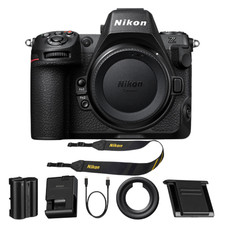
Compare · 2 products compared
Panasonic LUMIX S1IIvsNikon Z8: Which is Better?
These full-frame mirrorless cameras deliver advanced video codecs, internal raw recording, and dual memory card slots for demanding professionals. Choosing between them comes down to whether you prioritize Panasonic's lower launch price and stabilization or Nikon's higher sensor resolution and 8K video capture.
eBay prices refresh hourly — check the listing before you buy. We may earn a commission.

Best for Value-focused videographers and hybrid shooters needing strong stabilization
Wins8 / 18- MOST WINS

Best for Landscape and wildlife photographers requiring high-resolution sensors and 8K video
Wins10 / 18
Biggest differences
Pre-burst capture duration
Nikon Z8 leads
200×
higher is better
- Panasonic LUMIX S1II1.5 s
- Nikon Z8300 s
Continuous shooting (electronic)
Panasonic LUMIX S1II leads
2.33×
higher is better
- Panasonic LUMIX S1II70 fps
- Nikon Z830 fps
Effective pixels
Nikon Z8 leads
+90%
higher is better
- Panasonic LUMIX S1II24.1 MP
- Nikon Z845.7 MP
Viewfinder resolution
Panasonic LUMIX S1II leads
+56%
higher is better
- Panasonic LUMIX S1II5.76 M dots
- Nikon Z83.69 M dots
Where each one wins
Panasonic LUMIX S1II
- Launch price
- Native ISO maximum
- In-body image stabilization
- Continuous shooting (electronic)
- Viewfinder resolution
- Weight
- Width
- Height
Nikon Z8
- Effective pixels
- Sensor type
- Pre-burst capture duration
- Max video resolution
- 4K max frame rate (full width)
- Viewfinder magnification
- Screen size
- Screen articulation
- Rear screen resolution
- Depth
What both have
- High resolution pixel-shift mode✓
- Sensor formatFull-frame
- 4K max frame rate120 fps
- Raw video recordingInternal
- Video bit depth10 bit
- Log profile support✓
- Memory card slots2 slots
- Weather sealingDust and drip resistant
- USB charging & power delivery✓
- Minimum operating temperature-10 °C
- Headphone port✓
- HDMI port typeFull-size
Every spec
Red marks the better value in each row.
| Spec | Panasonic LUMIX S1II | Nikon Z8 |
|---|---|---|
| Overview | ||
| Release date | 2025-05 | 2023-05 |
| Launch price | 3,199 USD | 3,999.95 USD |
| Lens mount | L-Mount | Nikon Z |
| High resolution pixel-shift mode | Yes1 | Yes |
| Sensor & Image | ||
| Effective pixels | 24.1 MP | 45.7 MP |
| Sensor format | Full-frame | Full-frame |
| Native ISO maximum | 51,200 ISO | 25,600 ISO |
| In-body image stabilization | 8 stops | 5.5 stops2 |
| Sensor readout speed | 14.6 ms3 | Not published |
| Sensor type | Partially-stacked CMOS | Stacked CMOS |
| Aspect ratios | 3:2, 4:3, 1:1, 16:9, 2:1, 65:24 | 3:2, 1:1, 16:9 |
| Lens & Autofocus | ||
| Continuous shooting (mechanical) | 10 fps | Not published |
| Continuous shooting (electronic) | 70 fps | 30 fps4 |
| Max mechanical shutter speed | 8,000 1/s | Not published |
| Pre-burst capture duration | 1.5 s | 300 s5 |
| AF subject detection | Human, animal, car, train, airplane, motorcycle | Human, animal, bird, train, airplane, motorcycle, vehicle |
| Video | ||
| Max video resolution | 6K | 8K |
| 4K max frame rate | 120 fps6 | 120 fps |
| Video codecs | H.264, HEVC, ProRes 422, ProRes RAW | H.264, HEVC, ProRes 422 HQ, ProRes RAW, N-RAW |
| 4K max frame rate (full width) | 60 fps7 | 120 fps |
| Raw video recording | Internal | Internal |
| Video bit depth | 10 bit | 10 bit |
| Log profile support | Yes | Yes |
| Video dynamic range (log) | 15 stops | Not published |
| Viewfinder & Screen | ||
| Viewfinder resolution | 5.76 M dots | 3.69 M dots |
| Viewfinder magnification | 0.78 x | 0.8 x |
| Screen size | 3 in | 3.2 in |
| Screen articulation | Fully articulated | Multi-angle8 |
| Rear screen resolution | 1.84 M dots | 2.1 M dots |
| Handling & Power | ||
| Battery life | 360 shots | Not published |
| Memory card slots | 2 slots | 2 slots |
| Weather sealing | Dust and drip resistant | Dust and drip resistant |
| Weight | 800 g | 910 g |
| Width | 134 mm | 144 mm |
| Height | 102 mm | 118.5 mm |
| Depth | 92 mm | 83 mm |
| USB charging & power delivery | Yes | Yes |
| Minimum operating temperature | -10 °C | -10 °C |
| Headphone port | Yes | Yes |
| HDMI port type | Full-size | Full-size |
Notes on 8 values — test conditions and caveats
- 1Panasonic LUMIX S1II, High resolution pixel-shift mode: The full 96MP composite needs a tripod; handheld shooting caps at 48MP.
- 2Nikon Z8, In-body image stabilization: The 6.0-stop figure applies only with Synchro VR-compatible Nikkor Z lenses; the standard body rating is 5.5 stops.
- 3Panasonic LUMIX S1II, Sensor readout speed: Measured by DPReview using the electronic shutter in 14-bit stills mode.
- 4Nikon Z8, Continuous shooting (electronic): Full-resolution JPEG bursts reach 30 fps; 14-bit RAW bursts top out at 20 fps.
- 5Nikon Z8, Pre-burst capture duration: The 300 s Pre-Release Capture buffer arrived with firmware 2.0; launch firmware allowed 30 s.
- 6Panasonic LUMIX S1II, 4K max frame rate: Maximum 120 fps in 4K requires recording in MOV format at a 24.00Hz system frequency.
- 7Panasonic LUMIX S1II, 4K max frame rate (full width): 4K at 120fps requires an approximate 1.24x sensor crop; 60fps is the fastest at full sensor width.
- 8Nikon Z8, Screen articulation: Nikon's 4-axis monitor tilts both vertically and horizontally but does not swing out like a fully articulated screen.
Image Quality and Resolution
The Nikon Z8 wins for static detail with a 45.7 MP sensor that captures significantly more fine texture than the 24.1 MP Panasonic LUMIX S1II. Both bodies offer high-resolution pixel-shift modes for static subjects, though the Panasonic requires a tripod for its full 96MP output and caps handheld multi-shot composites at 48MP.
For low-light shooters, the LUMIX S1II provides a higher native ISO maximum of 51,200 compared to 25,600 on the Z8. However, the Nikon uses a stacked CMOS sensor design for faster performance, whereas the Panasonic employs a partially-stacked chip.
Video Capabilities
Nikon takes the lead in video resolution by offering 8K capture, while the Panasonic LUMIX S1II tops out at 6K. Both models support internal raw recording, 10-bit color depth, and log profiles across codecs like H.264, HEVC, and ProRes.
When shooting in 4K, the Z8 maintains full sensor width at 120 fps. The Panasonic also reaches 120 fps in 4K, but requires an approximate 1.24x sensor crop at that frame rate and needs specific system frequency settings in MOV format.
Speed and Autofocus
Action photographers benefit from the electronic shutter speeds of both bodies, with the LUMIX S1II reaching 70 fps compared to 30 fps on the Z8 for full-resolution JPEG bursts (though 14-bit RAW bursts on the Nikon top out at 20 fps). Pre-burst capture differs drastically, as the Z8 offers a 300 s pre-release buffer while the Panasonic provides 1.5 s.
Autofocus subject detection on both systems covers humans, animals, trains, airplanes, and motorcycles. The Nikon adds dedicated vehicle tracking, while the Panasonic includes specific animal and car recognition.
Handling and Stabilization
The Panasonic LUMIX S1II undercuts its rival on cost with a launch price of $3,199 compared to $3,999.95 for the Nikon Z8. It is also lighter at 800 g and built into a smaller body, while featuring a fully articulated screen versus the Nikon's tilting multi-angle monitor.
For handheld work, the LUMIX S1II provides 8 stops of in-body image stabilization. The Z8 is rated at 5.5 stops, though that figure reaches 6.0 stops when paired with Synchro VR-compatible Nikkor Z lenses.
The Verdict
Buy the Panasonic LUMIX S1II if you want superior image stabilization, faster electronic bursts, and a lower price tag. Buy the Nikon Z8 if you need maximum pixel count, 8K video recording, and a massive pre-burst buffer.
Where to buy
Panasonic LUMIX S1II
Best for Value-focused videographers and hybrid shooters needing strong stabilization
Nikon Z8
Best for Landscape and wildlife photographers requiring high-resolution sensors and 8K video
FAQ
What type of memory card slots do these cameras use?
Both the Panasonic LUMIX S1II and the Nikon Z8 feature two memory card slots.
Do both models offer weather sealing?
Yes, both cameras feature dust and drip resistant construction.
Can I charge these cameras via USB?
Yes, both support USB charging and power delivery.
What are the viewfinder resolutions?
The Panasonic LUMIX S1II has a 5.76 M dot viewfinder, while the Nikon Z8 uses a 3.69 M dot panel.
Spotted something wrong? Tap the next to any section or spec group to let us know. Every report is read.