Compare · 2 products compared
Insta360 Ace Pro 2vsDJI Osmo Pocket 4P: Action Cam or Gimbal?
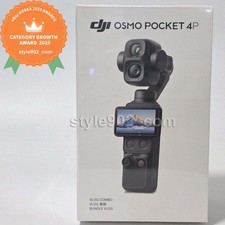
Both are pocket-size 4K-plus cameras with in-camera stabilization, single flip-style screens and no dedicated front display. The split is purpose: the Insta360 is a rugged waterproof action cam that shoots 8K, while the DJI is a gimbal-stabilized creator camera with a larger sensor and built-in storage. Pick by where and how you film.
eBay prices refresh hourly — check the listing before you buy. We may earn a commission.
 Insta360
Best for Action sports, water and cold-weather shooters who need 8K and high frame rates
9of 19 specs better- MOST WINSDJI
Best for Handheld creators shooting low light who want gimbal stability out of the box
10of 19 specs better
Biggest differences
Max digital zoom
DJI Osmo Pocket 4P leads
6×
higher is better
- Insta360 Ace Pro 22 x
- DJI Osmo Pocket 4P12 x
Max frame rate at 4K
Insta360 Ace Pro 2 leads
2×
higher is better
- Insta360 Ace Pro 2120 fps
- DJI Osmo Pocket 4P60 fps
Height
Insta360 Ace Pro 2 leads
2.97×
lower is better
- Insta360 Ace Pro 253.7 mm
- DJI Osmo Pocket 4P159.5 mm
Sensor size
DJI Osmo Pocket 4P leads
+30%
higher is better
- Insta360 Ace Pro 20.77 in
- DJI Osmo Pocket 4P1 in
Where each one wins
Insta360 Ace Pro 2
- Max video resolution
- Max frame rate at 4K
- Max photo resolution
- Rear screen size
- Weight
- Height
- Min operating temperature
- Max operating temperature
- Battery capacity
DJI Osmo Pocket 4P
- Sensor size
- Aperture
- Max digital zoom
- Rear screen brightness
- Width
- Depth
- Claimed max recording time
- Built-in storage
- Wi-Fi standard
- Live streaming resolution
What both have
- Max frame rate240 fps
- Max video bitrate180 Mbps
- RAW photos✓
- Image stabilizationIn-camera
- Front screen size0 in
- Rear touchscreen✓
- Memory card slot✓
- Max memory card size1,024 GB
Every spec
Red marks the better value in each row.
| Spec | Insta360 Ace Pro 2 | DJI Osmo Pocket 4P |
|---|---|---|
| Overview | ||
| Release date | 2024-10 | Not published |
| Launch price | 449 USD | Not published |
| Sensor & lens | ||
| Sensor size | 0.77 in | 1 in1 |
| Aperture | 2.6 f | 2 f2 |
| Field of view | 157 ° | Not published |
| Video | ||
| Max video resolution | 8K | 4K |
| Max frame rate at 4K | 120 fps | 60 fps |
| Max frame rate | 240 fps3 | 240 fps4 |
| Max video bitrate | 180 Mbps | 180 Mbps |
| Video codecs | H.264, HEVC | HEVC |
| Color bit depth | 8-bit | Not published |
| Log profile | Yes | Not published |
| HDR video | Yes | Not published |
| Time-lapse modes | Time-lapse, hyperlapse, night-lapse, star trails | Time-lapse, hyperlapse5 |
| Pre-recording | Yes6 | Not published |
| Max digital zoom | 2 x | 12 x7 |
| Photo | ||
| Max photo resolution | 50 MP | 37 MP |
| RAW photos | Yes | Yes |
| Stabilization | ||
| Image stabilization | In-camera | In-camera8 |
| Horizon lock | Yes | Not published |
| Screens | ||
| Rear screen size | 2.5 in | 2 in |
| Front screen size | 0 in | 0 in9 |
| Rear screen brightness | 900 nits | 1,000 nits |
| Rear touchscreen | Yes | Yes |
| Front touchscreen | No | No10 |
| Body & durability | ||
| Weight | 184 g | 230 g |
| Width | 73.2 mm | 63.3 mm11 |
| Height | 53.7 mm | 159.5 mm12 |
| Depth | 39.5 mm | 33.5 mm13 |
| Waterproof depth | 12 m | Not published |
| Waterproof depth with case | 60 m | Not published |
| Min operating temperature | -20 °C | 0 °C14 |
| Max operating temperature | 45 °C | 40 °C15 |
| Battery | ||
| Battery capacity | 1,800 mAh | 1,545 mAh |
| Claimed max recording time | 180 min16 | 210 min17 |
| Removable battery | Yes | Not published |
| Claimed recording time at 4K | Not published | Not published |
| Storage | ||
| Built-in storage | 0 GB | 103 GB |
| Memory card slot | Yes | Yes |
| Max memory card size | 1,024 GB | 1,024 GB18 |
| Connectivity | ||
| GPS | None | Not published |
| Wi-Fi standard | Wi-Fi 5 | Wi-Fi 6 |
| Live streaming resolution | None | 1080p |
| Audio | ||
| External microphone | Built-in | Not published |
Notes on 18 values — test conditions and caveats
- 1DJI Osmo Pocket 4P, Sensor size: Dual cameras: 1-inch wide-angle CMOS plus a 1/1.28-inch med-tele CMOS; figure given is the main wide sensor.
- 2DJI Osmo Pocket 4P, Aperture: The med-tele lens opens wider at f/1.8; f/2.0 is the main wide-angle lens.
- 3Insta360 Ace Pro 2, Max frame rate: 240 fps is only available in Slow Motion mode at 1080p.
- 4DJI Osmo Pocket 4P, Max frame rate: 240 fps is Slow Motion mode at 4K or 1080p; normal video tops out at 60 fps.
- 5DJI Osmo Pocket 4P, Time-lapse modes: Page also lists in-camera Hyperlapse and Motionlapse modes.
- 6Insta360 Ace Pro 2, Pre-recording: Pre-Recording is limited to 1440p or lower resolution.
- 7DJI Osmo Pocket 4P, Max digital zoom: Slow Motion and Timelapse support no digital zoom (1× or 3× optical focal lengths only).
- 8DJI Osmo Pocket 4P, Image stabilization: Three-axis mechanical gimbal stabilizes footage in camera while recording.
- 9DJI Osmo Pocket 4P, Front screen size: No dedicated front screen; the single 2-inch flip touchscreen serves both front and rear use.
- 10DJI Osmo Pocket 4P, Front touchscreen: No dedicated front screen; the one 2-inch flip touchscreen is the only display.
- 11DJI Osmo Pocket 4P, Width: From DJI's L×W×H listing; W (63.3 mm) is the left-to-right width.
- 12DJI Osmo Pocket 4P, Height: From DJI's L×W×H listing; L (159.5 mm) is the bottom-to-top height.
- 13DJI Osmo Pocket 4P, Depth: From DJI's L×W×H listing; H (33.5 mm) is the front-to-back depth.
- 14DJI Osmo Pocket 4P, Min operating temperature: Listed in the Battery section; battery is built in, so the range covers the camera.
- 15DJI Osmo Pocket 4P, Max operating temperature: Listed in the Battery section; battery is built in, so the range covers the camera.
- 16Insta360 Ace Pro 2, Claimed max recording time: 180 min is claimed for 1080p24 in Endurance Mode, not for 4K.
- 17DJI Osmo Pocket 4P, Claimed max recording time: Tested at 1080p/24 with Wi-Fi and screen off; real-world runtime will be lower.
- 18DJI Osmo Pocket 4P, Max memory card size: microSD cards up to 1 TB (1024 GB) are supported.
Resolution and frame rates
The Ace Pro 2 tops out at 8K and can run 4K at 120 fps, double the DJI's 4K ceiling of 60 fps. That matters if you want to crop into a wide shot in the edit, punch out slow motion from 4K footage, or deliver to a platform that rewards high-resolution uploads. It is the more flexible camera for shooters who treat footage as raw material.
The DJI matches 240 fps, but only in Slow Motion mode at 4K or 1080p, and normal video stops at 60 fps. Its 240 fps is a creative preset rather than a general capture mode. If you just want clean 4K60 with a reliable look straight out of camera, the DJI is not the weaker choice — it is simply the less granular one.
Sensor, aperture and low light
The Osmo Pocket 4P's 1-inch wide-angle sensor and f/2.0 main lens gather more light per pixel than the Ace Pro 2's 0.77-inch sensor at f/2.6. In dim rooms, at dusk or indoors without lights, that usually means cleaner shadows and less noise without leaning on noise reduction that smears detail. The DJI also carries a second 1/1.28-inch med-tele CMOS with an f/1.8 lens, so you get a tighter focal length without digital cropping.
Both shoot 180 Mbps, so the bitrate advantage goes nowhere — the light-gathering gap is the real story. For night footage, the DJI is the better starting point; the Insta360 has to work harder to match it.
Stabilization and zoom
The DJI stabilizes with a three-axis mechanical gimbal inside the camera. That is a physical system, and it shows in walking shots and slow pans where electronic stabilization tends to wobble or crop. It also reaches 12x digital zoom, though Slow Motion and Timelapse ignore zoom entirely and stick to 1x or the 3x optical length.
The Ace Pro 2 stabilizes in-camera electronically, with horizon lock, and stops at 2x digital zoom. The trade is durability versus smoothness: the Insta360 has no moving parts to protect, but the DJI's gimbal is the reason its handheld footage looks the way it does. Nothing here says the DJI survives a fall; nothing here says the Insta360 is as steady.
Battery, storage and size
The Osmo Pocket 4P ships with 103 GB of built-in storage, and both cameras take a microSD card up to 1,024 GB. For a buyer, free internal memory means you can shoot the day you unbox it without buying a card first, and it acts as overflow when your card fills mid-trip.
The DJI also claims longer runtime — 210 minutes, tested at 1080p24 with Wi-Fi and screen off — against the Insta360's 180 minutes at 1080p24 in Endurance Mode, and neither maker publishes a 4K figure. Treat both numbers as best cases. The Ace Pro 2 is lighter at 184 g, has a bigger 2.5-inch rear screen and a removable battery, so a spare cell extends a shoot day — the DJI is a taller 230 g rig with a battery you cannot swap.
Which is best for sports and water?
The Ace Pro 2 wins this outright on paper. It is waterproof to 12 m without a housing and 60 m in the maker's case, rated from -20 °C to 45 °C, and it has a 157° field of view for mounting on a helmet or bar. That is a camera built to be strapped to something moving and occasionally submerged.
The Osmo Pocket 4P publishes no waterproof rating, no minimum operating temperature below freezing, and no field of view, and its stated battery range starts at 0 °C. Its 63.3 mm width and folding gimbal make it a handheld tool, not a mount-and-forget one. If your plans involve surf, snow or rain, the decision is already made.
The Verdict
Buy the Insta360 Ace Pro 2 if you film sports, water or cold weather and want 8K and 4K120 for cropping. Buy the DJI Osmo Pocket 4P if you film handheld in low light and want gimbal-smooth footage and 103 GB of built-in storage. Choose the DJI for night and interiors, and the Insta360 for anything that gets wet or gets strapped to you.
Where to buy
Insta360 Ace Pro 2
Best for Action sports, water and cold-weather shooters who need 8K and high frame rates
DJI Osmo Pocket 4P
Best for Handheld creators shooting low light who want gimbal stability out of the box
FAQ
Does the DJI Osmo Pocket 4P have a front screen?
No. It has a single 2-inch flip touchscreen that serves both front and rear use, and the Insta360 Ace Pro 2 likewise has no dedicated front screen — its display is a 2.5-inch flip touchscreen.
Can the Insta360 Ace Pro 2 record before you press the button?
Yes, it has pre-recording, though it is limited to 1440p or lower resolution. DJI does not publish a pre-recording spec for the Osmo Pocket 4P.
Which one has a bigger screen?
The Insta360 Ace Pro 2, at 2.5 inches versus 2 inches on the DJI. The DJI's screen is the brighter of the two at 1,000 nits against 900 nits, which helps in direct sun.
Do both cameras support memory cards?
Yes, both accept microSD cards up to 1,024 GB. The DJI Osmo Pocket 4P additionally has 103 GB of built-in storage, while the Insta360 Ace Pro 2 has none, so the Insta360 needs a card before you shoot.
Which is lighter to wear or mount?
The Insta360 Ace Pro 2 at 184 g, against 230 g for the DJI Osmo Pocket 4P. The DJI is also noticeably taller at 159.5 mm, which changes how it sits on a helmet or harness.
Spotted something wrong? Tap the next to any section or spec group to let us know. Every report is read.