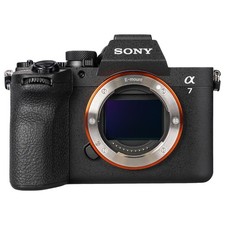
Compare · 2 products compared
Sony a7 VvsCanon EOS R50: Full-FramevsEntry-Level
These mirrorless cameras share 4K resolution and interchangeable lens designs. They differ fundamentally in format, pricing, and capability, dividing the choice between professional full-frame performance and entry-level portability.
eBay prices refresh hourly — check the listing before you buy. We may earn a commission.
- MOST WINS

Best for Professional creators needing full-frame performance and advanced video.
Wins20 / 27 
Best for Beginners seeking a lightweight, budget-friendly everyday camera.
Wins7 / 27
Biggest differences
Launch price
Canon EOS R50 leads
4.26×
lower is better
- Sony a7 V2,899 USD
- Canon EOS R50679.99 USD
Continuous shooting (electronic)
Sony a7 V leads
2×
higher is better
- Sony a7 V30 fps
- Canon EOS R5015 fps
4K max frame rate
Sony a7 V leads
4×
higher is better
- Sony a7 V119.88 fps
- Canon EOS R5029.97 fps
Memory card slots
Sony a7 V leads
2×
higher is better
- Sony a7 V2 slots
- Canon EOS R501 slots
Features not all of them have
Log profile support
- Sony a7 V✓
- Canon EOS R50✕
Headphone port
- Sony a7 V✓
- Canon EOS R50✕
Where each one wins
Sony a7 V
- Effective pixels
- Sensor format
- Native ISO maximum
- In-body image stabilization
- Sensor type
- Continuous shooting (electronic)
- Max mechanical shutter speed
- Pre-burst capture duration
- 4K max frame rate
- 4K max frame rate (full width)
- Log profile support
- Viewfinder resolution
- Screen size
- Screen articulation
- Rear screen resolution
- Battery life
- Memory card slots
- Weather sealing
- Headphone port
- HDMI port type
Canon EOS R50
- Launch price
- Continuous shooting (mechanical)
- Viewfinder magnification
- Weight
- Width
- Height
- Depth
What both have
- Aspect ratios3:2, 4:3, 1:1, 16:9
- Max video resolution4K
- Video codecsH.264, HEVC
- Raw video recordingNone
- Video bit depth10 bit
- USB charging & power delivery✓
- Minimum operating temperature0 °C
Every spec
Red marks the better value in each row.
| Spec | Sony a7 V | Canon EOS R50 |
|---|---|---|
| Overview | ||
| Release date | 2025-12 | Not published |
| Launch price | 2,899 USD | 679.99 USD1 |
| Lens mount | Sony E | Canon RF |
| High resolution pixel-shift mode | No2 | Not published |
| Sensor & Image | ||
| Effective pixels | 33 MP | 24.2 MP |
| Sensor format | Full-frame | APS-C |
| Native ISO maximum | 51,200 ISO3 | 32,000 ISO |
| In-body image stabilization | 7.5 stops4 | 0 stops5 |
| Sensor readout speed | 15 ms | Not published |
| Sensor type | Partially-stacked CMOS | CMOS |
| Aspect ratios | 3:2, 4:3, 1:1, 16:9 | 3:2, 4:3, 1:1, 16:9 |
| Lens & Autofocus | ||
| Continuous shooting (mechanical) | 10 fps6 | 12 fps |
| Continuous shooting (electronic) | 30 fps7 | 15 fps |
| Max mechanical shutter speed | 8,000 1/s | 4,000 1/s |
| Pre-burst capture duration | 1 s | 0 s8 |
| AF subject detection | Human, animal, bird, insect, car, train, airplane | Human, animal, bird, vehicle |
| Video | ||
| Max video resolution | 4K | 4K |
| 4K max frame rate | 119.88 fps9 | 29.97 fps |
| Video codecs | H.264, HEVC | H.264, HEVC |
| 4K max frame rate (full width) | 60 fps10 | 29.97 fps |
| Raw video recording | None | None11 |
| Video bit depth | 10 bit | 10 bit12 |
| Log profile support | Yes | No13 |
| Video dynamic range (log) | Not published | Not published |
| Viewfinder & Screen | ||
| Viewfinder resolution | 3.69 M dots | 2.36 M dots |
| Viewfinder magnification | 0.78 x14 | 0.95 x |
| Screen size | 3.2 in | 2.95 in |
| Screen articulation | Multi-angle | Fully articulated |
| Rear screen resolution | 2.1 M dots | 1.62 M dots |
| Handling & Power | ||
| Battery life | 750 shots15 | 440 shots16 |
| Memory card slots | 2 slots | 1 slots |
| Weather sealing | Dust and drip resistant | None17 |
| Weight | 695 g | 375 g18 |
| Width | 130.3 mm | 116.3 mm |
| Height | 96.4 mm | 85.5 mm |
| Depth | 72.3 mm19 | 68.8 mm |
| USB charging & power delivery | Yes | Yes20 |
| Minimum operating temperature | 0 °C | 0 °C21 |
| Headphone port | Yes | No22 |
| HDMI port type | Full-size | Micro |
Notes on 22 values — test conditions and caveats
- 1Canon EOS R50, Launch price: US RRP at launch as listed by Trusted Reviews; the page does not state whether it is body-only.
- 2Sony a7 V, High resolution pixel-shift mode: No in-camera pixel shift; Sony's Extended Hi-Res merges burst frames later in its desktop software.
- 3Sony a7 V, Native ISO maximum: Refers to standard still image shooting prior to ISO expansion.
- 4Sony a7 V, In-body image stabilization: Measured at the center with an FE 50mm F1.2 GM lens mounted per CIPA 2024 standards with long exposure NR off.
- 5Canon EOS R50, In-body image stabilization: No in-body stabilisation; shake control relies on lens IS or Movie Digital IS.
- 6Sony a7 V, Continuous shooting (mechanical): Maximum continuous shooting speed achieved using mechanical shutter in Hi+ mode.
- 7Sony a7 V, Continuous shooting (electronic): Maximum continuous shooting speed achieved using electronic shutter in Hi+ mode.
- 8Canon EOS R50, Pre-burst capture duration: No pre-capture mode appears anywhere in Canon's official R50 specifications, so it is treated as absent.
- 9Sony a7 V, 4K max frame rate: Maximum 4K frame rate is available in XAVC HS 4K 4:2:0 10-bit mode.
- 10Sony a7 V, 4K max frame rate (full width): 4K 120p needs an APS-C/Super 35 crop; the full sensor width tops out at 4K 60p.
- 11Canon EOS R50, Raw video recording: Canon lists only MP4 recording with H.264 or HEVC; no raw video is offered internally or externally.
- 12Canon EOS R50, Video bit depth: Standard Rec.709 recording is 8-bit; 10-bit output requires HDR PQ to be switched on.
- 13Canon EOS R50, Log profile support: No Canon Log profile; HDR PQ (a PQ gamma curve) is available instead, which is not a log curve.
- 14Sony a7 V, Viewfinder magnification: Measured with a 50mm lens focused at infinity at -1 m⁻¹.
- 15Sony a7 V, Battery life: Measured using the LCD monitor under standard CIPA test conditions.
- 16Canon EOS R50, Battery life: CIPA test with the supplied LP-E17 in power-saving mode; viewfinder shooting is rated at about 310 shots.
- 17Canon EOS R50, Weather sealing: Canon's own spec sheet also lists water/dust resistance as not provided, so treat the body as unsealed.
- 18Canon EOS R50, Weight: Black body with battery and card per CIPA; the white version is 376 g with battery and card.
- 19Sony a7 V, Depth: Overall maximum depth including the viewfinder eyepiece is 82.4 mm.
- 20Canon EOS R50, USB charging & power delivery: USB-C charging works with the supplied LP-E17; unauthenticated third-party batteries may not charge.
- 21Canon EOS R50, Minimum operating temperature: Rated operating range is 0–40 °C at up to 85% humidity.
- 22Canon EOS R50, Headphone port: Canon's full port list covers USB-C, mic-in, HDMI micro and the shoe only — no headphone jack.
Image Quality and Stabilization
The Sony delivers a larger full-frame sensor format with 33 MP for sharper details and better low-light handling under its 51,200 ISO limit. It also provides 7.5 stops of in-body image stabilization to steady handheld shots.
By comparison, the Canon relies on a smaller APS-C sensor with 24.2 MP and lacks in-body stabilization entirely, requiring lens IS or digital stabilization instead.
Video and Performance
Video creators benefit from the Sony because it shoots up to 119.88 fps in 4K and includes professional log profile support. It also features dual card slots for backup storage and a full-size HDMI port.
The Canon caps its 4K video at 29.97 fps, lacks a log profile, and uses a single card slot with a micro HDMI port, making it much more suited for casual casual recording.
Handling and Portability
For travel and lightweight carry, the Canon wins significantly by weighing only 375 g and offering a much slimmer body width of 116.3 mm. It also launches at an affordable price of $679.99.
On the other hand, the Sony weighs 695 g and costs $2,899, but rewards that heavier investment with robust weather sealing, a much larger 3.2-inch screen, and a durable 750-shot battery life.
The Verdict
Buy the Sony a7 V if you need professional full-frame quality, dual card slots, advanced video framerates, and reliable weather sealing. Buy the Canon EOS R50 if you want an ultra-lightweight, budget-friendly setup for casual photography and basic video.
Where to buy
Sony a7 V
Best for Professional creators needing full-frame performance and advanced video.
Canon EOS R50
Best for Beginners seeking a lightweight, budget-friendly everyday camera.
FAQ
Does either camera feature a built-in flash?
Neither camera includes a built-in flash in the provided specifications.
Can I charge both cameras via USB?
Yes, both models support USB charging and power delivery.
What kind of lenses do these cameras use?
The Sony uses the Sony E lens mount, while the Canon uses the Canon RF lens mount.
Spotted something wrong? Tap the next to any section or spec group to let us know. Every report is read.