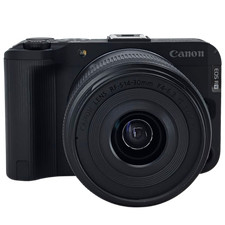
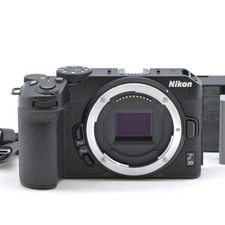
Compare · 2 products compared
Canon EOS R50 VvsNikon Z 30: Which APS-C Camera Wins?
The Canon EOS R50 V and Nikon Z 30 are mirrorless APS-C cameras built for content creators. They share identical 3-inch fully articulated touchscreens and lack built-in electronic viewfinders. The choice between them comes down to video capability, autofocus tracking, and body dimensions.
eBay prices refresh hourly — check the listing before you buy. We may earn a commission.
- MOST WINS
 Canon
CanonBest for Creators prioritizing advanced video tools, higher resolution, and longer battery life
7of 11 specs better - Nikon
Best for Shooters wanting uncropped 4K 30p video and a mini HDMI connection
4of 11 specs better
Biggest differences
4K max frame rate
Canon EOS R50 V leads
2×
higher is better
- Canon EOS R50 V59.94 fps
- Nikon Z 3030 fps
Battery life
Canon EOS R50 V leads
+45%
higher is better
- Canon EOS R50 V480 shots
- Nikon Z 30330 shots
Native ISO maximum
Nikon Z 30 leads
+60%
higher is better
- Canon EOS R50 V32,000 ISO
- Nikon Z 3051,200 ISO
Depth
Canon EOS R50 V leads
−24%
lower is better
- Canon EOS R50 V45.2 mm
- Nikon Z 3059.5 mm
Where each one wins
Canon EOS R50 V
- Effective pixels
- Continuous shooting (mechanical)
- 4K max frame rate
- Battery life
- Weight
- Width
- Depth
Nikon Z 30
- Native ISO maximum
- 4K max frame rate (full width)
- Height
- HDMI port type
What both have
- Sensor formatAPS-C
- Sensor typeCMOS
- Max mechanical shutter speed4,000 1/s
- Max video resolution4K
- Viewfinder resolution0 M dots
- Screen size3 in
- Screen articulationFully articulated
- Rear screen resolution1.04 M dots
- Memory card slots1 slots
- USB charging & power delivery✓
- Minimum operating temperature0 °C
Every spec
Red marks the better value in each row.
| Spec | Canon EOS R50 V | Nikon Z 30 |
|---|---|---|
| Overview | ||
| Release date | 2025-04 | Not published |
| Launch price | 649 USD | Not published |
| Lens mount | Canon RF | Nikon Z |
| High resolution pixel-shift mode | Not published | Not published |
| Sensor & Image | ||
| Effective pixels | 24.2 MP | 20.9 MP |
| Sensor format | APS-C | APS-C1 |
| Native ISO maximum | 32,000 ISO | 51,200 ISO2 |
| In-body image stabilization | Not published | Not published |
| Sensor readout speed | Not published | Not published |
| Sensor type | CMOS | CMOS |
| Aspect ratios | 3:2, 4:3, 1:1, 16:9 | 3:2, 1:1, 16:93 |
| Lens & Autofocus | ||
| Continuous shooting (mechanical) | 12 fps | 11 fps4 |
| Continuous shooting (electronic) | 15 fps | Not published |
| Max mechanical shutter speed | 4,000 1/s | 4,000 1/s |
| Pre-burst capture duration | Not published | Not published |
| AF subject detection | Human, animal, vehicle | — |
| Video | ||
| Max video resolution | 4K | 4K |
| 4K max frame rate | 59.94 fps | 30 fps |
| Video codecs | H.264, HEVC, XF-AVC, XF-HEVC | H.264 |
| 4K max frame rate (full width) | 29.97 fps5 | 30 fps |
| Raw video recording | Not published | Not published |
| Video bit depth | 10 bit | Not published |
| Log profile support | Yes | Not published |
| Video dynamic range (log) | Not published | Not published |
| Viewfinder & Screen | ||
| Viewfinder resolution | 0 M dots6 | 0 M dots7 |
| Viewfinder magnification | Not published | Not published |
| Screen size | 3 in | 3 in |
| Screen articulation | Fully articulated | Fully articulated |
| Rear screen resolution | 1.04 M dots | 1.04 M dots |
| Handling & Power | ||
| Battery life | 480 shots8 | 330 shots9 |
| Memory card slots | 1 slots | 1 slots |
| Weather sealing | None | Not published |
| Weight | 370 g | 405 g |
| Width | 119.3 mm | 128 mm |
| Height | 73.7 mm | 73.5 mm |
| Depth | 45.2 mm | 59.5 mm |
| USB charging & power delivery | Yes10 | Yes11 |
| Minimum operating temperature | 0 °C | 0 °C |
| Headphone port | Yes | Not published |
| HDMI port type | Micro | Mini |
Notes on 11 values — test conditions and caveats
- 1Nikon Z 30, Sensor format: DX format is Nikon's name for its APS-C-size sensor (23.5 x 15.7 mm).
- 2Nikon Z 30, Native ISO maximum: Settings above ISO 51200 (102400, 204800) are expanded, not native.
- 3Nikon Z 30, Aspect ratios: Native DX ratio is 3:2; 1:1 and 16:9 are in-camera crop modes.
- 4Nikon Z 30, Continuous shooting (mechanical): Nikon's in-house measured maximum; the rate is approximate.
- 5Canon EOS R50 V, 4K max frame rate (full width): Full-width 4K tops out at 29.97 fps; 4K 50p/60p uses a crop to 64% of the sensor's horizontal area.
- 6Canon EOS R50 V, Viewfinder resolution: The EOS R50 V has no built-in electronic viewfinder; framing is done on the rear screen only.
- 7Nikon Z 30, Viewfinder resolution: The Z 30 has no electronic viewfinder; compose on the rear LCD.
- 8Canon EOS R50 V, Battery life: Canon's CIPA rating uses the supplied LP-E17 battery with the LCD in power-saving mode.
- 9Nikon Z 30, Battery life: Figure is for the EN-EL25 battery; shot count differs with EN-EL25a.
- 10Canon EOS R50 V, USB charging & power delivery: USB charging requires a genuine (authenticated) Canon battery; unauthenticated batteries will not charge over USB.
- 11Nikon Z 30, USB charging & power delivery: In-camera USB charging/power needs Nikon's optional EH-7P or EH-8P adapter.
Video and Features
The Canon EOS R50 V outpaces its rival for video work by supporting 10-bit color, Log profile recording, and codecs including XF-AVC and HEVC. It shoots 4K video at up to 59.94 fps, though full-width 4K tops out at 29.97 fps and higher frame rates apply a 64% crop. The Nikon Z 30 stays at 8-bit H.264 video with a steady 30 fps in 4K across the entire sensor.
For audio monitoring, the Canon includes a dedicated headphone port, while the Nikon omits one entirely. Both cameras feature a micro HDMI port on the Canon and a mini HDMI connection on the Nikon.
Speed and Autofocus
Action shooters will find the Canon EOS R50 V more capable thanks to its advanced subject detection for humans, animals, and vehicles, a feature completely missing on the Nikon Z 30. The Canon also wins on burst rates, offering 15 fps electronic and 12 fps mechanical shooting compared to the Nikon's 11 fps mechanical maximum.
Both models share a maximum mechanical shutter speed of 1/4,000s and rely entirely on electronic stabilization, as neither body includes built-in sensor shift. Image resolution favors the Canon slightly with 24.2 megapixels against the Nikon's 20.9 megapixels.
Battery and Handling
The Canon EOS R50 V is notably more compact, measuring 119.3 mm wide, 45.2 mm deep, and weighing 370 g. The Nikon Z 30 is larger at 128 mm wide and 59.5 mm deep, carrying a heavier 405 g frame while offering a slightly shorter body height.
Battery endurance heavily favors the Canon, delivering 480 shots per CIPA rating in power-saving mode compared to the Nikon's 330 shots. Both cameras include a single card slot and support USB power delivery, though the Canon requires an authenticated battery to charge over USB while the Nikon needs an optional EH-7P or EH-8P adapter.
The Verdict
Buy the Canon EOS R50 V if you need advanced video codecs, 10-bit Log recording, a headphone jack, and superior subject tracking. Buy the Nikon Z 30 if you prefer uncropped 4K video at 30 fps and a mini HDMI port.
Where to buy
Canon EOS R50 V
Best for Creators prioritizing advanced video tools, higher resolution, and longer battery life
Nikon Z 30
Best for Shooters wanting uncropped 4K 30p video and a mini HDMI connection
FAQ
Do these cameras have a built-in electronic viewfinder?
No, neither camera includes an electronic viewfinder, so framing must be done entirely on the rear screen.
Can I charge these cameras via USB while traveling?
Yes, both support USB charging and power delivery, but the Canon requires a genuine battery while the Nikon requires a specific optional adapter.
What is the maximum ISO for each camera?
The Canon EOS R50 V reaches a native ISO maximum of 32,000, while the Nikon Z 30 reaches a native maximum of 51,200.
Do either of these cameras feature weather sealing?
The Canon EOS R50 V has no weather sealing, and weather sealing is not published for the Nikon Z 30.
Spotted something wrong? Tap the next to any section or spec group to let us know. Every report is read.