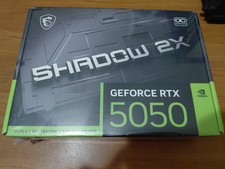
Compare · 2 products compared
NVIDIA GeForce RTX 5050vsNVIDIA GeForce RTX 4060 Ti 8GB: Which to Buy
The NVIDIA GeForce RTX 5050 and the NVIDIA GeForce RTX 4060 Ti 8GB share identical video memory capacity and bus widths. Choosing between them comes down to generational architectural updates, pricing, and raw compute capability.
eBay prices refresh hourly — check the listing before you buy. We may earn a commission.
- MOST WINS
 NVIDIA
Best for Budget-conscious builders wanting lower power draw and modern display outputs
8of 11 specs better - NVIDIA
NVIDIA GeForce RTX 4060 Ti 8GB
Best for Users needing higher raw compute performance and more CUDA cores
3of 11 specs better
Biggest differences
Shader cores
NVIDIA GeForce RTX 4060 Ti 8GB leads
+70%
higher is better
- NVIDIA GeForce RTX 50502,560 cores
- NVIDIA GeForce RTX 4060 Ti 8GB4,352 cores
Launch price
NVIDIA GeForce RTX 5050 leads
−38%
lower is better
- NVIDIA GeForce RTX 5050249 USD
- NVIDIA GeForce RTX 4060 Ti 8GB399 USD
HDMI outputs
NVIDIA GeForce RTX 4060 Ti 8GB leads
2×
higher is better
- NVIDIA GeForce RTX 50501 ports
- NVIDIA GeForce RTX 4060 Ti 8GB2 ports
FP32 compute
NVIDIA GeForce RTX 4060 Ti 8GB leads
+67%
higher is better
- NVIDIA GeForce RTX 505013.2 TFLOPS
- NVIDIA GeForce RTX 4060 Ti 8GB22 TFLOPS
Where each one wins
NVIDIA GeForce RTX 5050
- Launch price
- Boost clock
- Memory bandwidth
- Memory speed
- Board power
- PCIe version
- HDMI version
- DisplayPort version
NVIDIA GeForce RTX 4060 Ti 8GB
- Shader cores
- FP32 compute
- HDMI outputs
What both have
- Base clock2,310 MHz
- Video memory8 GB
- Memory typeGddr6
- Memory bus width128 bit
- Recommended PSU550 W
- PCIe lanes8 lanes
- DisplayPort outputs3 ports
- Max displays4 displays
- Hardware encodeAV1
- Video encoders1 encoders
Every spec
Red marks the better value in each row.
| Spec | NVIDIA GeForce RTX 5050 | NVIDIA GeForce RTX 4060 Ti 8GB |
|---|---|---|
| Overview | ||
| Release date | 2025-07 | 2023-05 |
| Launch price | 249 USD | 399 USD |
| Graphics chip | ||
| Architecture | Blackwell | Ada lovelace |
| Shader cores | 2,560 cores | 4,352 cores |
| Boost clock | 2,570 MHz | 2,540 MHz |
| Base clock | 2,310 MHz | 2,310 MHz |
| FP32 compute | 13.2 TFLOPS | 22 TFLOPS |
| Memory | ||
| Video memory | 8 GB | 8 GB |
| Memory type | Gddr6 | Gddr6 |
| Memory bus width | 128 bit | 128 bit |
| Memory bandwidth | 320 GB/s | 288 GB/s |
| Memory speed | 20 Gbps | 18 Gbps |
| Last-level cache | Not published | 32 MB |
| Power | ||
| Board power | 130 W | 160 W1 |
| Recommended PSU | 550 W2 | 550 W3 |
| Power connectors | 8-pin4 | 12V-2x65 |
| Interface | ||
| PCIe version | 5.0 | 4.0 |
| PCIe lanes | 8 lanes | 8 lanes |
| Display outputs | ||
| HDMI version | 2.1b | 2.1a |
| DisplayPort version | 2.1b6 | 1.4a |
| HDMI outputs | 1 ports | 2 ports |
| DisplayPort outputs | 3 ports | 3 ports |
| Max displays | 4 displays | 4 displays |
| Video engine | ||
| Hardware encode | AV1 | AV1 |
| Video encoders | 1 encoders | 1 encoders |
| Size | ||
| Card length | Not published | 244 mm7 |
| Card height | Not published | 112 mm8 |
| Slot width | Not published | 2 slots |
Notes on 8 values — test conditions and caveats
- 1NVIDIA GeForce RTX 4060 Ti 8GB, Board power: NVIDIA's table shows 165 or 160 W for RTX 4060 Ti; Tom's and TechSpot list 160 W for the 8GB model.
- 2NVIDIA GeForce RTX 5050, Recommended PSU: NVIDIA's 550 W minimum assumes a Ryzen 9 9950X system; requirements vary with your configuration.
- 3NVIDIA GeForce RTX 4060 Ti 8GB, Recommended PSU: NVIDIA's 550 W minimum assumes a Ryzen 9 5900X-class system; your build may need more.
- 4NVIDIA GeForce RTX 5050, Power connectors: Native input is one 8-pin; NVIDIA's 300 W+ PCIe Gen 5 PSU-cable option works via the in-box adapter.
- 5NVIDIA GeForce RTX 4060 Ti 8GB, Power connectors: The card takes a 16-pin connector; NVIDIA includes an 8-pin PCIe adapter in the box.
- 6NVIDIA GeForce RTX 5050, DisplayPort version: NVIDIA specifies UHBR20 on these DisplayPort 2.1b outputs.
- 7NVIDIA GeForce RTX 4060 Ti 8GB, Card length: Founders Edition length; partner cards vary by manufacturer.
- 8NVIDIA GeForce RTX 4060 Ti 8GB, Card height: NVIDIA labels this 'Width' (slot edge to card top); its clearance text cites 98 mm for the card.
Performance and Architecture
The RTX 4060 Ti 8GB features more shader cores and higher FP32 compute capability, reaching 22 TFLOPS compared to the 13.2 TFLOPS of the RTX 5050. This gives the older card an advantage in heavy computational workloads.
However, the RTX 5050 runs on the Blackwell architecture and achieves a slightly higher boost clock of 2,570 MHz, along with faster memory speed at 20 Gbps and higher memory bandwidth at 320 GB/s. Buyers prioritizing raw compute throughput will lean toward the older model, while newer architectural features benefit the RTX 5050.
Power and Efficiency
The RTX 5050 requires less energy, operating at a board power of 130 W compared to the 160 W draw of the RTX 4060 Ti 8GB. Both cards call for a 550 W minimum power supply unit, though system requirements vary depending on your specific hardware configuration.
For power connectors, the RTX 5050 utilizes a standard 8-pin input, whereas the RTX 4060 Ti 8GB employs a 16-bit 12V-2x6 connector that includes an 8-pin adapter in the box. Lower power consumption makes the RTX 5050 easier to integrate into tighter systems.
Connectivity and Interface
The RTX 5050 adopts the newer PCIe 5.0 interface, doubling the version standard found on the PCIe 4.0 RTX 4060 Ti 8GB, though both cards restrict themselves to 8 lanes. Display output configurations also favor the newer card with DisplayPort 2.1b and HDMI 2.1b support.
The RTX 4060 Ti 8GB counters with two HDMI ports instead of the single port on the RTX 5050, while both models provide three DisplayPort outputs and support up to 4 displays simultaneously.
The Verdict
Buy the RTX 5050 if you want lower power consumption, a modern PCIe 5.0 interface, and DisplayPort 2.1b connections at a lower launch price of $249. Buy the RTX 4060 Ti 8GB if you need higher raw FP32 compute performance and more shader cores for demanding tasks.
Where to buy
NVIDIA GeForce RTX 5050
Best for Budget-conscious builders wanting lower power draw and modern display outputs
NVIDIA GeForce RTX 4060 Ti 8GB
Best for Users needing higher raw compute performance and more CUDA cores
FAQ
Do both graphics cards support AV1 hardware encoding?
Yes, both the RTX 5050 and the RTX 4060 Ti 8GB feature hardware encode support for AV1 with a single encoder.
What type of video memory do these graphics cards use?
Both models are equipped with 8 GB of GDDR6 memory across a 128-bit memory bus width.
How many total displays can be connected to each card?
Both graphics cards support a maximum of 4 displays simultaneously.
Spotted something wrong? Tap the next to any section or spec group to let us know. Every report is read.