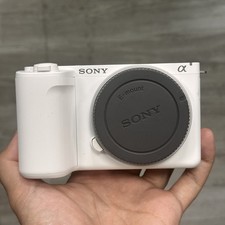
Compare · 2 products compared
Sony ZV-E10 IIvsNikon Z6III: Which Should You Buy?
Both are 2024 mirrorless cameras that shoot 4K 60p, 10-bit video with log profiles and fully articulated screens. The choice comes down to sensor size and budget: the Sony's APS-C body costs a quarter as much and weighs half as much, while the Nikon's full-frame sensor, in-body stabilization and 6K video push it into professional territory.
eBay prices refresh hourly — check the listing before you buy. We may earn a commission.
 Sony
SonyBest for Budget-conscious vloggers and travelers who want light 4K 60p video
7of 21 specs better- MOST WINSNikon
Best for Stills and video shooters who need full-frame, IBIS, an EVF and fast bursts
14of 21 specs better
Biggest differences
Continuous shooting (electronic)
Nikon Z6III leads
5.45×
higher is better
- Sony ZV-E10 II11 fps
- Nikon Z6III60 fps
Launch price
Sony ZV-E10 II leads
2.5×
lower is better
- Sony ZV-E10 II999 USD
- Nikon Z6III2,499.95 USD
Weight
Sony ZV-E10 II leads
2.02×
lower is better
- Sony ZV-E10 II377 g
- Nikon Z6III760 g
Memory card slots
Nikon Z6III leads
2×
higher is better
- Sony ZV-E10 II1 slots
- Nikon Z6III2 slots
Features not all of them have
High resolution pixel-shift mode
- Sony ZV-E10 II✕
- Nikon Z6III✓
Where each one wins
Sony ZV-E10 II
- Launch price
- Effective pixels
- Battery life
- Weight
- Width
- Height
- Depth
Nikon Z6III
- High resolution pixel-shift mode
- Sensor format
- Native ISO maximum
- Sensor type
- Continuous shooting (electronic)
- Max video resolution
- 4K max frame rate
- Raw video recording
- Viewfinder resolution
- Screen size
- Rear screen resolution
- Memory card slots
- Minimum operating temperature
- HDMI port type
What both have
- Max mechanical shutter speed8,000 1/s
- 4K max frame rate (full width)60 fps
- Video bit depth10 bit
- Log profile support✓
- Screen articulationFully articulated
- USB charging & power delivery✓
- Headphone port✓
Every spec
Red marks the better value in each row.
| Spec | Sony ZV-E10 II | Nikon Z6III |
|---|---|---|
| Overview | ||
| Release date | 2024-07 | 2024-06 |
| Launch price | 999 USD | 2,499.95 USD |
| Lens mount | Sony E | Nikon Z |
| High resolution pixel-shift mode | No | Yes1 |
| Sensor & Image | ||
| Effective pixels | 26 MP | 24.5 MP |
| Sensor format | APS-C | Full-frame |
| Native ISO maximum | 32,000 ISO | 64,000 ISO |
| In-body image stabilization | Not published | 8 stops2 |
| Sensor readout speed | Not published | 14.3 ms |
| Sensor type | CMOS | Partially-stacked CMOS |
| Aspect ratios | Not published | 3:2, 1:1, 16:9 |
| Lens & Autofocus | ||
| Continuous shooting (mechanical) | Not published | 14 fps |
| Continuous shooting (electronic) | 11 fps | 60 fps3 |
| Max mechanical shutter speed | 8,000 1/s | 8,000 1/s |
| Pre-burst capture duration | Not published | 1 s4 |
| AF subject detection | Human, animal, bird | Human, animal, bird, car, train, airplane, motorcycle |
| Video | ||
| Max video resolution | 4K | 6K |
| 4K max frame rate | 60 fps | 120 fps |
| Video codecs | H.264, HEVC | H.264, HEVC, ProRes 422 HQ, ProRes RAW, N-RAW |
| 4K max frame rate (full width) | 60 fps | 60 fps |
| Raw video recording | None | Internal |
| Video bit depth | 10 bit | 10 bit |
| Log profile support | Yes | Yes |
| Video dynamic range (log) | Not published | 13 stops5 |
| Viewfinder & Screen | ||
| Viewfinder resolution | 0 M dots | 5.76 M dots |
| Viewfinder magnification | Not published | 0.8 x |
| Screen size | 3 in | 3.2 in |
| Screen articulation | Fully articulated | Fully articulated |
| Rear screen resolution | 1.037 M dots | 2.1 M dots |
| Handling & Power | ||
| Battery life | 610 shots | 390 shots |
| Memory card slots | 1 slots | 2 slots |
| Weather sealing | Not published | Dust and drip resistant |
| Weight | 377 g | 760 g |
| Width | 114.8 mm | 138.5 mm |
| Height | 67.5 mm | 101.5 mm |
| Depth | 54.2 mm | 74 mm |
| USB charging & power delivery | Yes | Yes6 |
| Minimum operating temperature | 0 °C | -10 °C |
| Headphone port | Yes | Yes |
| HDMI port type | Micro | Full-size |
Notes on 6 values — test conditions and caveats
- 1Nikon Z6III, High resolution pixel-shift mode: Pixel-shift frames are merged on a computer in NX Studio, not in the camera.
- 2Nikon Z6III, In-body image stabilization: CIPA figure measured with the non-VR NIKKOR Z 24-120mm f/4 S at 120mm.
- 3Nikon Z6III, Continuous shooting (electronic): 60 fps is full-resolution JPEG only; Raw bursts top out at 20 fps, and 120 fps uses a DX crop.
- 4Nikon Z6III, Pre-burst capture duration: Pre-Release Capture records JPEG only.
- 5Nikon Z6III, Video dynamic range (log): Nikon states "13+ stops" for N-Log in H.265 10-bit at ISO 800.
- 6Nikon Z6III, USB charging & power delivery: In-camera charging and USB power need a USB-PD source such as Nikon's EH-8P.
Price and value
The Sony ZV-E10 II launches at $999, roughly $1,500 less than the Nikon Z6III at $2,499. That gap funds a lens or two, which matters because the kit lens only gets you so far on either mount.
The Sony's price reflects its APS-C sensor and electronic-only shutter. The Z6III's price buys a full-frame partially-stacked sensor, in-body stabilization and dual card slots. Buyers on a strict budget get a capable 4K camera in the Sony; buyers who need the larger sensor and stabilization pay for it.
Sensor and low light
The Nikon's full-frame sensor is roughly 2.3 times the area of the Sony's APS-C chip, which translates to cleaner files in dim light and shallower depth of field for subject separation. Its native ISO ceiling of 64,000 doubles the Sony's 32,000, giving more headroom before noise becomes distracting.
The Sony counters with slightly more pixels (26 MP vs 24.5 MP), a marginal resolution edge that rarely shows in prints. The bigger practical difference is stabilization: the Z6III's in-body system rated at 8 stops lets you handhold slow shutter speeds, while the Sony relies on lens-based stabilization only. For handheld video or low-light stills without a tripod, the Nikon has a real advantage.
Video
Both shoot 10-bit 4K at 60 fps full width, so for standard 4K work they match. The Z6III pulls ahead with 6K resolution, 4K at 120 fps (with a DX crop) and internal Raw recording in ProRes RAW and N-RAW, codecs the Sony does not offer at all.
Those extras matter for color grading and cropping in post. The Sony covers the essentials for vlogging and social video: 4K 60p, S-Log3 and a compact body. If your workflow ends at 4K delivery and you do not need Raw, the Sony's video specs are sufficient.
Autofocus and burst shooting
Both cameras detect humans, animals and birds. The Z6III adds cars, trains, airplanes and motorcycles, which helps motorsports and aviation shooters who track those subjects.
Burst speed separates them further. The Sony's 11 fps electronic burst handles casual action. The Z6III reaches 60 fps full-resolution JPEG (Raw tops out at 20 fps, and 120 fps uses a DX crop) plus a 1-second pre-burst capture in JPEG. For sports and wildlife where the decisive moment is unpredictable, the Nikon's speed and pre-burst are meaningful tools.
Battery and size
The Sony lasts 610 shots per charge versus the Nikon's 390, a 56% advantage that means fewer spare batteries on a shoot day. It also weighs 377 g against the Nikon's 760 g and is noticeably smaller in every dimension, so it disappears into a bag or a jacket pocket.
The Z6III's larger body houses dual card slots, a full-size HDMI port and dust-and-drip sealing, features the Sony lacks. It also operates down to -10 °C, while the Sony is rated only to 0 °C. For travel and everyday carry the Sony wins on portability; for demanding environments the Nikon's build and redundancy matter.
Viewfinder and screen
The Sony has no viewfinder at all, so all framing happens on the rear screen, even in bright sun. The Z6III has a 5.76 M-dot EVF with 0.8x magnification, which many shooters find essential for stable handheld work and precise composition.
The Nikon also has a slightly larger rear screen (3.2 in vs 3 in) with roughly double the resolution. If you have never relied on an EVF this may not matter, but for stills shooters coming from DSLRs the Sony's missing viewfinder is a significant adjustment.
The Verdict
Buy the Sony ZV-E10 II if you want a light, affordable 4K camera for vlogging, travel and everyday video where the rear screen is enough. Buy the Nikon Z6III if you need full-frame low-light performance, in-body stabilization, an EVF and the video and burst headroom of a professional body. The Sony saves money and weight; the Nikon buys capability and durability. Match the camera to how you shoot, not to the spec sheet.
Where to buy
Sony ZV-E10 II
Best for Budget-conscious vloggers and travelers who want light 4K 60p video
Nikon Z6III
Best for Stills and video shooters who need full-frame, IBIS, an EVF and fast bursts
FAQ
Does the Sony ZV-E10 II have a viewfinder?
No. The Sony is screen-only, with a fully articulated rear display. The Nikon Z6III includes a 5.76 M-dot EVF with 0.8x magnification.
Can the Sony ZV-E10 II shoot 6K or Raw video?
No. Its maximum is 4K at 60 fps with H.264 and HEVC codecs. The Nikon Z6III records 6K and internal Raw in ProRes RAW and N-RAW.
Does the Nikon Z6III have in-body stabilization?
Yes, rated at 8 stops (CIPA, with the non-VR NIKKOR Z 24-120mm f/4 S at 120mm). Sony does not publish an IBIS figure for the ZV-E10 II.
How many memory card slots does each camera have?
The Nikon Z6III has two slots; the Sony ZV-E10 II has one. Dual slots allow backup recording or separating stills and video.
Which camera is better for cold weather?
The Nikon Z6III is rated to -10 °C, while the Sony ZV-E10 II is rated only to 0 °C. The Nikon also has dust-and-drip sealing, which the Sony does not publish.
Spotted something wrong? Tap the next to any section or spec group to let us know. Every report is read.