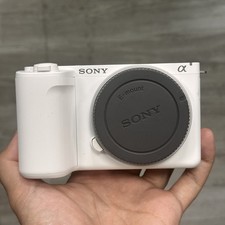
Compare · 2 products compared
Nikon Z5IICvsSony ZV-E10 II: Full-Frame or Compact?
Both are 4K mirrorless cameras with a fully articulated screen, one card slot and USB-C charging, but they sit in different classes. The Nikon Z5IIC is a full-frame body with in-body stabilization and internal raw video; the Sony ZV-E10 II is a much smaller, cheaper APS-C camera. Sensor size and price decide this one.
eBay prices refresh hourly — check the listing before you buy. We may earn a commission.
 Nikon
NikonBest for Low-light and hybrid shooters who want stabilization and raw video
6of 15 specs better- MOST WINSSony
Best for Travel and vlog creators who want light weight and long battery life
9of 15 specs better
Biggest differences
Continuous shooting (electronic)
Nikon Z5IIC leads
2.73×
higher is better
- Nikon Z5IIC30 fps
- Sony ZV-E10 II11 fps
Battery life
Sony ZV-E10 II leads
+74%
higher is better
- Nikon Z5IIC350 shots
- Sony ZV-E10 II610 shots
Weight
Sony ZV-E10 II leads
−39%
lower is better
- Nikon Z5IIC620 g
- Sony ZV-E10 II377 g
Native ISO maximum
Nikon Z5IIC leads
2×
higher is better
- Nikon Z5IIC64,000 ISO
- Sony ZV-E10 II32,000 ISO
Where each one wins
Nikon Z5IIC
- Sensor format
- Native ISO maximum
- Continuous shooting (electronic)
- Raw video recording
- Screen size
- Rear screen resolution
Sony ZV-E10 II
- Launch price
- Effective pixels
- Max mechanical shutter speed
- 4K max frame rate (full width)
- Battery life
- Weight
- Width
- Height
- Depth
What both have
- Sensor typeCMOS
- Max video resolution4K
- 4K max frame rate60 fps
- Video bit depth10 bit
- Log profile support✓
- Viewfinder resolution0 M dots
- Screen articulationFully articulated
- Memory card slots1 slots
- USB charging & power delivery✓
- Minimum operating temperature0 °C
- Headphone port✓
- HDMI port typeMicro
Every spec
Red marks the better value in each row.
| Spec | Nikon Z5IIC | Sony ZV-E10 II |
|---|---|---|
| Overview | ||
| Release date | 2026-10 | 2024-07 |
| Launch price | 1,399.95 USD | 999 USD |
| Lens mount | Nikon Z | Sony E |
| High resolution pixel-shift mode | Not published | No |
| Sensor & Image | ||
| Effective pixels | 24.5 MP | 26 MP |
| Sensor format | Full-frame | APS-C |
| Native ISO maximum | 64,000 ISO1 | 32,000 ISO |
| In-body image stabilization | 7.5 stops2 | Not published |
| Sensor readout speed | Not published | Not published |
| Sensor type | CMOS | CMOS |
| Aspect ratios | 3:2, 1:1, 16:93 | Not published |
| Lens & Autofocus | ||
| Continuous shooting (mechanical) | 14 fps4 | Not published |
| Continuous shooting (electronic) | 30 fps5 | 11 fps |
| Max mechanical shutter speed | 4,000 1/s6 | 8,000 1/s |
| Pre-burst capture duration | 1 s7 | Not published |
| AF subject detection | Human, animal, bird, airplane, vehicle | Human, animal, bird |
| Video | ||
| Max video resolution | 4K | 4K |
| 4K max frame rate | 60 fps8 | 60 fps |
| Video codecs | H.264, HEVC, N-RAW | H.264, HEVC |
| 4K max frame rate (full width) | 30 fps9 | 60 fps |
| Raw video recording | Internal | None |
| Video bit depth | 10 bit | 10 bit |
| Log profile support | Yes | Yes |
| Video dynamic range (log) | Not published | Not published |
| Viewfinder & Screen | ||
| Viewfinder resolution | 0 M dots | 0 M dots |
| Viewfinder magnification | Not published | Not published |
| Screen size | 3.2 in | 3 in |
| Screen articulation | Fully articulated | Fully articulated |
| Rear screen resolution | 1.04 M dots | 1.037 M dots |
| Handling & Power | ||
| Battery life | 350 shots10 | 610 shots |
| Memory card slots | 1 slots | 1 slots |
| Weather sealing | Dust and drip resistant11 | Not published |
| Weight | 620 g12 | 377 g |
| Width | 134 mm | 114.8 mm |
| Height | 80.5 mm | 67.5 mm |
| Depth | 72 mm | 54.2 mm |
| USB charging & power delivery | Yes | Yes |
| Minimum operating temperature | 0 °C | 0 °C |
| Headphone port | Yes13 | Yes |
| HDMI port type | Micro | Micro |
Notes on 13 values — test conditions and caveats
- 1Nikon Z5IIC, Native ISO maximum: Expanded settings reach ISO 204800 (Hi 1.7); 64000 is the highest standard/native value.
- 2Nikon Z5IIC, In-body image stabilization: CIPA 2024 standard: up to 7.5 stops at the frame center, 6.0 stops at the periphery.
- 3Nikon Z5IIC, Aspect ratios: Native FX (36 x 24) stills are 3:2; 1:1 and 16:9 are selectable in-camera image areas.
- 4Nikon Z5IIC, Continuous shooting (mechanical): Spec table: extended burst is approx. 14 fps (15 fps with silent mode); rates apply to non-RAW quality.
- 5Nikon Z5IIC, Continuous shooting (electronic): C30 is fixed at JPEG [L]/NORMAL; Nikon advises use of a recommended card.
- 6Nikon Z5IIC, Max mechanical shutter speed: The 1/8000 s figure is the overall shutter-speed range; the fastest mechanical speed is 1/4000 s.
- 7Nikon Z5IIC, Pre-burst capture duration: In High-Speed Frame Capture +, Pre-Release Capture is fixed at JPEG [L] NORMAL.
- 8Nikon Z5IIC, 4K max frame rate: 4K/60p is recorded in a DX (APS-C) crop.
- 9Nikon Z5IIC, 4K max frame rate (full width): 4K/60p uses a DX (APS-C) crop, so full-width 4K recording tops out at 30p.
- 10Nikon Z5IIC, Battery life: Approx. 390 shots per charge with [Energy saving (photo mode)] set to ON.
- 11Nikon Z5IIC, Weather sealing: Complete dust- and drip-resistant performance is not guaranteed in all situations or conditions.
- 12Nikon Z5IIC, Weight: 620 g is with battery and memory card; the body alone weighs approx. 538 g.
- 13Nikon Z5IIC, Headphone port: Shared 3.5 mm output doubles as remote release; set its function to headphones for monitoring.
Which fits your bag and budget?
The Sony ZV-E10 II is in a different weight class. At 377 g with battery and card it is roughly 240 g lighter than the Nikon Z5IIC, and it is narrower, shorter and shallower on every axis. If the camera rides in a day bag or on a gimbal all day, that gap is the whole story.
The Sony also costs $400 less at launch. The Nikon's $1,399.95 buys a full-frame sensor, stabilization and raw video — real hardware, not fluff. Neither is a bad value; they just spend the money on different things.
Low light and stabilization
The Nikon Z5IIC's full-frame sensor reaches ISO 64,000 natively and adds in-body stabilization rated to 7.5 stops at the center of the frame. That combination lets you hand-hold slower shutter speeds in dim rooms and keep noise down when the light is simply not there. Sony publishes no stabilization figure for the ZV-E10 II, so handheld work leans on the lens or a gimbal.
If most of your shooting happens after sunset or indoors, the Nikon's sensor and stabilization are the reason to pay more. In good light the two are much closer than the price gap suggests.
Video
Both record 4K at up to 60p in 10-bit with a log profile, so color grading headroom is comparable. The difference is how each gets there: the Sony ZV-E10 II shoots 4K/60p at full width, while the Nikon Z5IIC crops to DX (APS-C) for 4K/60p and tops out at 30p at full width. Anyone who wants wide 60p framing straight out of camera should take the Sony.
The Nikon answers with internal raw recording, which the Sony does not offer at any setting. Raw footage gives you far more latitude to fix white balance and exposure after the fact. The two cameras are aimed at different editors.
Speed and autofocus
The Sony ZV-E10 II shoots 11 fps electronically. The Nikon Z5IIC goes to 14 fps mechanically and up to 30 fps electronically, and adds a 1-second pre-release capture that starts recording before you fully press the shutter. For timing a bird taking off or a sprinter's start, that pre-burst is genuinely useful.
The Nikon also detects more subject types — human, animal, bird, airplane and vehicle — where the Sony covers human, animal and bird. If you photograph aircraft or cars, that list matters. The Sony's 1/8000 s top shutter speed is faster than the Nikon's 1/4000 s, which helps in bright light with fast lenses.
Battery and handling
The Sony ZV-E10 II is rated for 610 shots per charge against the Nikon's 350, and the Nikon only reaches about 390 with energy saving on. That is a meaningful gap on a long day out, and it partly offsets the Sony's smaller body.
The Nikon Z5IIC is dust and drip resistant, and Sony publishes no weather sealing for the ZV-E10 II. If you shoot in rain, dust or at the coast, that rating is worth more than the weight savings. Both have a single card slot and a micro HDMI port, and both charge over USB.
The Verdict
Buy the Nikon Z5IIC if you shoot in low light, want stabilization, internal raw video or weather sealing, and do not mind the weight. Buy the Sony ZV-E10 II if you want full-width 4K/60p, much longer battery life and a body you can carry all day for $400 less.
Where to buy
Nikon Z5IIC
Best for Low-light and hybrid shooters who want stabilization and raw video
Sony ZV-E10 II
Best for Travel and vlog creators who want light weight and long battery life
FAQ
Does the Nikon Z5IIC have a viewfinder?
No. Neither camera has an electronic viewfinder, so both rely entirely on the rear screen. The Nikon's screen is slightly larger and higher resolution, but composition is screen-only on both.
Can the Sony ZV-E10 II record raw video?
No. Internal raw recording is a Nikon Z5IIC feature. The Sony records H.264 and HEVC only, though both cameras do 10-bit with a log profile.
Which camera is better for handheld shooting?
The Nikon Z5IIC, because it is the only one of the two with in-body image stabilization. Sony publishes no stabilization rating for the ZV-E10 II, so handheld stability depends on whether your lens has it.
Do both cameras have a headphone jack?
Yes, both include a headphone port for audio monitoring. On the Nikon Z5IIC the shared 3.5 mm output also serves as a remote release, so you have to set its function to headphones before monitoring.
Is the Sony ZV-E10 II weather sealed?
Sony does not publish a weather-sealing rating for it. The Nikon Z5IIC is listed as dust and drip resistant, though Nikon notes that full protection is not guaranteed in every situation.
Spotted something wrong? Tap the next to any section or spec group to let us know. Every report is read.