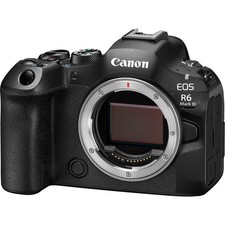
Compare · 2 products compared
Nikon Z5IICvsCanon EOS R6 Mark III
Both full-frame mirrorless cameras offer advanced autofocus and robust weather sealing. Choosing between them comes down to balancing resolution and video frame rates against cost and physical portability.
eBay prices refresh hourly — check the listing before you buy. We may earn a commission.
- NikonZ5IIC
Best for Budget-conscious full-frame photography
Wins8 / 20 - MOST WINS

Best for Advanced hybrid video and dual-slot reliability
Wins12 / 20 Add a product
Biggest differences
4K max frame rate (full width)
Canon EOS R6 Mark III leads
4×
higher is better
- Nikon Z5IIC30 fps
- Canon EOS R6 Mark III120 fps
Memory card slots
Canon EOS R6 Mark III leads
2×
higher is better
- Nikon Z5IIC1 slots
- Canon EOS R6 Mark III2 slots
Launch price
Nikon Z5IIC leads
2×
lower is better
- Nikon Z5IIC1,399.95 USD
- Canon EOS R6 Mark III2,799 USD
Battery life
Canon EOS R6 Mark III leads
+77%
higher is better
- Nikon Z5IIC350 shots
- Canon EOS R6 Mark III620 shots
Where each one wins
Nikon Z5IIC
- Launch price
- Continuous shooting (mechanical)
- Pre-burst capture duration
- Screen size
- Weight
- Width
- Height
- Depth
Canon EOS R6 Mark III
- Effective pixels
- In-body image stabilization
- Continuous shooting (electronic)
- Max mechanical shutter speed
- Max video resolution
- 4K max frame rate
- 4K max frame rate (full width)
- Viewfinder resolution
- Rear screen resolution
- Battery life
- Memory card slots
- HDMI port type
What both have
- Sensor formatFull-frame
- Native ISO maximum64,000 ISO
- Sensor typeCMOS
- Raw video recordingInternal
- Video bit depth10 bit
- Log profile support✓
- Screen articulationFully articulated
- Weather sealingDust and drip resistant
- USB charging & power delivery✓
- Minimum operating temperature0 °C
- Headphone port✓
Every spec
Red marks the better value in each row.
| Spec | Nikon Z5IIC | Canon EOS R6 Mark III |
|---|---|---|
| Overview | ||
| Release date | 2026-10 | 2025-11 |
| Launch price | 1,399.95 USD | 2,799 USD |
| Lens mount | Nikon Z | Canon RF |
| High resolution pixel-shift mode | Not published | No |
| Sensor & Image | ||
| Effective pixels | 24.5 MP | 32.5 MP |
| Sensor format | Full-frame | Full-frame |
| Native ISO maximum | 64,000 ISO1 | 64,000 ISO |
| In-body image stabilization | 7.5 stops2 | 8.5 stops3 |
| Sensor readout speed | Not published | 13.2 ms |
| Sensor type | CMOS | CMOS |
| Aspect ratios | 3:2, 1:1, 16:94 | 3:2 |
| Lens & Autofocus | ||
| Continuous shooting (mechanical) | 14 fps5 | 12 fps |
| Continuous shooting (electronic) | 30 fps6 | 40 fps |
| Max mechanical shutter speed | 4,000 1/s7 | 8,000 1/s |
| Pre-burst capture duration | 1 s8 | 0.5 s9 |
| AF subject detection | Human, animal, bird, airplane, vehicle | Human, animal, bird, car, train, airplane, motorcycle10 |
| Video | ||
| Max video resolution | 4K | 7K11 |
| 4K max frame rate | 60 fps12 | 119.9 fps |
| Video codecs | H.264, HEVC, N-RAW | H.264, HEVC, XF-AVC, XF-HEVC |
| 4K max frame rate (full width) | 30 fps13 | 120 fps14 |
| Raw video recording | Internal | Internal |
| Video bit depth | 10 bit | 10 bit |
| Log profile support | Yes | Yes |
| Video dynamic range (log) | Not published | 15 stops15 |
| Viewfinder & Screen | ||
| Viewfinder resolution | 0 M dots | 3.69 M dots |
| Viewfinder magnification | Not published | 0.76 x |
| Screen size | 3.2 in | 3 in |
| Screen articulation | Fully articulated | Fully articulated |
| Rear screen resolution | 1.04 M dots | 1.6 M dots |
| Handling & Power | ||
| Battery life | 350 shots16 | 620 shots17 |
| Memory card slots | 1 slots | 2 slots |
| Weather sealing | Dust and drip resistant18 | Dust and drip resistant |
| Weight | 620 g19 | 699 g |
| Width | 134 mm | 138.4 mm |
| Height | 80.5 mm | 98.4 mm |
| Depth | 72 mm | 88.4 mm |
| USB charging & power delivery | Yes | Yes20 |
| Minimum operating temperature | 0 °C | 0 °C |
| Headphone port | Yes21 | Yes |
| HDMI port type | Micro | Full-size |
Notes on 21 values — test conditions and caveats
- 1Nikon Z5IIC, Native ISO maximum: Expanded settings reach ISO 204800 (Hi 1.7); 64000 is the highest standard/native value.
- 2Nikon Z5IIC, In-body image stabilization: CIPA 2024 standard: up to 7.5 stops at the frame center, 6.0 stops at the periphery.
- 3Canon EOS R6 Mark III, In-body image stabilization: 8.5 stops is Canon's best-case center rating with certain RF lenses; peripheral and other lenses see less, down to 7.5 stops.
- 4Nikon Z5IIC, Aspect ratios: Native FX (36 x 24) stills are 3:2; 1:1 and 16:9 are selectable in-camera image areas.
- 5Nikon Z5IIC, Continuous shooting (mechanical): Spec table: extended burst is approx. 14 fps (15 fps with silent mode); rates apply to non-RAW quality.
- 6Nikon Z5IIC, Continuous shooting (electronic): C30 is fixed at JPEG [L]/NORMAL; Nikon advises use of a recommended card.
- 7Nikon Z5IIC, Max mechanical shutter speed: The 1/8000 s figure is the overall shutter-speed range; the fastest mechanical speed is 1/4000 s.
- 8Nikon Z5IIC, Pre-burst capture duration: In High-Speed Frame Capture +, Pre-Release Capture is fixed at JPEG [L] NORMAL.
- 9Canon EOS R6 Mark III, Pre-burst capture duration: Works only in the 40 fps electronic-shutter mode; Canon states it as up to 20 frames.
- 10Canon EOS R6 Mark III, AF subject detection: Car detection is tuned for racing cars, per Canon.
- 11Canon EOS R6 Mark III, Max video resolution: 7K is available only in RAW Video mode; standard MP4 recording tops out at 4K.
- 12Nikon Z5IIC, 4K max frame rate: 4K/60p is recorded in a DX (APS-C) crop.
- 13Nikon Z5IIC, 4K max frame rate (full width): 4K/60p uses a DX (APS-C) crop, so full-width 4K recording tops out at 30p.
- 14Canon EOS R6 Mark III, 4K max frame rate (full width): 4K 120p uses the full width but is not oversampled; oversampled 4K tops out at 60p.
- 15Canon EOS R6 Mark III, Video dynamic range (log): Canon's claim of 15+ stops in its Canon Log profiles, not a lab measurement.
- 16Nikon Z5IIC, Battery life: Approx. 390 shots per charge with [Energy saving (photo mode)] set to ON.
- 17Canon EOS R6 Mark III, Battery life: 620 shots is CIPA's rating using the rear LCD (not the viewfinder) at 23°C; real-world results vary.
- 18Nikon Z5IIC, Weather sealing: Complete dust- and drip-resistant performance is not guaranteed in all situations or conditions.
- 19Nikon Z5IIC, Weight: 620 g is with battery and memory card; the body alone weighs approx. 538 g.
- 20Canon EOS R6 Mark III, USB charging & power delivery: USB-C charging and power need a capable USB-PD source such as Canon's PD-E2; not every power bank works.
- 21Nikon Z5IIC, Headphone port: Shared 3.5 mm output doubles as remote release; set its function to headphones for monitoring.
Price and Value
The Nikon Z5IIC costs significantly less at $1,399.95, making it an accessible entry point for photographers upgrading to full-frame gear. The Canon EOS R6 Mark III carries a much higher launch price of $2,799.
That steep price difference reflects heavier feature sets in video and stabilization for the Canon, while the Nikon delivers core full-frame performance on a strict budget.
Image Quality and Resolution
The Canon EOS R6 Mark III packs a 32.5 MP sensor, delivering higher-resolution files than the 24.5 MP Nikon Z5IIC. Both cameras utilize full-frame CMOS sensors and share a native ISO maximum of 64,000.
More pixels on the Canon allow for deeper cropping and larger prints, whereas the Nikon provides ample resolution for everyday professional and enthusiast work.
Video Capabilities
Filmmakers will find much stronger specifications on the Canon EOS R6 Mark III, which shoots 7K in RAW Video mode and reaches 119.9 fps in 4K. The Nikon Z5IIC caps standard video at 4K and restricts its 4K/60p mode to an APS-C crop.
Both models support 10-bit internal recording and log profiles. The Canon adds a full-size HDMI port for robust external connections compared to the Nikon's micro HDMI.
Speed and Autofocus
The Canon EOS R6 Mark III hits 40 fps with its electronic shutter and features a fast 13.2 ms sensor readout speed. The Nikon Z5IIC counters with a 30 fps electronic mode and a 1-second pre-burst capture duration.
For mechanical shooting, the Nikon pulls ahead with a 14 fps burst rate against the Canon's 12 fps limit. Both systems track diverse subjects ranging from humans and animals to airplanes and vehicles.
Handling and Design
The Nikon Z5IIC is noticeably lighter at 620 g and has a more compact body width, height, and depth. It also features a slightly larger 3.2-inch fully articulated screen.
Conversely, the Canon EOS R6 Mark III includes dual memory card slots and a much larger battery life of 620 shots, outlasting the Nikon's 350-shot rating.
The Verdict
Buy the Nikon Z5IIC if you want a lightweight, highly affordable full-frame camera with strong mechanical burst speeds. Buy the Canon EOS R6 Mark III if you need dual card slots, high-resolution 7K video, and extended battery endurance.
Where to buy
Nikon Z5IIC
Best for Budget-conscious full-frame photography
Canon EOS R6 Mark III
Best for Advanced hybrid video and dual-slot reliability
FAQ
Do both cameras feature in-body image stabilization?
Yes, the Nikon Z5IIC offers up to 7.5 stops of stabilization at the frame center, while the Canon EOS R6 Mark III provides an 8.5-stop center rating with compatible lenses.
Can I charge both cameras via USB?
Yes, both models support USB charging and power delivery, though the Canon requires a capable USB-PD source like its PD-E2 adapter.
What kind of memory card slots do they have?
The Nikon Z5IIC features a single memory card slot, whereas the Canon EOS R6 Mark III is equipped with dual card slots.
Spotted something wrong? Tap the next to any section or spec group to let us know. Every report is read.