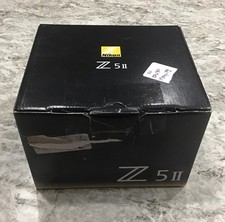
Compare · 2 products compared
Nikon Z5IIvsNikon ZR: Which Nikon Z to Buy
Both are 24.5MP full-frame Nikon Z bodies with in-body stabilization, dual card slots, weather sealing and the same subject-detection autofocus. The split is simple: the ZR is a video-first small body, while the Z5II is a stills camera with an electronic viewfinder, faster burst and a stacked sensor.
eBay prices refresh hourly — check the listing before you buy. We may earn a commission.
 Nikon
NikonBest for Stills shooters who want an EVF, fast burst and a stacked sensor
4of 11 specs better- MOST WINSNikon
Best for Video-first creators who want 6K and ProRes in a small body
7of 11 specs better
Biggest differences
Continuous shooting (electronic)
Nikon Z5II leads
+50%
higher is better
- Nikon Z5II30 fps
- Nikon ZR20 fps
4K max frame rate
Nikon ZR leads
2×
higher is better
- Nikon Z5II60 fps
- Nikon ZR119.88 fps
Depth
Nikon ZR leads
−32%
lower is better
- Nikon Z5II72 mm
- Nikon ZR49 mm
Rear screen resolution
Nikon ZR leads
+46%
higher is better
- Nikon Z5II2.1 M dots
- Nikon ZR3.07 M dots
Where each one wins
Nikon Z5II
- Native ISO maximum
- Sensor type
- Continuous shooting (electronic)
- Viewfinder resolution
Nikon ZR
- Max video resolution
- 4K max frame rate
- Screen size
- Rear screen resolution
- Weight
- Height
- Depth
What both have
- Lens mountNikon Z
- High resolution pixel-shift mode✓
- Effective pixels24.5 MP
- Sensor formatFull-frame
- AF subject detectionHuman, animal, bird, car, train, airplane, motorcycle
- Raw video recordingInternal
- Video bit depth10 bit
- Log profile support✓
- Screen articulationFully articulated
- Memory card slots2 slots
- Weather sealingDust and drip resistant
- Width134 mm
- USB charging & power delivery✓
- Minimum operating temperature0 °C
- Headphone port✓
- HDMI port typeMicro
Every spec
Red marks the better value in each row.
| Spec | Nikon Z5II | Nikon ZR |
|---|---|---|
| Overview | ||
| Release date | 2025-04 | Not published |
| Launch price | 1,696.95 USD | Not published |
| Lens mount | Nikon Z | Nikon Z |
| High resolution pixel-shift mode | Yes1 | Yes |
| Sensor & Image | ||
| Effective pixels | 24.5 MP | 24.5 MP |
| Sensor format | Full-frame | Full-frame |
| Native ISO maximum | 64,000 ISO | 51,200 ISO |
| In-body image stabilization | 7.5 stops | Not published |
| Sensor readout speed | Not published | Not published |
| Sensor type | Partially-stacked CMOS | CMOS |
| Aspect ratios | — | 3:2, 4:3, 1:1, 16:9 |
| Lens & Autofocus | ||
| Continuous shooting (mechanical) | 7.8 fps | Not published |
| Continuous shooting (electronic) | 30 fps | 20 fps |
| Max mechanical shutter speed | 8,000 1/s | Not published |
| Pre-burst capture duration | Not published | 0 s |
| AF subject detection | Human, animal, bird, car, train, airplane, motorcycle | Human, animal, bird, car, train, airplane, motorcycle |
| Video | ||
| Max video resolution | 4K | 6K |
| 4K max frame rate | 60 fps | 119.88 fps |
| Video codecs | H.264, HEVC, N-RAW | HEVC, ProRes 422 HQ, ProRes RAW, N-RAW |
| 4K max frame rate (full width) | 30 fps | Not published |
| Raw video recording | Internal | Internal |
| Video bit depth | 10 bit | 10 bit |
| Log profile support | Yes | Yes |
| Video dynamic range (log) | Not published | 15 stops |
| Viewfinder & Screen | ||
| Viewfinder resolution | 3.69 M dots | 0 M dots |
| Viewfinder magnification | 0.8 x | Not published |
| Screen size | 3.2 in | 4 in |
| Screen articulation | Fully articulated | Fully articulated |
| Rear screen resolution | 2.1 M dots | 3.07 M dots |
| Handling & Power | ||
| Battery life | 350 shots | Not published |
| Memory card slots | 2 slots | 2 slots |
| Weather sealing | Dust and drip resistant | Dust and drip resistant |
| Weight | 700 g | 630 g |
| Width | 134 mm | 134 mm |
| Height | 100.5 mm | 80.5 mm |
| Depth | 72 mm | 49 mm |
| USB charging & power delivery | Yes | Yes |
| Minimum operating temperature | 0 °C | 0 °C |
| Headphone port | Yes | Yes |
| HDMI port type | Micro | Micro |
Notes on 1 value — test conditions and caveats
- 1Nikon Z5II, High resolution pixel-shift mode: Pixel-shift composite raises resolution to 96MP, but images must be combined in NX Studio on a computer.
Video
The Nikon ZR is the video body here. It records 6K and hits 119.88 fps in 4K, where the Z5II tops out at 4K 60 fps. That resolution and frame-rate headroom matters if you crop in post or want slow motion straight out of camera.
The ZR also brings ProRes 422 HQ and ProRes RAW alongside N-RAW and HEVC, and Nikon rates its log dynamic range at 15 stops. The Z5II records internal raw too, but its codec list is shorter and no dynamic range figure is published. For anyone whose output is footage, the ZR is the clear pick.
Viewfinder and screen
The Nikon Z5II has a 3.69M-dot electronic viewfinder, and that single feature is the biggest everyday difference. Shooting stills in bright sun, framing precisely or tracking a subject is far easier through an EVF than on a rear panel.
The ZR has no viewfinder at all, but its rear screen is 4 in and 3.07M dots against the Z5II's 3.2 in and 2.1M dots. Both fully articulate. If you compose at arm's length on a gimbal or tripod, the ZR's larger, sharper panel is the better tool.
Stills and speed
The Z5II is set up for stills shooters. Its sensor is partially stacked, which helps readout, and it bursts at 30 fps electronically versus 20 fps on the ZR. Native ISO also reaches 64,000 instead of 51,200, a modest low-light edge.
Nikon publishes a mechanical shutter rating of 8,000 1/s and 7.8 fps mechanical shooting for the Z5II; neither figure exists for the ZR. Stabilization is rated at 7.5 stops on the Z5II and unpublished on the ZR. If you shoot action or handheld in low light, the Z5II gives you more to work with.
Size, weight and handling
The Nikon ZR is the smaller camera: 630 g against 700 g, and roughly 30 mm shorter and 23 mm thinner. It keeps the same width and the same dual card slots, USB charging and headphone jack.
That compactness is the point if you carry a camera all day or rig it on a gimbal, where every millimeter of depth matters. The Z5II's extra bulk buys the viewfinder and a taller grip, which most stills shooters prefer in the hand.
The Verdict
Buy the Nikon ZR if you shoot video first and want 6K, ProRes and a big screen in the smallest body. Buy the Nikon Z5II if you shoot stills, need a viewfinder and want the faster burst and stacked sensor. Buy the ZR if you rig to a gimbal and never raise a camera to your eye. Buy the Z5II if you shoot handheld in low light and want the rated stabilization.
Where to buy
Nikon Z5II
Best for Stills shooters who want an EVF, fast burst and a stacked sensor
Nikon ZR
Best for Video-first creators who want 6K and ProRes in a small body
FAQ
Does the Nikon ZR have a viewfinder?
No. Its viewfinder resolution is listed as 0M dots, so you compose on the 4 in rear screen. The Nikon Z5II has a 3.69M-dot EVF.
Can both cameras record raw video internally?
Yes. Both record raw internally, and both offer 10-bit depth and log profiles. The ZR adds ProRes 422 HQ and ProRes RAW on top of HEVC and N-RAW.
Which has better low-light ISO?
The Nikon Z5II, which reaches a native ISO of 64,000 against 51,200 on the ZR. It also carries a rated 7.5 stops of in-body stabilization, which the ZR does not publish.
How many memory card slots do they have?
Two each. Both are also dust and drip resistant and both support USB charging and power delivery.
Which is lighter to carry?
The Nikon ZR at 630 g, versus 700 g for the Z5II. The ZR is also shorter and thinner, which matters more on a gimbal than in a bag.
Spotted something wrong? Tap the next to any section or spec group to let us know. Every report is read.