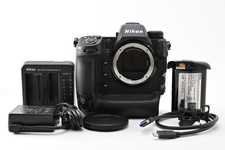
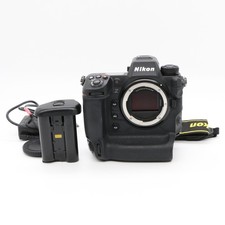
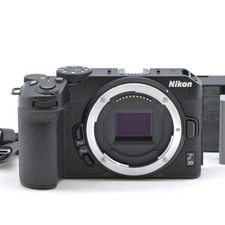
Compare · 2 products compared
Nikon Z9vsNikon Z 30: Full-Frame Flagship or Compact DX
Both cameras share the Nikon Z mount, so every Z lens fits either body. What separates them is scale: the Z9 is a full-frame flagship with a stacked sensor, 8K video and a built-in viewfinder, while the Z 30 is a light DX-format body built for handheld, screen-first shooting. Pick by what you carry and what you shoot.
eBay prices refresh hourly — check the listing before you buy. We may earn a commission.
- MOST WINS
 Nikon
NikonBest for Pros and serious enthusiasts shooting action, wildlife or high-end video
13of 19 specs better - Nikon
Best for Travelers, vloggers and beginners who want a light, affordable Z body
6of 19 specs better
Biggest differences
Weight
Nikon Z 30 leads
3.31×
lower is better
- Nikon Z91,340 g
- Nikon Z 30405 g
Max mechanical shutter speed
Nikon Z9 leads
8×
higher is better
- Nikon Z932,000 1/s
- Nikon Z 304,000 1/s
Battery life
Nikon Z9 leads
2.24×
higher is better
- Nikon Z9740 shots
- Nikon Z 30330 shots
Effective pixels
Nikon Z9 leads
2.19×
higher is better
- Nikon Z945.7 MP
- Nikon Z 3020.9 MP
Where each one wins
Nikon Z9
- Effective pixels
- Sensor format
- Sensor type
- Max mechanical shutter speed
- Max video resolution
- 4K max frame rate
- Viewfinder resolution
- Screen size
- Rear screen resolution
- Battery life
- Memory card slots
- Minimum operating temperature
- HDMI port type
Nikon Z 30
- Native ISO maximum
- Screen articulation
- Weight
- Width
- Height
- Depth
What both have
- Lens mountNikon Z
- 4K max frame rate (full width)30 fps
- USB charging & power delivery✓
Every spec
Red marks the better value in each row.
| Spec | Nikon Z9 | Nikon Z 30 |
|---|---|---|
| Overview | ||
| Release date | 2021-12 | Not published |
| Launch price | 5,500 USD | Not published |
| Lens mount | Nikon Z | Nikon Z |
| High resolution pixel-shift mode | No | Not published |
| Sensor & Image | ||
| Effective pixels | 45.7 MP | 20.9 MP |
| Sensor format | Full-frame | APS-C1 |
| Native ISO maximum | 25,600 ISO | 51,200 ISO2 |
| In-body image stabilization | 6 stops3 | Not published |
| Sensor readout speed | Not published | Not published |
| Sensor type | Stacked CMOS | CMOS |
| Aspect ratios | — | 3:2, 1:1, 16:94 |
| Lens & Autofocus | ||
| Continuous shooting (mechanical) | Not published | 11 fps5 |
| Continuous shooting (electronic) | 20 fps | Not published |
| Max mechanical shutter speed | 32,000 1/s | 4,000 1/s |
| Pre-burst capture duration | 1 s6 | Not published |
| AF subject detection | Human, animal, bird, car, train, airplane, motorcycle | — |
| Video | ||
| Max video resolution | 8K | 4K |
| 4K max frame rate | 120 fps | 30 fps |
| Video codecs | H.264, HEVC, ProRes 422 HQ, ProRes RAW, N-RAW | H.264 |
| 4K max frame rate (full width) | 30 fps | 30 fps |
| Raw video recording | Internal | Not published |
| Video bit depth | 10 bit | Not published |
| Log profile support | Yes | Not published |
| Video dynamic range (log) | Not published | Not published |
| Viewfinder & Screen | ||
| Viewfinder resolution | 3.69 M dots | 0 M dots7 |
| Viewfinder magnification | 0.8 x | Not published |
| Screen size | 3.2 in | 3 in |
| Screen articulation | Tilting | Fully articulated |
| Rear screen resolution | 2.1 M dots | 1.04 M dots |
| Handling & Power | ||
| Battery life | 740 shots | 330 shots8 |
| Memory card slots | 2 slots | 1 slots |
| Weather sealing | Dust and drip resistant | Not published |
| Weight | 1,340 g | 405 g |
| Width | 149 mm | 128 mm |
| Height | 149.5 mm | 73.5 mm |
| Depth | 90.5 mm | 59.5 mm |
| USB charging & power delivery | Yes | Yes9 |
| Minimum operating temperature | -10 °C | 0 °C |
| Headphone port | Yes | Not published |
| HDMI port type | Full-size | Mini |
Notes on 9 values — test conditions and caveats
- 1Nikon Z 30, Sensor format: DX format is Nikon's name for its APS-C-size sensor (23.5 x 15.7 mm).
- 2Nikon Z 30, Native ISO maximum: Settings above ISO 51200 (102400, 204800) are expanded, not native.
- 3Nikon Z9, In-body image stabilization: The 6.0-stop rating requires Synchro VR, combining in-body 5-axis VR with 2-axis lens VR on compatible lenses.
- 4Nikon Z 30, Aspect ratios: Native DX ratio is 3:2; 1:1 and 16:9 are in-camera crop modes.
- 5Nikon Z 30, Continuous shooting (mechanical): Nikon's in-house measured maximum; the rate is approximate.
- 6Nikon Z9, Pre-burst capture duration: Pre-Release Capture is only available in the C30 and C120 high-speed frame capture modes.
- 7Nikon Z 30, Viewfinder resolution: The Z 30 has no electronic viewfinder; compose on the rear LCD.
- 8Nikon Z 30, Battery life: Figure is for the EN-EL25 battery; shot count differs with EN-EL25a.
- 9Nikon Z 30, USB charging & power delivery: In-camera USB charging/power needs Nikon's optional EH-7P or EH-8P adapter.
Sensor and image quality
The Nikon Z9 packs roughly twice the pixels of the Nikon Z 30 onto a full-frame sensor, so you can crop harder and print larger before resolution runs out. Full-frame also gathers more light at the same exposure, which helps in dim venues where the Z 30's smaller DX sensor shows noise sooner.
The Z 30 fights back on sensitivity: its native ceiling reaches ISO 51200, one stop above the Z9's 25600, and settings beyond that are expanded rather than native. That is a real advantage for available-light snapshots, but the smaller sensor gives up depth-of-field control and wide-angle framing, which matters if you shoot portraits or architecture.
Video
The Nikon Z9 is a serious video machine: 8K capture, 4K at up to 120 fps, internal raw recording and a 10-bit pipeline with log support. The Nikon Z 30 tops out at 4K/30p in H.264 with no published raw, bit-depth or log figures. For anyone delivering graded footage or slow motion, the Z9 is the only one of the two that qualifies.
Both hit 4K/30p at full sensor width, so casual clips look similar. The gap appears the moment you want to push footage in post, shoot high frame rates, or record to an external rig, where the Z9's full-size HDMI and headphone port make life easier than the Z 30's mini HDMI.
Handling, size and battery
The Nikon Z 30 is a fraction of the Z9's bulk: 405 g against 1,340 g, and noticeably smaller in every dimension. That is the whole point of the camera, and it is why it suits travel, vlogging and all-day carry where the Z9 becomes a commitment.
The trade runs the other way on endurance. The Z9's battery rating roughly doubles the Z 30's, and its two card slots let you back up or split stills and video. The Z 30 has one slot, so a single card failure or a full card ends the shoot. The Z 30's fully articulating screen is friendlier for self-recording; the Z9 tilts instead.
Autofocus and speed
Subject detection is the Z9's headline: it recognizes people, animals, birds, cars, trains, airplanes and motorcycles, and its stacked sensor supports 20 fps electronic bursts plus pre-release capture of up to one second before you press the shutter. The Z 30 lists no subject-detection modes, so you rely on standard autofocus and timing.
For sports, wildlife and any fast, unpredictable action, that difference decides the shot. The Z 30's 11 fps mechanical rate is respectable for casual use, but pre-burst and tracking subject recognition simply are not available on it. The Z9 also reaches a 1/32,000 s top shutter speed, useful in bright light with fast lenses.
Build and conditions
The Nikon Z9 is dust and drip resistant and rated to operate down to -10 °C, so it can stay out in rain or cold. The Nikon Z 30 publishes no weather sealing or cold rating and is rated only to 0 °C, which means sheltering it in bad conditions. If your work happens outdoors in winter or weather, that alone points to the Z9.
The Verdict
Buy the Nikon Z9 if you shoot fast action, wildlife or professional video and need full-frame reach, subject tracking and weather sealing. Buy the Nikon Z 30 if you want a small, light Z-mount body for travel, vlogging and everyday stills, and can accept a single card slot and no viewfinder.
Where to buy
Nikon Z9
Best for Pros and serious enthusiasts shooting action, wildlife or high-end video
Nikon Z 30
Best for Travelers, vloggers and beginners who want a light, affordable Z body
FAQ
Does the Nikon Z 30 have a viewfinder?
No. The Z 30 has no electronic viewfinder, so you compose on the rear LCD. The Nikon Z9 has a 3.69 M-dot EVF with 0.8x magnification.
Can I use the same lenses on both cameras?
Yes. Both use the Nikon Z mount, so any Z lens fits either body. Note the Z 30's smaller DX sensor crops the field of view of full-frame lenses.
Which one is better in low light?
The Nikon Z 30 reaches a higher native ISO ceiling of 51200, but the Z9's larger full-frame sensor generally produces cleaner files at the same exposure. Higher ISO numbers alone do not mean better low-light images.
Can both cameras charge over USB?
Yes, both support USB charging and power delivery. On the Z 30 this requires Nikon's optional EH-7P or EH-8P adapter.
Which is better for video work?
The Nikon Z9, by a wide margin. It records 8K, 4K at up to 120 fps, internal raw and 10-bit with log support, while the Z 30 records 4K at up to 30p in H.264.
Spotted something wrong? Tap the next to any section or spec group to let us know. Every report is read.