Compare · 2 products compared
Canon EOS R6 Mark IIvsFujifilm X100VI: Which to Buy
Both cameras offer 10-bit video, seven AF subject types, and the same 3.69M-dot viewfinder resolution. The Canon EOS R6 Mark II wins on sensor size, burst speed, and battery life, while the Fujifilm X100VI wins on resolution, video resolution, and size. That split decides most purchases.
eBay prices refresh hourly — check the listing before you buy. We may earn a commission.
- MOST WINS
 Canon
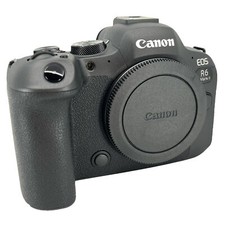
CanonBest for Sports, event, and low-light shooters who need fast bursts, dual card slots, and interchangeable RF lenses.
14of 20 specs better - Fujifilm
Best for Travel and street photographers who want a light, high-resolution fixed-lens camera they will carry daily.
6of 20 specs better
Biggest differences
Continuous shooting (electronic)
Canon EOS R6 Mark II leads
3.08×
higher is better
- Canon EOS R6 Mark II40 fps
- Fujifilm X100VI13 fps
Native ISO maximum
Canon EOS R6 Mark II leads
8×
higher is better
- Canon EOS R6 Mark II102,400 ISO
- Fujifilm X100VI12,800 ISO
Battery life
Canon EOS R6 Mark II leads
2.38×
higher is better
- Canon EOS R6 Mark II760 shots
- Fujifilm X100VI320 shots
Memory card slots
Canon EOS R6 Mark II leads
2×
higher is better
- Canon EOS R6 Mark II2 slots
- Fujifilm X100VI1 slots
Features not all of them have
Headphone port
- Canon EOS R6 Mark II✓
- Fujifilm X100VI✕
Where each one wins
Canon EOS R6 Mark II
- Sensor format
- Native ISO maximum
- In-body image stabilization
- Continuous shooting (mechanical)
- Continuous shooting (electronic)
- Max mechanical shutter speed
- Pre-burst capture duration
- 4K max frame rate
- Viewfinder magnification
- Screen articulation
- Battery life
- Memory card slots
- Weather sealing
- Headphone port
Fujifilm X100VI
- Effective pixels
- Max video resolution
- Weight
- Width
- Height
- Depth
What both have
- Sensor typeCMOS
- Aspect ratios3:2, 4:3, 1:1, 16:9
- AF subject detectionHuman, animal, bird, car, train, airplane, motorcycle
- Video codecsH.264, HEVC
- Video bit depth10 bit
- Log profile support✓
- Viewfinder resolution3.69 M dots
- Screen size3 in
- Rear screen resolution1.62 M dots
- USB charging & power delivery✓
- Minimum operating temperature0 °C
- HDMI port typeMicro
Every spec
Red marks the better value in each row.
| Spec | Canon EOS R6 Mark II | Fujifilm X100VI |
|---|---|---|
| Overview | ||
| Release date | Not published | Not published |
| Launch price | 2,499 USD | Not published |
| Lens mount | Canon RF | Fixed lens |
| High resolution pixel-shift mode | Not published | — |
| Sensor & Image | ||
| Effective pixels | 24.2 MP | 40.2 MP |
| Sensor format | Full-frame | APS-C |
| Native ISO maximum | 102,400 ISO1 | 12,800 ISO |
| In-body image stabilization | 8 stops2 | 6 stops3 |
| Sensor readout speed | Not published | Not published |
| Sensor type | CMOS | CMOS |
| Aspect ratios | 3:2, 4:3, 1:1, 16:9 | 3:2, 4:3, 1:1, 16:9 |
| Lens & Autofocus | ||
| Continuous shooting (mechanical) | 12 fps | 11 fps |
| Continuous shooting (electronic) | 40 fps | 13 fps |
| Max mechanical shutter speed | 8,000 1/s | 4,000 1/s |
| Pre-burst capture duration | 0.5 s4 | 0 s5 |
| AF subject detection | Human, animal, bird, car, train, airplane, motorcycle | Human, animal, bird, car, train, airplane, motorcycle |
| Video | ||
| Max video resolution | 4K | 6K |
| 4K max frame rate | 60 fps | 59.94 fps |
| Video codecs | H.264, HEVC6 | H.264, HEVC |
| 4K max frame rate (full width) | 60 fps | — |
| Raw video recording | External7 | — |
| Video bit depth | 10 bit8 | 10 bit |
| Log profile support | Yes | Yes |
| Video dynamic range (log) | Not published | Not published |
| Viewfinder & Screen | ||
| Viewfinder resolution | 3.69 M dots | 3.69 M dots |
| Viewfinder magnification | 0.76 x | 0.66 x |
| Screen size | 3 in | 3 in |
| Screen articulation | Fully articulated | Tilting |
| Rear screen resolution | 1.62 M dots | 1.62 M dots |
| Handling & Power | ||
| Battery life | 760 shots9 | 320 shots |
| Memory card slots | 2 slots | 1 slots |
| Weather sealing | Dust and drip resistant10 | None11 |
| Weight | 670 g | 521 g |
| Width | 138.4 mm | 128 mm |
| Height | 98.4 mm | 74.8 mm |
| Depth | 88.4 mm | 55.3 mm |
| USB charging & power delivery | Yes12 | Yes |
| Minimum operating temperature | 0 °C13 | 0 °C |
| Headphone port | Yes | No |
| HDMI port type | Micro | Micro |
Notes on 13 values — test conditions and caveats
- 1Canon EOS R6 Mark II, Native ISO maximum: ISO 204800 (H) is an expanded setting; the native range tops out at ISO 102400.
- 2Canon EOS R6 Mark II, In-body image stabilization: The 8-stop rating combines lens optical IS with in-body IS; results vary by lens.
- 3Fujifilm X100VI, In-body image stabilization: 6.0 stops of shake compensation is achieved when using the LCD or EVF.
- 4Canon EOS R6 Mark II, Pre-burst capture duration: Pre-release capture works in RAW burst mode and buffers up to 0.5s of action before full shutter press.
- 5Fujifilm X100VI, Pre-burst capture duration: Pre-shot buffers frames while the shutter is half-pressed (e.g., 20 frames at 20fps = 1 second), not a fixed seconds setting.
- 6Canon EOS R6 Mark II, Video codecs: Movies record H.264 by default; H.265/HEVC is used when Canon Log 3 or HDR PQ is enabled.
- 7Canon EOS R6 Mark II, Raw video recording: 6K ProRes RAW requires an external Atomos Ninja V+ recorder connected over HDMI.
- 8Canon EOS R6 Mark II, Video bit depth: Standard profiles record 8-bit 4:2:0; 10-bit 4:2:2 requires Canon Log 3 or HDR PQ.
- 9Canon EOS R6 Mark II, Battery life: 760 shots is the CIPA power-saving rating with the rear LCD; Canon's smooth-mode rating is 580 shots.
- 10Canon EOS R6 Mark II, Weather sealing: Sealed dust- and water-resistant build, not IP-rated; Canon cautions ingress cannot be fully prevented.
- 11Fujifilm X100VI, Weather sealing: The camera body itself isn't weather-sealed; weather resistance requires the optional AR-X100 adapter ring and PRF-49 filter.
- 12Canon EOS R6 Mark II, USB charging & power delivery: In-body USB charging and power supply require Canon's optional PD-E1 USB power adapter.
- 13Canon EOS R6 Mark II, Minimum operating temperature: Canon's product manual rates 0–40°C; regional Canon spec sheets list a 2°C minimum.
Sensor and low light
The Canon EOS R6 Mark II uses a full-frame 24.2MP sensor, while the Fujifilm X100VI packs 40.2MP into APS-C. The Canon's larger pixels and native ISO ceiling of 102,400 give it a real advantage in dim venues and at high shutter speeds, where the Fujifilm tops out at 12,800 ISO.
The Fujifilm's higher resolution pays off for cropping and large prints. If you shoot indoor sports, weddings, or concerts, the Canon's sensor headroom matters more than pixel count. For landscapes and street work in decent light, the Fujifilm's detail is the reason to pick it.
Lens and autofocus
The Canon takes any Canon RF lens, so you can match glass to the job, from fast primes to telephoto zooms. The Fujifilm has a fixed 23mm-equivalent lens, which means one field of view forever. That lock-in is the trade for its compact body.
Both cameras detect the same seven subject types: human, animal, bird, car, train, airplane, and motorcycle. Autofocus intelligence is a wash on paper, so the lens mount is the real dividing line. Buy the Canon if you need reach or fast primes; buy the Fujifilm if one focal length suits how you shoot.
Speed and sports
The Canon fires at 12 fps mechanically and 40 fps electronically, and its mechanical shutter reaches 1/8000s. The Fujifilm manages 11 fps and 13 fps with a 1/4000s mechanical ceiling. For fast action in bright light, that shutter gap can force you into electronic mode sooner on the Fujifilm.
The Canon also buffers 0.5s of pre-release frames in RAW burst mode, so you catch the moment just before you press the shutter. The Fujifilm's pre-shot works while the shutter is half-pressed rather than as a fixed seconds setting. For sports and wildlife, the Canon is the clear pick.
Video
The Fujifilm records up to 6K, while the Canon tops out at 4K. If you deliver in 6K or want cropping room in post, the Fujifilm has the edge on paper. The Canon shoots 4K at 60 fps across the full sensor width, though, and the Fujifilm's 4K tops out at 59.94 fps.
The Canon can output 6K ProRes RAW to an external Atomos Ninja V+ over HDMI. Its 10-bit capture requires Canon Log 3 or HDR PQ, since standard profiles record 8-bit 4:2:0. The Canon also has a headphone jack, which the Fujifilm lacks, so audio monitoring on the Fujifilm needs another route.
Battery, cards, and build
The Canon rates 760 shots on the CIPA LCD power-saving test and carries two card slots. The Fujifilm rates 320 shots and has one slot. Double the battery life and a backup card slot are meaningful on a full wedding or event day; the Fujifilm will need spare batteries and offloads mid-shoot.
The Canon is dust- and drip-resistant, though Canon notes ingress cannot be fully prevented. The Fujifilm body is not weather-sealed at all unless you add the optional AR-X100 adapter ring and PRF-49 filter. For rain or dusty environments, the Canon is the safer body.
Size and viewfinder
The Fujifilm is dramatically smaller and lighter at 521g versus 670g, and narrower in every dimension. That gap is why the X100VI gets carried and the Canon often stays home. The Canon's viewfinder magnifies at 0.76x against the Fujifilm's 0.66x, and its screen is fully articulated rather than tilting.
A bigger, brighter finder and a flip-out screen help for video work and awkward angles. The Fujifilm's size advantage matters most for daily carry and travel. USB charging works on both, though the Canon requires its optional PD-E1 adapter for in-body charging and power delivery.
The Verdict
Buy the Canon EOS R6 Mark II if you shoot sports, events, or low light and want interchangeable lenses, dual cards, and long battery life. Buy the Fujifilm X100VI if you want maximum detail and 6K video in a small, light body you will actually carry every day. Skip the Canon if one fixed focal length covers how you shoot. Skip the Fujifilm if you need weather sealing without buying extra accessories.
Where to buy
Canon EOS R6 Mark II
Best for Sports, event, and low-light shooters who need fast bursts, dual card slots, and interchangeable RF lenses.
Fujifilm X100VI
Best for Travel and street photographers who want a light, high-resolution fixed-lens camera they will carry daily.
FAQ
Does the Fujifilm X100VI have a headphone jack?
No. Only the Canon EOS R6 Mark II has a headphone port, so the Fujifilm needs an external audio solution for monitoring.
Can the Canon EOS R6 Mark II record 6K?
Yes, but only externally. It outputs 6K ProRes RAW to an Atomos Ninja V+ recorder over HDMI, while internal recording tops out at 4K.
Is the Fujifilm X100VI weather-sealed?
Not by itself. Weather resistance requires the optional AR-X100 adapter ring and PRF-49 filter, which you buy separately.
How many memory card slots does each camera have?
The Canon EOS R6 Mark II has two, and the Fujifilm X100VI has one. The second slot gives the Canon a backup or overflow option.
Which camera is easier to carry all day?
The Fujifilm X100VI. It weighs 521g against the Canon's 670g and is smaller in width, height, and depth, which makes it far easier to keep on you.
Spotted something wrong? Tap the next to any section or spec group to let us know. Every report is read.