Compare · 2 products compared
Nikon Z9vsCanon EOS R100: Which Camera Should You Buy?
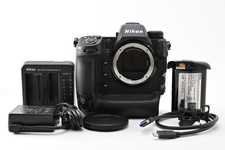
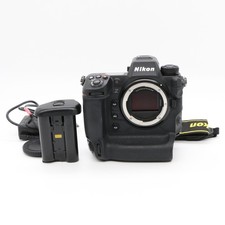
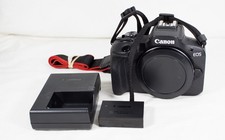
These two mirrorless cameras share almost nothing except the ability to take a photo. The Nikon Z9 is a full-frame professional body built for speed and 8K video, while the Canon EOS R100 is a small APS-C camera aimed at first-time buyers. The deciding factor is almost always size and cost against capability.
eBay prices refresh hourly — check the listing before you buy. We may earn a commission.
- MOST WINS
 Nikon
NikonBest for Working pros who need 8K, speed and weather sealing
25of 29 specs better - Canon
Best for Beginners and travellers who want a light, simple first camera
4of 29 specs better
Biggest differences
Weight
Canon EOS R100 leads
3.76×
lower is better
- Nikon Z91,340 g
- Canon EOS R100356 g
Max mechanical shutter speed
Nikon Z9 leads
8×
higher is better
- Nikon Z932,000 1/s
- Canon EOS R1004,000 1/s
4K max frame rate
Nikon Z9 leads
4.8×
higher is better
- Nikon Z9120 fps
- Canon EOS R10025 fps
Memory card slots
Nikon Z9 leads
2×
higher is better
- Nikon Z92 slots
- Canon EOS R1001 slots
Features not all of them have
Log profile support
- Nikon Z9✓
- Canon EOS R100✕
USB charging & power delivery
- Nikon Z9✓
- Canon EOS R100✕
Headphone port
- Nikon Z9✓
- Canon EOS R100✕
Where each one wins
Nikon Z9
- Effective pixels
- Sensor format
- Native ISO maximum
- In-body image stabilization
- Sensor type
- Continuous shooting (electronic)
- Max mechanical shutter speed
- Max video resolution
- 4K max frame rate
- 4K max frame rate (full width)
- Raw video recording
- Video bit depth
- Log profile support
- Viewfinder resolution
- Viewfinder magnification
- Screen size
- Screen articulation
- Rear screen resolution
- Battery life
- Memory card slots
- Weather sealing
- USB charging & power delivery
- Minimum operating temperature
- Headphone port
- HDMI port type
Canon EOS R100
- Weight
- Width
- Height
- Depth
Every spec
Red marks the better value in each row.
| Spec | Nikon Z9 | Canon EOS R100 |
|---|---|---|
| Overview | ||
| Release date | 2021-12 | Not published |
| Launch price | 5,500 USD | Not published |
| Lens mount | Nikon Z | Canon RF |
| High resolution pixel-shift mode | No | Not published |
| Sensor & Image | ||
| Effective pixels | 45.7 MP | 24.1 MP |
| Sensor format | Full-frame | APS-C |
| Native ISO maximum | 25,600 ISO | 12,800 ISO1 |
| In-body image stabilization | 6 stops2 | 0 stops3 |
| Sensor readout speed | Not published | Not published |
| Sensor type | Stacked CMOS | CMOS |
| Aspect ratios | — | 3:2, 4:3, 1:1, 16:9 |
| Lens & Autofocus | ||
| Continuous shooting (mechanical) | Not published | 6.5 fps |
| Continuous shooting (electronic) | 20 fps | 0 fps4 |
| Max mechanical shutter speed | 32,000 1/s | 4,000 1/s |
| Pre-burst capture duration | 1 s5 | Not published |
| AF subject detection | Human, animal, bird, car, train, airplane, motorcycle | Human |
| Video | ||
| Max video resolution | 8K | 4K |
| 4K max frame rate | 120 fps | 25 fps |
| Video codecs | H.264, HEVC, ProRes 422 HQ, ProRes RAW, N-RAW | H.264 |
| 4K max frame rate (full width) | 30 fps | 0 fps6 |
| Raw video recording | Internal | None |
| Video bit depth | 10 bit | 8 bit |
| Log profile support | Yes | No |
| Video dynamic range (log) | Not published | Not published |
| Viewfinder & Screen | ||
| Viewfinder resolution | 3.69 M dots | 2.36 M dots |
| Viewfinder magnification | 0.8 x | 0.59 x7 |
| Screen size | 3.2 in | 3 in |
| Screen articulation | Tilting | Fixed |
| Rear screen resolution | 2.1 M dots | 1.04 M dots |
| Handling & Power | ||
| Battery life | 740 shots | 430 shots |
| Memory card slots | 2 slots | 1 slots |
| Weather sealing | Dust and drip resistant | None |
| Weight | 1,340 g | 356 g8 |
| Width | 149 mm | 116.3 mm |
| Height | 149.5 mm | 85.5 mm |
| Depth | 90.5 mm | 68.8 mm |
| USB charging & power delivery | Yes | No9 |
| Minimum operating temperature | -10 °C | 0 °C |
| Headphone port | Yes | No |
| HDMI port type | Full-size | Micro |
Notes on 9 values — test conditions and caveats
- 1Canon EOS R100, Native ISO maximum: ISO 25600 (H) is an expanded setting, not a native sensitivity.
- 2Nikon Z9, In-body image stabilization: The 6.0-stop rating requires Synchro VR, combining in-body 5-axis VR with 2-axis lens VR on compatible lenses.
- 3Canon EOS R100, In-body image stabilization: No in-body stabilization; shake correction relies on IS lenses or Movie Digital IS.
- 4Canon EOS R100, Continuous shooting (electronic): The electronic (silent) shutter does not support continuous shooting on this camera.
- 5Nikon Z9, Pre-burst capture duration: Pre-Release Capture is only available in the C30 and C120 high-speed frame capture modes.
- 6Canon EOS R100, 4K max frame rate (full width): All 4K recording uses a ~1.6x centre crop, so no full-width 4K mode exists.
- 7Canon EOS R100, Viewfinder magnification: Canon's 0.95x is quoted with a 50mm lens on APS-C; in 35mm-equivalent terms it is 0.59x.
- 8Canon EOS R100, Weight: CIPA weight: body with battery and memory card, without lens.
- 9Canon EOS R100, USB charging & power delivery: The battery must be charged in the external LC-E17E charger; no USB power delivery.
Sensor and image quality
The Nikon Z9's 45.7 MP full-frame stacked sensor captures far more detail and gathers more light per pixel than the 24.1 MP APS-C chip in the Canon EOS R100. A larger sensor means cleaner images in dim light, shallower depth of field for portraits, and more room to crop afterward.
The Z9 also wins on stabilization: 6 stops of in-body correction (on compatible lenses with Synchro VR) versus none in the Canon, which leans on lens IS or Movie Digital IS. For handheld shooting at slow shutter speeds in low light, that gap decides sharpness. The Canon counters with four aspect ratios and a lighter, more forgiving sensor for casual use.
Video
The Z9 records 8K internally, 4K at up to 120 fps, and full-width 4K at 30 fps, with 10-bit depth, log profiles and internal raw in several codecs. The Canon EOS R100 tops out at 4K/25 fps in H.264 at 8 bit, with no log and no raw, and every 4K mode uses a roughly 1.6x centre crop.
For anyone cutting footage professionally, that crop alone is a dealbreaker: wide shots become tighter and detail drops. For casual clips destined for social media, the R100's 4K is adequate, but the Z9 is in a different class entirely.
Autofocus and speed
The Z9's electronic shutter fires at 20 fps, with Pre-Release Capture up to 1 second in the C30 and C120 modes, a 1/32,000 s top shutter speed and subject detection for humans, animals, birds, cars, trains, planes and motorcycles. The Canon EOS R100 detects only human subjects and its electronic shutter cannot shoot bursts at all, so continuous work relies on the mechanical shutter at 6.5 fps.
For sports, wildlife or any fast-moving subject, the Z9 is the only realistic choice of the two. The R100 suits portraits, travel and everyday snapshots where subjects hold still.
Viewfinder and screen
Both cameras have an electronic viewfinder, but the Z9's 3.69 M-dot panel at 0.8x magnification is roughly double the resolution and noticeably larger than the R100's 2.36 M-dot unit at 0.59x in 35mm-equivalent terms. Manual focusing and framing fast action are easier on the Z9.
The Z9 also has a bigger 3.2 in tilting touchscreen at 2.1 M dots versus a 3 in fixed panel at 1.04 M dots. A fixed screen is awkward for vlogging and low-angle shots; the Z9's tilt solves that while the R100 forces you to change your shooting position.
Battery, size and durability
The Z9 rates 740 shots per charge, has two memory card slots, dust and drip sealing, USB charging and power delivery, a headphone jack, a full-size HDMI port and operation down to -10 °C. The R100 offers 430 shots, one slot, no weather sealing, no USB charging, no headphone jack, a micro HDMI port and a 0 °C limit, but weighs just 356 g against the Z9's 1,340 g.
That weight and bulk difference is the entire argument for the Canon: it disappears into a small bag and doesn't tire your neck on a day out. The Z9 is built to survive rain, cold and long shoots, and it charges over USB-C rather than needing a separate brick.
Which is best for you?
Pick the Nikon Z9 if you shoot professionally, need 8K or high-frame-rate 4K, chase fast subjects, or work in bad weather. The 45.7 MP full-frame sensor, 20 fps bursts and 6-stop stabilization are tools you'll use on every paid job.
Pick the Canon EOS R100 if you want a light, affordable entry into mirrorless and mostly shoot stills of people and places in good light. It's a first camera, a travel companion or a backup body, not a workhorse.
The Verdict
Buy the Nikon Z9 if you shoot professionally, need 8K video, fast burst rates or weather sealing, and don't mind the size. Buy the Canon EOS R100 if you want a light, low-cost first mirrorless camera for everyday stills and casual video.
Where to buy
Nikon Z9
Best for Working pros who need 8K, speed and weather sealing
Canon EOS R100
Best for Beginners and travellers who want a light, simple first camera
FAQ
Is the Canon EOS R100 full-frame?
No. The EOS R100 uses an APS-C sensor, which is smaller than the full-frame chip in the Nikon Z9. That means less light gathering, more depth of field and generally lower detail at the same print size.
Can the Nikon Z9 shoot 8K video?
Yes, it records 8K internally along with 4K at up to 120 fps, in 10-bit depth with log profiles and internal raw. The Canon EOS R100 tops out at cropped 4K at 25 fps in 8-bit H.264 with no log or raw.
Which camera has better battery life?
The Nikon Z9, at 740 shots versus 430 for the Canon EOS R100. The Z9 also supports USB charging and power delivery, while the R100 needs its external charger.
Does the Canon EOS R100 have in-body stabilization?
No. The R100 relies on lens IS or Movie Digital IS for shake correction. The Nikon Z9 has in-body 5-axis VR that reaches 6 stops when paired with compatible lenses using Synchro VR.
How much heavier is the Nikon Z9 than the Canon EOS R100?
The Nikon Z9 weighs 1,340 g with battery and card, compared to 356 g for the Canon EOS R100. That's nearly four times the weight for the professional body.
Spotted something wrong? Tap the next to any section or spec group to let us know. Every report is read.