Compare · 2 products compared
Canon EOS R100vsFujifilm X100VI: Which to Buy?
Both are compact APS-C cameras with a 3-inch screen and a single card slot, but they solve different problems. The Fujifilm X100VI packs a 40.2MP sensor, in-body stabilization and 6K video into a fixed-lens body, while the Canon EOS R100 is a lighter, cheaper interchangeable-lens camera built around Canon RF glass.
eBay prices refresh hourly — check the listing before you buy. We may earn a commission.
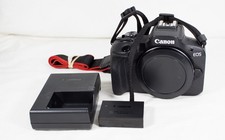
 Canon
CanonBest for Beginners and travelers who want interchangeable RF lenses, low weight and long battery life
3of 18 specs better- MOST WINSFujifilm
Best for Street, travel and hybrid shooters who want one fixed-lens camera with IBIS and strong video
15of 18 specs better
Biggest differences
Effective pixels
Fujifilm X100VI leads
+67%
higher is better
- Canon EOS R10024.1 MP
- Fujifilm X100VI40.2 MP
4K max frame rate
Fujifilm X100VI leads
2.4×
higher is better
- Canon EOS R10025 fps
- Fujifilm X100VI59.94 fps
Viewfinder resolution
Fujifilm X100VI leads
+56%
higher is better
- Canon EOS R1002.36 M dots
- Fujifilm X100VI3.69 M dots
Weight
Canon EOS R100 leads
−32%
lower is better
- Canon EOS R100356 g
- Fujifilm X100VI521 g
Features not all of them have
Log profile support
- Canon EOS R100✕
- Fujifilm X100VI✓
USB charging & power delivery
- Canon EOS R100✕
- Fujifilm X100VI✓
Where each one wins
Canon EOS R100
- Battery life
- Weight
- Width
Fujifilm X100VI
- Effective pixels
- In-body image stabilization
- Continuous shooting (mechanical)
- Continuous shooting (electronic)
- Max video resolution
- 4K max frame rate
- Video bit depth
- Log profile support
- Viewfinder resolution
- Viewfinder magnification
- Screen articulation
- Rear screen resolution
- Height
- Depth
- USB charging & power delivery
What both have
- Sensor formatAPS-C
- Native ISO maximum12,800 ISO
- Sensor typeCMOS
- Aspect ratios3:2, 4:3, 1:1, 16:9
- Max mechanical shutter speed4,000 1/s
- Screen size3 in
- Memory card slots1 slots
- Weather sealingNone
- Minimum operating temperature0 °C
- HDMI port typeMicro
Every spec
Red marks the better value in each row.
| Spec | Canon EOS R100 | Fujifilm X100VI |
|---|---|---|
| Overview | ||
| Release date | Not published | Not published |
| Launch price | Not published | Not published |
| Lens mount | Canon RF | Fixed lens |
| High resolution pixel-shift mode | Not published | — |
| Sensor & Image | ||
| Effective pixels | 24.1 MP | 40.2 MP |
| Sensor format | APS-C | APS-C |
| Native ISO maximum | 12,800 ISO1 | 12,800 ISO |
| In-body image stabilization | 0 stops2 | 6 stops3 |
| Sensor readout speed | Not published | Not published |
| Sensor type | CMOS | CMOS |
| Aspect ratios | 3:2, 4:3, 1:1, 16:9 | 3:2, 4:3, 1:1, 16:9 |
| Lens & Autofocus | ||
| Continuous shooting (mechanical) | 6.5 fps | 11 fps |
| Continuous shooting (electronic) | 0 fps4 | 13 fps |
| Max mechanical shutter speed | 4,000 1/s | 4,000 1/s |
| Pre-burst capture duration | Not published | 0 s5 |
| AF subject detection | Human | Human, animal, bird, car, train, airplane, motorcycle |
| Video | ||
| Max video resolution | 4K | 6K |
| 4K max frame rate | 25 fps | 59.94 fps |
| Video codecs | H.264 | H.264, HEVC |
| 4K max frame rate (full width) | 0 fps6 | — |
| Raw video recording | None | — |
| Video bit depth | 8 bit | 10 bit |
| Log profile support | No | Yes |
| Video dynamic range (log) | Not published | Not published |
| Viewfinder & Screen | ||
| Viewfinder resolution | 2.36 M dots | 3.69 M dots |
| Viewfinder magnification | 0.59 x7 | 0.66 x |
| Screen size | 3 in | 3 in |
| Screen articulation | Fixed | Tilting |
| Rear screen resolution | 1.04 M dots | 1.62 M dots |
| Handling & Power | ||
| Battery life | 430 shots | 320 shots |
| Memory card slots | 1 slots | 1 slots |
| Weather sealing | None | None8 |
| Weight | 356 g9 | 521 g |
| Width | 116.3 mm | 128 mm |
| Height | 85.5 mm | 74.8 mm |
| Depth | 68.8 mm | 55.3 mm |
| USB charging & power delivery | No10 | Yes |
| Minimum operating temperature | 0 °C | 0 °C |
| Headphone port | No | No |
| HDMI port type | Micro | Micro |
Notes on 10 values — test conditions and caveats
- 1Canon EOS R100, Native ISO maximum: ISO 25600 (H) is an expanded setting, not a native sensitivity.
- 2Canon EOS R100, In-body image stabilization: No in-body stabilization; shake correction relies on IS lenses or Movie Digital IS.
- 3Fujifilm X100VI, In-body image stabilization: 6.0 stops of shake compensation is achieved when using the LCD or EVF.
- 4Canon EOS R100, Continuous shooting (electronic): The electronic (silent) shutter does not support continuous shooting on this camera.
- 5Fujifilm X100VI, Pre-burst capture duration: Pre-shot buffers frames while the shutter is half-pressed (e.g., 20 frames at 20fps = 1 second), not a fixed seconds setting.
- 6Canon EOS R100, 4K max frame rate (full width): All 4K recording uses a ~1.6x centre crop, so no full-width 4K mode exists.
- 7Canon EOS R100, Viewfinder magnification: Canon's 0.95x is quoted with a 50mm lens on APS-C; in 35mm-equivalent terms it is 0.59x.
- 8Fujifilm X100VI, Weather sealing: The camera body itself isn't weather-sealed; weather resistance requires the optional AR-X100 adapter ring and PRF-49 filter.
- 9Canon EOS R100, Weight: CIPA weight: body with battery and memory card, without lens.
- 10Canon EOS R100, USB charging & power delivery: The battery must be charged in the external LC-E17E charger; no USB power delivery.
Image quality and stabilization
The X100VI resolves 40.2MP against the R100's 24.1MP, and the difference shows up as cropping headroom: you can shoot looser and still have a usable file after the crop, or print larger from the same framing. The Fujifilm also carries 6 stops of in-body stabilization, so handheld shots at slow shutter speeds stay sharp without a stabilized lens.
The Canon has no in-body stabilization at all. Shake correction depends on an IS lens or the Movie Digital IS mode, which means a cheap non-IS RF lens leaves you exposed in low light. For anyone shooting interiors, dusk or handheld video, the X100VI has a real edge; the R100 only closes the gap if you buy stabilized glass.
Lens mount and system flexibility
The R100 uses the Canon RF mount, so you can change lenses: a wide zoom for landscapes, a fast prime for portraits, a long zoom for wildlife. That is the whole reason to pick it over the X100VI. The trade-off is that body-only purchases mean budgeting for glass, and stabilization only arrives with the lens you choose.
The X100VI has a fixed lens, so the focal length you buy is the focal length you keep. What you give up in flexibility you get back in consistency: one body, one lens, no mount decisions, and stabilization that works with every shot. Buyers who want a single camera to carry daily tend to prefer this; buyers who shoot multiple subjects tend to prefer the R100.
Video
The X100VI records 6K and 4K at up to 59.94 fps, in 10-bit color with a log profile. That combination gives you latitude to grade footage and push shadows without banding, plus slow-motion options at 4K that the R100 simply cannot match. The R100 tops out at 4K 25 fps in 8-bit H.264, and every 4K clip is cropped to roughly 1.6x, so no full-width 4K mode exists.
For casual clips the Canon is fine. For anything headed into an edit, the Fujifilm's codec, bit depth and frame rates do the heavy lifting. Neither camera records raw video or offers a headphone jack, so serious audio work needs an external recorder on both.
Handling, viewfinder and screen
The X100VI has the better viewing experience: a 3.69M-dot EVF at 0.66x against the R100's 2.36M-dot 0.59x, plus a tilting 1.62M-dot rear screen against a fixed 1.04M-dot panel. That matters for low-angle and above-head shooting, where the Canon forces you to guess framing.
Against that, the Canon is smaller and lighter at 356g versus 521g, and shorter in depth. It is the easier camera to slip into a bag and forget about. Neither body is weather-sealed as sold, though the Fujifilm can gain weather resistance with the optional AR-X100 adapter ring and PRF-49 filter, while the R100 has no path to sealing.
Battery, charging and everyday use
The R100 is rated for 430 shots against the X100VI's 320, so the Canon lasts longer between charges. The Fujifilm counters with USB charging and power delivery, which means topping up from a laptop, power bank or car adapter on the road. The Canon must be charged in the external LC-E17E charger, so you carry one more thing.
Which matters more depends on your habits. Day trips with a wall outlet favor the Fujifilm's convenience; long days away from power favor the Canon's larger reserve. Both accept a single memory card, so neither offers redundancy for paid work.
Which is better for action and sports?
The X100VI shoots 11 fps with the mechanical shutter and 13 fps electronically, and its autofocus recognizes humans plus animals, birds, cars, trains, airplanes and motorcycles. The R100 manages 6.5 fps mechanically and has no electronic continuous shooting at all, and its subject detection covers humans only.
That combination makes the Fujifilm the clear pick for moving subjects, especially vehicles and wildlife. The Canon can still photograph motion, but you will work harder for keepers and rely on single-point technique rather than subject tracking.
The Verdict
Buy the Fujifilm X100VI if you want one camera with a big sensor, working stabilization, strong video and subject tracking for travel, street and documentary work. Buy the Canon EOS R100 if you want the lightest, longest-lasting body and need the freedom to change lenses on a tighter budget. The X100VI is the more capable camera; the R100 is the more adaptable system.
Where to buy
Canon EOS R100
Best for Beginners and travelers who want interchangeable RF lenses, low weight and long battery life
Fujifilm X100VI
Best for Street, travel and hybrid shooters who want one fixed-lens camera with IBIS and strong video
FAQ
Does the Canon EOS R100 have in-body image stabilization?
No. The R100 has zero stops of in-body stabilization, so shake correction relies on an IS lens or Movie Digital IS. The X100VI offers 6 stops of compensation when using the LCD or EVF.
Can the Fujifilm X100VI shoot 4K at 60fps?
Yes, up to 59.94 fps in 4K, and it also records 6K. The Canon EOS R100 caps 4K at 25 fps and crops every 4K clip by about 1.6x.
Is the Fujifilm X100VI weather-sealed?
Not on its own. Weather resistance requires the optional AR-X100 adapter ring and PRF-49 filter. The R100 has no weather sealing and no accessory path to it.
Can I change lenses on the Fujifilm X100VI?
No. It has a fixed lens, while the Canon EOS R100 uses the Canon RF mount and accepts interchangeable lenses.
Which camera charges over USB?
The Fujifilm X100VI supports USB charging and power delivery. The R100 does not, and its battery must be charged in the external LC-E17E charger.
Spotted something wrong? Tap the next to any section or spec group to let us know. Every report is read.