Compare · 2 products compared
Canon EOS R100vsCanon EOS R8: Full-Frame or Budget?
Both cameras share the Canon RF mount, a 24-megapixel CMOS sensor, a 2.36M-dot viewfinder and a single card slot. The deciding differences are sensor format and video capability: the R8 is full-frame with 4K at 60p and 10-bit color, while the R100 is a small APS-C body built for budget stills shooting.
eBay prices refresh hourly — check the listing before you buy. We may earn a commission.
 Canon
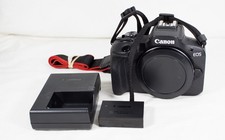
CanonBest for Budget stills shooters who want the lightest RF body
6of 20 specs better- MOST WINSCanon
Best for Hybrid shooters who need full-frame, fast AF and serious video
14of 20 specs better
Biggest differences
Native ISO maximum
Canon EOS R8 leads
8×
higher is better
- Canon EOS R10012,800 ISO
- Canon EOS R8102,400 ISO
4K max frame rate
Canon EOS R8 leads
2.4×
higher is better
- Canon EOS R10025 fps
- Canon EOS R860 fps
Rear screen resolution
Canon EOS R8 leads
+56%
higher is better
- Canon EOS R1001.04 M dots
- Canon EOS R81.62 M dots
Weight
Canon EOS R100 leads
−23%
lower is better
- Canon EOS R100356 g
- Canon EOS R8461 g
Features not all of them have
Log profile support
- Canon EOS R100✕
- Canon EOS R8✓
USB charging & power delivery
- Canon EOS R100✕
- Canon EOS R8✓
Headphone port
- Canon EOS R100✕
- Canon EOS R8✓
Where each one wins
Canon EOS R100
- Continuous shooting (mechanical)
- Battery life
- Weight
- Width
- Height
- Depth
Canon EOS R8
- Effective pixels
- Sensor format
- Native ISO maximum
- Continuous shooting (electronic)
- 4K max frame rate
- 4K max frame rate (full width)
- Video bit depth
- Log profile support
- Viewfinder magnification
- Screen articulation
- Rear screen resolution
- Weather sealing
- USB charging & power delivery
- Headphone port
What both have
- Lens mountCanon RF
- In-body image stabilization0 stops
- Sensor typeCMOS
- Aspect ratios3:2, 4:3, 1:1, 16:9
- Max mechanical shutter speed4,000 1/s
- Max video resolution4K
- Raw video recordingNone
- Viewfinder resolution2.36 M dots
- Screen size3 in
- Memory card slots1 slots
- Minimum operating temperature0 °C
- HDMI port typeMicro
Every spec
Red marks the better value in each row.
| Spec | Canon EOS R100 | Canon EOS R8 |
|---|---|---|
| Overview | ||
| Release date | Not published | Not published |
| Launch price | Not published | Not published |
| Lens mount | Canon RF | Canon RF |
| High resolution pixel-shift mode | Not published | No |
| Sensor & Image | ||
| Effective pixels | 24.1 MP | 24.2 MP |
| Sensor format | APS-C | Full-frame |
| Native ISO maximum | 12,800 ISO1 | 102,400 ISO |
| In-body image stabilization | 0 stops2 | 0 stops |
| Sensor readout speed | Not published | Not published |
| Sensor type | CMOS | CMOS |
| Aspect ratios | 3:2, 4:3, 1:1, 16:9 | 3:2, 4:3, 1:1, 16:9 |
| Lens & Autofocus | ||
| Continuous shooting (mechanical) | 6.5 fps | 6 fps |
| Continuous shooting (electronic) | 0 fps3 | 40 fps |
| Max mechanical shutter speed | 4,000 1/s | 4,000 1/s |
| Pre-burst capture duration | Not published | 0.5 s |
| AF subject detection | Human | Human, animal, bird, car, train, airplane, motorcycle |
| Video | ||
| Max video resolution | 4K | 4K |
| 4K max frame rate | 25 fps | 60 fps |
| Video codecs | H.264 | H.264, HEVC |
| 4K max frame rate (full width) | 0 fps4 | 60 fps |
| Raw video recording | None | None |
| Video bit depth | 8 bit | 10 bit |
| Log profile support | No | Yes |
| Video dynamic range (log) | Not published | Not published |
| Viewfinder & Screen | ||
| Viewfinder resolution | 2.36 M dots | 2.36 M dots |
| Viewfinder magnification | 0.59 x5 | 0.7 x |
| Screen size | 3 in | 3 in |
| Screen articulation | Fixed | Fully articulated |
| Rear screen resolution | 1.04 M dots | 1.62 M dots |
| Handling & Power | ||
| Battery life | 430 shots | 370 shots |
| Memory card slots | 1 slots | 1 slots |
| Weather sealing | None | Dust and drip resistant |
| Weight | 356 g6 | 461 g |
| Width | 116.3 mm | 132.5 mm |
| Height | 85.5 mm | 86.1 mm |
| Depth | 68.8 mm | 70 mm |
| USB charging & power delivery | No7 | Yes |
| Minimum operating temperature | 0 °C | 0 °C |
| Headphone port | No | Yes |
| HDMI port type | Micro | Micro |
Notes on 7 values — test conditions and caveats
- 1Canon EOS R100, Native ISO maximum: ISO 25600 (H) is an expanded setting, not a native sensitivity.
- 2Canon EOS R100, In-body image stabilization: No in-body stabilization; shake correction relies on IS lenses or Movie Digital IS.
- 3Canon EOS R100, Continuous shooting (electronic): The electronic (silent) shutter does not support continuous shooting on this camera.
- 4Canon EOS R100, 4K max frame rate (full width): All 4K recording uses a ~1.6x centre crop, so no full-width 4K mode exists.
- 5Canon EOS R100, Viewfinder magnification: Canon's 0.95x is quoted with a 50mm lens on APS-C; in 35mm-equivalent terms it is 0.59x.
- 6Canon EOS R100, Weight: CIPA weight: body with battery and memory card, without lens.
- 7Canon EOS R100, USB charging & power delivery: The battery must be charged in the external LC-E17E charger; no USB power delivery.
Sensor and low light
The Canon EOS R8 uses a full-frame sensor, which gathers more light across the frame than the APS-C chip in the Canon EOS R100. That shows up most at high ISO: the R8 reaches 102,400 natively, so indoor and evening shots hold up better before noise takes over.
The R100 tops out at 12,800 ISO natively, with 25,600 available only as an expanded setting. Neither body has in-body stabilization, so handheld low-light work depends on IS lenses or, for video, digital stabilization. If most of your shooting happens after dark, the R8 is the clear choice.
Video
The R8 records 4K at up to 60 fps using the full width of the sensor, captures 10-bit color and supports a Canon Log profile for grading. The R100 caps 4K at 25 fps, always with roughly a 1.6x center crop, records 8-bit H.264 only and offers no log profile.
For anyone cutting footage rather than grabbing stills, that gap decides it. Crop means your wide lenses are not wide on the R100, and 8-bit without log leaves little room to push exposure in editing. The R8 also adds a headphone jack, which the R100 lacks, so you can monitor audio as you record.
Speed and autofocus
The R100 edges ahead for mechanical burst at 6.5 fps versus 6 fps, but its electronic shutter cannot shoot continuously at all. The R8 reaches 40 fps electronically and adds a 0.5-second pre-burst, which starts recording before you fully press the shutter.
Subject detection is the bigger divide. The R100 recognizes humans only; the R8 tracks people, animals, birds, cars, trains, airplanes and motorcycles. For wildlife, pets or motorsport, the R8 finds and holds focus on moving subjects that the R100 will simply miss.
Handling and power
The R100 is the lighter, smaller camera at 356 g against 461 g, and it lasts longer per charge at 430 shots versus 370. Its screen is fixed, though, so vlogging and odd-angle framing get awkward.
The R8 has a fully articulated screen, a sharper 1.62M-dot panel, a larger viewfinder image and dust-and-drip sealing. It also charges and powers over USB, while the R100 needs its external charger. The R8 is the better travel and rough-weather body; the R100 is the easier one to carry every day.
Which is best for stills on a budget?
If your priority is light, inexpensive stills shooting in good light, the R100 covers the basics: the same viewfinder resolution, the same shutter ceiling, a slightly faster mechanical burst and better battery life. Its smaller APS-C sensor also means RF lenses frame tighter, which suits reach-limited subjects.
Step up to the R8 the moment low light, fast action or video enters the picture. It costs more in size and battery, and gains full-frame image quality, serious autofocus and modern video tools.
The Verdict
Buy the Canon EOS R100 if you want the smallest, lightest RF-mount body for daylight stills and you rarely shoot video. Buy the Canon EOS R8 if you need full-frame low-light quality, reliable subject tracking for action, or 4K at 60 fps with 10-bit color. Skip the R100 if video is a real part of your work; skip the R8 if you never shoot past sunset or clip a single frame.
Where to buy
Canon EOS R100
Best for Budget stills shooters who want the lightest RF body
Canon EOS R8
Best for Hybrid shooters who need full-frame, fast AF and serious video
FAQ
Does the Canon EOS R8 have in-body image stabilization?
No. It relies on lens IS or digital stabilization in movie mode, the same as the EOS R100. Neither body offers sensor-shift stabilization.
Can the Canon EOS R100 shoot 4K at 60p?
No. Its 4K tops out at 25 fps and always uses roughly a 1.6x center crop, so there is no full-width 4K mode. The R8 does full-width 4K at 60 fps.
Which camera is better for photographing pets or wildlife?
The Canon EOS R8. It detects animals and birds among seven subject types, while the R100 detects humans only, and the R8's 40 fps electronic burst plus pre-burst help catch fast movement.
Do both cameras record RAW video internally?
No. Neither the EOS R100 nor the EOS R8 records RAW video internally. The R8 is still the stronger video body thanks to 10-bit color and Canon Log support.
Can I charge these cameras over USB?
Only the Canon EOS R8 supports USB charging and power delivery. The EOS R100 battery must be charged in the external LC-E17E charger.
Spotted something wrong? Tap the next to any section or spec group to let us know. Every report is read.