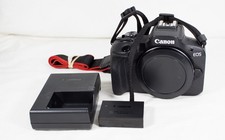
Compare · 2 products compared
Canon EOS R5 Mark IIvsCanon EOS R100: Full-FramevsBudget APS-C
Both cameras use the Canon RF mount, but they sit at opposite ends of Canon's mirrorless lineup. The R5 Mark II pairs a 45MP full-frame stacked sensor with 8K video and in-body stabilization, while the R100 is a compact 24MP APS-C body built for beginners. The sensor size and stabilization gap decides most purchases.
eBay prices refresh hourly — check the listing before you buy. We may earn a commission.
- MOST WINS
 Canon
CanonBest for Professionals and enthusiasts shooting action, wildlife or high-end video
22of 26 specs better - Canon
Best for Beginners and travelers who want a light, affordable RF-mount camera
4of 26 specs better
Biggest differences
Viewfinder resolution
Canon EOS R5 Mark II leads
2.44×
higher is better
- Canon EOS R5 Mark II5.76 M dots
- Canon EOS R1002.36 M dots
Weight
Canon EOS R100 leads
2.1×
lower is better
- Canon EOS R5 Mark II746 g
- Canon EOS R100356 g
Memory card slots
Canon EOS R5 Mark II leads
2×
higher is better
- Canon EOS R5 Mark II2 slots
- Canon EOS R1001 slots
Effective pixels
Canon EOS R5 Mark II leads
+87%
higher is better
- Canon EOS R5 Mark II45 MP
- Canon EOS R10024.1 MP
Features not all of them have
Log profile support
- Canon EOS R5 Mark II✓
- Canon EOS R100✕
USB charging & power delivery
- Canon EOS R5 Mark II✓
- Canon EOS R100✕
Headphone port
- Canon EOS R5 Mark II✓
- Canon EOS R100✕
Where each one wins
Canon EOS R5 Mark II
- Effective pixels
- Sensor format
- In-body image stabilization
- Sensor type
- Continuous shooting (mechanical)
- Continuous shooting (electronic)
- Max mechanical shutter speed
- Max video resolution
- 4K max frame rate (full width)
- Raw video recording
- Video bit depth
- Log profile support
- Viewfinder resolution
- Viewfinder magnification
- Screen articulation
- Rear screen resolution
- Battery life
- Memory card slots
- Weather sealing
- USB charging & power delivery
- Headphone port
- HDMI port type
Canon EOS R100
- Weight
- Width
- Height
- Depth
What both have
- Lens mountCanon RF
- Aspect ratios3:2, 4:3, 1:1, 16:9
- Minimum operating temperature0 °C
Every spec
Red marks the better value in each row.
| Spec | Canon EOS R5 Mark II | Canon EOS R100 |
|---|---|---|
| Overview | ||
| Release date | 2024-08 | Not published |
| Launch price | Not published | Not published |
| Lens mount | Canon RF | Canon RF |
| High resolution pixel-shift mode | Not published | Not published |
| Sensor & Image | ||
| Effective pixels | 45 MP | 24.1 MP |
| Sensor format | Full-frame | APS-C |
| Native ISO maximum | Not published | 12,800 ISO1 |
| In-body image stabilization | 8.5 stops | 0 stops2 |
| Sensor readout speed | Not published | Not published |
| Sensor type | Stacked CMOS | CMOS |
| Aspect ratios | 3:2, 4:3, 1:1, 16:9 | 3:2, 4:3, 1:1, 16:9 |
| Lens & Autofocus | ||
| Continuous shooting (mechanical) | 12 fps | 6.5 fps |
| Continuous shooting (electronic) | 30 fps | 0 fps3 |
| Max mechanical shutter speed | 8,000 1/s | 4,000 1/s |
| Pre-burst capture duration | 0.5 s4 | Not published |
| AF subject detection | Human, animal, bird, car, train, airplane, motorcycle | Human |
| Video | ||
| Max video resolution | 8K | 4K |
| 4K max frame rate | — | 25 fps |
| Video codecs | HEVC, ProRes RAW, Cinema RAW Light, XF-AVC5 | H.264 |
| 4K max frame rate (full width) | 59.94 fps | 0 fps6 |
| Raw video recording | Internal | None |
| Video bit depth | 10 bit | 8 bit |
| Log profile support | Yes | No |
| Video dynamic range (log) | Not published | Not published |
| Viewfinder & Screen | ||
| Viewfinder resolution | 5.76 M dots | 2.36 M dots |
| Viewfinder magnification | 0.76 x | 0.59 x7 |
| Screen size | Not published | 3 in |
| Screen articulation | Fully articulated | Fixed |
| Rear screen resolution | 2.1 M dots | 1.04 M dots |
| Handling & Power | ||
| Battery life | 630 shots | 430 shots |
| Memory card slots | 2 slots | 1 slots |
| Weather sealing | Dust and drip resistant | None |
| Weight | 746 g | 356 g8 |
| Width | 138.5 mm | 116.3 mm |
| Height | 101.2 mm | 85.5 mm |
| Depth | 93.5 mm | 68.8 mm |
| USB charging & power delivery | Yes | No9 |
| Minimum operating temperature | 0 °C | 0 °C |
| Headphone port | Yes | No |
| HDMI port type | Full-size | Micro |
Notes on 9 values — test conditions and caveats
- 1Canon EOS R100, Native ISO maximum: ISO 25600 (H) is an expanded setting, not a native sensitivity.
- 2Canon EOS R100, In-body image stabilization: No in-body stabilization; shake correction relies on IS lenses or Movie Digital IS.
- 3Canon EOS R100, Continuous shooting (electronic): The electronic (silent) shutter does not support continuous shooting on this camera.
- 4Canon EOS R5 Mark II, Pre-burst capture duration: Up to 15 shots can be buffered before you fully press the shutter, which is about half a second at 30 fps.
- 5Canon EOS R5 Mark II, Video codecs: Internal codecs are XF-HEVC S, XF-AVC S and H.264 MP4; ProRes RAW is recorded via HDMI to an external recorder.
- 6Canon EOS R100, 4K max frame rate (full width): All 4K recording uses a ~1.6x centre crop, so no full-width 4K mode exists.
- 7Canon EOS R100, Viewfinder magnification: Canon's 0.95x is quoted with a 50mm lens on APS-C; in 35mm-equivalent terms it is 0.59x.
- 8Canon EOS R100, Weight: CIPA weight: body with battery and memory card, without lens.
- 9Canon EOS R100, USB charging & power delivery: The battery must be charged in the external LC-E17E charger; no USB power delivery.
Sensor and image quality
The R5 Mark II's full-frame 45MP stacked sensor captures far more resolution and cleaner low-light detail than the R100's 24.1MP APS-C chip. That extra sensor area matters most in dim venues and when cropping, where the R5 Mark II holds detail the R100 cannot.
The R5 Mark II also adds 8.5 stops of in-body stabilization, so handheld shots stay sharp with any lens. The R100 has no IBIS at all, leaving shake correction to stabilized lenses or Movie Digital IS.
Speed and autofocus
Continuous shooting favors the R5 Mark II heavily: 12 fps mechanical and 30 fps electronic versus 6.5 fps on the R100, which cannot shoot continuously with its silent shutter at all. The R5 Mark II also buffers about a half-second of frames before you fully press the shutter.
Subject detection widens the gap. The R5 Mark II recognizes people, animals, birds, cars, trains, planes and motorcycles; the R100 tracks only humans. For wildlife, sports or moving vehicles, the R100 will miss shots the R5 Mark II nails.
Video
The R5 Mark II records 8K internally and full-width 4K at up to 59.94 fps, with 10-bit color, log profiles and internal raw. The R100 tops out at 4K/25p in 8-bit H.264, and every 4K mode uses a roughly 1.6x center crop, so wide shots are impossible without stepping back.
For anyone delivering graded footage or shooting in tight spaces, the R5 Mark II is the only real option here. The R100 suits casual clips where editing flexibility does not matter.
Viewfinder, screen and handling
The R5 Mark II offers a 5.76M-dot EVF at 0.76x magnification and a fully articulated 2.1M-dot touchscreen. The R100's finder is 2.36M dots at 0.59x equivalent, and its rear screen is fixed, which makes low-angle and selfie shooting awkward.
Build quality diverges too. The R5 Mark II is dust and drip resistant with two card slots, a headphone jack and full-size HDMI. The R100 has no weather sealing, one slot and a micro HDMI port.
Battery and size
The R100 wins on portability: 356 g versus 746 g, and noticeably smaller in every dimension. That makes it an easy carry for travel and everyday use.
The R5 Mark II lasts longer per charge at 630 shots versus 430, and supports USB charging and power delivery. The R100 must be charged in its external LC-E17E charger, so USB power banks are useless on the road.
Which is best for beginners?
The R100 is the simpler, lighter, more affordable entry point into RF-mount mirrorless. Its fixed screen, modest autofocus and cropped 4K will frustrate anyone who outgrows it quickly, but it covers the basics for casual stills.
The R5 Mark II is a professional tool that demands more from its user and its budget. Beginners rarely need 45MP, 8K or dual card slots, but those who shoot action, wildlife or paid video work will find the R100 limiting almost immediately.
The Verdict
Buy the Canon EOS R5 Mark II if you shoot professionally or need full-frame resolution, 8K video, stabilization and subject tracking that keeps up with fast action. Buy the Canon EOS R100 if you want a light, simple RF-mount camera for casual stills and travel on a tight budget. The R5 Mark II is the more capable camera by a wide margin, but the R100 is far easier to carry and live with day to day.
Where to buy
Canon EOS R5 Mark II
Best for Professionals and enthusiasts shooting action, wildlife or high-end video
Canon EOS R100
Best for Beginners and travelers who want a light, affordable RF-mount camera
FAQ
Does the Canon EOS R100 have in-body image stabilization?
No. The R100 has zero stops of IBIS, so stabilization depends on IS lenses or Movie Digital IS. The R5 Mark II offers 8.5 stops of in-body stabilization.
Can the Canon EOS R100 shoot 4K video without a crop?
No. All 4K recording on the R100 uses an approximately 1.6x center crop, so there is no full-width 4K mode. The R5 Mark II records full-width 4K at up to 59.94 fps.
Does the Canon EOS R100 have a headphone jack?
No. The R100 lacks a headphone port, while the R5 Mark II includes one for monitoring audio during video recording.
Can the Canon EOS R100 be charged via USB?
No. The R100 battery must be charged in the external LC-E17E charger, with no USB power delivery. The R5 Mark II supports USB charging and power delivery.
Do both cameras use the same lenses?
Yes. Both use the Canon RF mount, so RF lenses work on either body. The R100's APS-C sensor applies a crop factor that narrows the effective field of view.
Spotted something wrong? Tap the next to any section or spec group to let us know. Every report is read.