Compare · 2 products compared
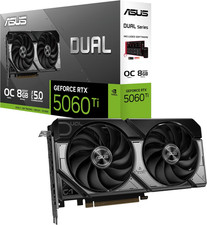
NVIDIA GeForce RTX 5060 Ti 8GBvsAMD Radeon RX 7800 XT
The NVIDIA GeForce RTX 5060 Ti 8GB and the AMD Radeon RX 7800 XT are powerful desktop graphics cards supporting modern hardware encoding and multiple displays. Choosing between them comes down to a trade-off between NVIDIA's modern Blackwell architecture with GDDR7 memory and AMD's higher VRAM capacity and compute throughput.
eBay prices refresh hourly — check the listing before you buy. We may earn a commission.
- MOST WINS

NVIDIA GeForce RTX 5060 Ti 8GB
Best for Lower power consumption and modern GDDR7 speeds
Wins11 / 17 
Best for Higher VRAM capacity and raw compute performance
Wins6 / 17
Biggest differences
Video memory
AMD Radeon RX 7800 XT leads
2×
higher is better
- NVIDIA GeForce RTX 5060 Ti 8GB8 GB
- AMD Radeon RX 7800 XT16 GB
Memory bus width
AMD Radeon RX 7800 XT leads
2×
higher is better
- NVIDIA GeForce RTX 5060 Ti 8GB128 bit
- AMD Radeon RX 7800 XT256 bit
PCIe lanes
AMD Radeon RX 7800 XT leads
2×
higher is better
- NVIDIA GeForce RTX 5060 Ti 8GB8 lanes
- AMD Radeon RX 7800 XT16 lanes
Last-level cache
AMD Radeon RX 7800 XT leads
2×
higher is better
- NVIDIA GeForce RTX 5060 Ti 8GB32 MB
- AMD Radeon RX 7800 XT64 MB
Where each one wins
NVIDIA GeForce RTX 5060 Ti 8GB
- Launch price
- Shader cores
- Boost clock
- Base clock
- Memory type
- Memory speed
- Board power
- Recommended PSU
- PCIe version
- HDMI version
- DisplayPort version
AMD Radeon RX 7800 XT
- FP32 compute
- Video memory
- Memory bus width
- Memory bandwidth
- Last-level cache
- PCIe lanes
What both have
- Power connectors8-pin
- HDMI outputs1 ports
- DisplayPort outputs3 ports
- Max displays4 displays
- Hardware encodeH.264, HEVC, AV1
Every spec
Red marks the better value in each row.
| Spec | NVIDIA GeForce RTX 5060 Ti 8GB | AMD Radeon RX 7800 XT |
|---|---|---|
| Overview | ||
| Release date | 2025-04 | 2023-09 |
| Launch price | 379 USD1 | 499 USD |
| Graphics chip | ||
| Architecture | Blackwell | Rdna 3 |
| Shader cores | 4,608 cores | 3,840 cores |
| Boost clock | 2,572 MHz | 2,430 MHz |
| Base clock | 2,407 MHz | 1,295 MHz |
| FP32 compute | 23.7 TFLOPS | 37.3 TFLOPS |
| Memory | ||
| Video memory | 8 GB | 16 GB |
| Memory type | Gddr7 | Gddr6 |
| Memory bus width | 128 bit | 256 bit |
| Memory bandwidth | 448 GB/s | 624 GB/s |
| Memory speed | 28 Gbps | 19.5 Gbps |
| Last-level cache | 32 MB | 64 MB |
| Power | ||
| Board power | 180 W | 263 W |
| Recommended PSU | 600 W | 700 W |
| Power connectors | 8-pin2 | 8-pin |
| Interface | ||
| PCIe version | 5.0 | 4.0 |
| PCIe lanes | 8 lanes3 | 16 lanes |
| Display outputs | ||
| HDMI version | 2.1b | 2.1a4 |
| DisplayPort version | 2.1b5 | 2.16 |
| HDMI outputs | 1 ports | 1 ports |
| DisplayPort outputs | 3 ports | 3 ports |
| Max displays | 4 displays | 4 displays |
| Video engine | ||
| Hardware encode | H.264, HEVC, AV1 | H.264, HEVC, AV1 |
| Video encoders | 1 encoders | Not published |
| Size | ||
| Card length | Not published | 267 mm |
| Card height | Not published | Not published |
| Slot width | Not published | 2.5 slots |
Notes on 6 values — test conditions and caveats
- 1NVIDIA GeForce RTX 5060 Ti 8GB, Launch price: NVIDIA sells no Founders Edition of this card; $379 is the starting MSRP for partner cards.
- 2NVIDIA GeForce RTX 5060 Ti 8GB, Power connectors: No Founders Edition exists; most partner cards use one 8-pin socket, a few use a 16-pin 12V-2x6 instead.
- 3NVIDIA GeForce RTX 5060 Ti 8GB, PCIe lanes: Only 8 lanes: on a PCIe 4.0 or 3.0 board it gets half or a quarter of the PCIe 5.0 bandwidth.
- 4AMD Radeon RX 7800 XT, HDMI version: AMD's spec page lists HDMI 2.1; its own press release and Notebookcheck state HDMI 2.1a.
- 5NVIDIA GeForce RTX 5060 Ti 8GB, DisplayPort version: DisplayPort 2.1b at the full UHBR20 rate.
- 6AMD Radeon RX 7800 XT, DisplayPort version: Notebookcheck lists the DisplayPort 2.1 link rate as UHBR13.5; AMD notes DP 2.1 support depends on AIB designs.
Performance and Architecture
The RTX 5060 Ti uses the newer Blackwell architecture with 4,608 shader cores and faster clock speeds, reaching a base clock of 2,407 MHz and a boost clock of 2,572 MHz. This allows it to handle intensive workloads efficiently.
On the other side, the RX 7800 XT relies on Rdna 3 and delivers a higher FP32 compute performance of 37.3 TFLOPS compared to the 23.7 TFLOPS of its rival, giving AMD an advantage in raw compute capability.
Memory and Bandwidth
The RX 7800 XT equips 16 GB of GDDR6 memory across a 256-bit bus, yielding a memory bandwidth of 624 GB/s and a 64 MB last-level cache. This larger pool of video memory helps sustain high-resolution textures.
Meanwhile, the RTX 5060 Ti features 8 GB of GDDR7 memory on a 128-bit bus with a memory speed of 28 Gbps. While its bandwidth is lower at 448 GB/s and its cache sits at 32 MB, the GDDR7 type offers bleeding-edge transfer rates.
Power and Efficiency
The RTX 5060 Ti requires a board power of 180 W and a recommended PSU of 600 W, making it much easier on system power supplies and cooling requirements.
The RX 7800 XT demands a heftier 263 W board power and a 700 W recommended PSU, running hotter and drawing more electricity under load.
Connectivity and Features
The RTX 5060 Ti introduces PCIe 5.0 support with 8 lanes, alongside HDMI 2.1b and DisplayPort 2.1b outputs. Buyers using older PCIe 3.0 or 4.0 boards should note that the x8 link can restrict bandwidth once video memory overflows.
The RX 7800 XT relies on PCIe 4.0 with 16 lanes, providing a wider physical interface, paired with HDMI 2.1a and DisplayPort 2.1 outputs.
The Verdict
Buy the NVIDIA GeForce RTX 5060 Ti 8GB if you want a lower power draw, advanced GDDR7 memory speeds, and PCIe 5.0 support at a $379 starting MSRP. Buy the AMD Radeon RX 7800 XT if you need 16 GB of video memory, a 256-bit memory bus, and higher raw compute performance for $499.
Where to buy
NVIDIA GeForce RTX 5060 Ti 8GB
Best for Lower power consumption and modern GDDR7 speeds
AMD Radeon RX 7800 XT
Best for Higher VRAM capacity and raw compute performance
FAQ
What power supply do I need for these graphics cards?
The RTX 5060 Ti requires a recommended PSU of 600 W, while the RX 7800 XT requires a 700 W power supply.
How much video memory do they have?
The RTX 5060 Ti comes with 8 GB of GDDR7 memory, whereas the RX 7800 XT features 16 GB of GDDR6 memory.
Do both cards support AV1 hardware encoding?
Yes, both graphics cards support H.264, HEVC, and AV1 hardware encoding.
What are their launch prices?
The RTX 5060 Ti has a starting MSRP of $379 for partner cards, while the RX 7800 XT launched at $499.
Spotted something wrong? Tap the next to any section or spec group to let us know. Every report is read.