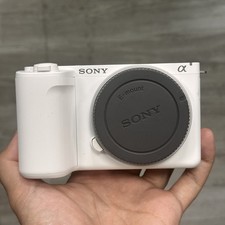
Compare · 2 products compared
Sony ZV-E10 IIvsSony a7 IV: Full-Frame or Crop?
Both cameras share the Sony E mount, 4K recording, 10-bit color, S-Log3 and the same human, animal and bird autofocus subject detection. The decision comes down to two things: how much you need a full-frame sensor with in-body stabilization, and how much you want to pay and carry. The a7 IV buys image quality and sealing; the ZV-E10 II buys price and portability.
eBay prices refresh hourly — check the listing before you buy. We may earn a commission.
- MOST WINS
 Sony
SonyBest for Vloggers, travelers and first-time buyers who want full-width 4K 60p on a small budget
9of 16 specs better - Sony
Best for Working hybrid shooters who need full-frame stills, IBIS, dual cards and a viewfinder
7of 16 specs better
Biggest differences
Launch price
Sony ZV-E10 II leads
2.5×
lower is better
- Sony ZV-E10 II999 USD
- Sony a7 IV2,499.99 USD
Memory card slots
Sony a7 IV leads
2×
higher is better
- Sony ZV-E10 II1 slots
- Sony a7 IV2 slots
Weight
Sony ZV-E10 II leads
−43%
lower is better
- Sony ZV-E10 II377 g
- Sony a7 IV658 g
4K max frame rate (full width)
Sony ZV-E10 II leads
2×
higher is better
- Sony ZV-E10 II60 fps
- Sony a7 IV30 fps
Where each one wins
Sony ZV-E10 II
- Launch price
- Continuous shooting (electronic)
- 4K max frame rate (full width)
- Screen size
- Battery life
- Weight
- Width
- Height
- Depth
Sony a7 IV
- Effective pixels
- Sensor format
- Native ISO maximum
- Viewfinder resolution
- Rear screen resolution
- Memory card slots
- HDMI port type
What both have
- Lens mountSony E
- Sensor typeCMOS
- Max mechanical shutter speed8,000 1/s
- AF subject detectionHuman, animal, bird
- Max video resolution4K
- 4K max frame rate60 fps
- Video codecsH.264, HEVC
- Raw video recordingNone
- Video bit depth10 bit
- Log profile support✓
- Screen articulationFully articulated
- USB charging & power delivery✓
- Minimum operating temperature0 °C
- Headphone port✓
Every spec
Red marks the better value in each row.
| Spec | Sony ZV-E10 II | Sony a7 IV |
|---|---|---|
| Overview | ||
| Release date | 2024-07 | 2021-10 |
| Launch price | 999 USD | 2,499.99 USD |
| Lens mount | Sony E | Sony E |
| High resolution pixel-shift mode | No | No |
| Sensor & Image | ||
| Effective pixels | 26 MP | 33 MP |
| Sensor format | APS-C | Full-frame |
| Native ISO maximum | 32,000 ISO | 51,200 ISO1 |
| In-body image stabilization | Not published | 5.5 stops2 |
| Sensor readout speed | Not published | Not published |
| Sensor type | CMOS | CMOS |
| Aspect ratios | Not published | 3:2 |
| Lens & Autofocus | ||
| Continuous shooting (mechanical) | Not published | 10 fps3 |
| Continuous shooting (electronic) | 11 fps | 10 fps |
| Max mechanical shutter speed | 8,000 1/s | 8,000 1/s |
| Pre-burst capture duration | Not published | Not published |
| AF subject detection | Human, animal, bird | Human, animal, bird |
| Video | ||
| Max video resolution | 4K | 4K |
| 4K max frame rate | 60 fps | 60 fps4 |
| Video codecs | H.264, HEVC | H.264, HEVC |
| 4K max frame rate (full width) | 60 fps | 30 fps5 |
| Raw video recording | None | None6 |
| Video bit depth | 10 bit | 10 bit |
| Log profile support | Yes | Yes |
| Video dynamic range (log) | Not published | 15 stops7 |
| Viewfinder & Screen | ||
| Viewfinder resolution | 0 M dots | 3.69 M dots |
| Viewfinder magnification | Not published | 0.78 x |
| Screen size | 3 in | 2.95 in8 |
| Screen articulation | Fully articulated | Fully articulated |
| Rear screen resolution | 1.037 M dots | 1.04 M dots9 |
| Handling & Power | ||
| Battery life | 610 shots | 580 shots10 |
| Memory card slots | 1 slots | 2 slots |
| Weather sealing | Not published | Dust and drip resistant11 |
| Weight | 377 g | 658 g |
| Width | 114.8 mm | 131.3 mm |
| Height | 67.5 mm | 96.4 mm |
| Depth | 54.2 mm | 69.7 mm12 |
| USB charging & power delivery | Yes | Yes13 |
| Minimum operating temperature | 0 °C | 0 °C |
| Headphone port | Yes | Yes |
| HDMI port type | Micro | Full-size |
Notes on 13 values — test conditions and caveats
- 1Sony a7 IV, Native ISO maximum: Native range tops out at ISO 51200; 50-204800 requires expanded ISO settings.
- 2Sony a7 IV, In-body image stabilization: CIPA rating measured with the 50mm F1.4 ZA test lens attached.
- 3Sony a7 IV, Continuous shooting (mechanical): 10 fps applies to compressed RAW/JPEG/HEIF; drops to 6 fps for lossless or uncompressed RAW.
- 4Sony a7 IV, 4K max frame rate: 4K 60p is only available in Super35mm crop; full-frame 4K tops out at 30p.
- 5Sony a7 IV, 4K max frame rate (full width): 4K 60p requires the Super35mm crop; full-width 4K is limited to 30p.
- 6Sony a7 IV, Raw video recording: No internal or external raw recording; HDMI output tops out at 10-bit 4:2:2.
- 7Sony a7 IV, Video dynamic range (log): Sony's claim for S-Log3 per internal tests; stated as 15+ stops.
- 8Sony a7 IV, Screen size: Sony rates the panel at 2.95in (3.0-type); most sources round to 3in.
- 9Sony a7 IV, Rear screen resolution: 1,036,800 dots; Sony's retail pages round this to 1.03 megadots.
- 10Sony a7 IV, Battery life: 580 shots per charge with the rear LCD; 520 with the EVF.
- 11Sony a7 IV, Weather sealing: Dust and moisture resistant but not IP-rated; Sony does not guarantee 100% sealing.
- 12Sony a7 IV, Depth: Sony lists 79.8mm total depth; 69.7mm is measured from front grip to rear monitor.
- 13Sony a7 IV, USB charging & power delivery: Charging and USB power delivery work only through the USB Type-C port.
Sensor and low light
The a7 IV's full-frame 33 MP sensor is the single biggest reason it costs two and a half times as much. It gathers more light and lets you push to ISO 51200 natively instead of 32000, which matters for dim venues, evening events and indoor work where you cannot add light. It also gives shallower depth of field at the same framing, the look many portrait and event shooters are paying for.
The ZV-E10 II counters with 26 MP on APS-C — plenty for prints, social and most client delivery. If most of your shooting is outdoors or lit, the sensor gap shrinks a lot in practice, and the money saved can go toward a lens. Neither camera offers a pixel-shift high-resolution mode, so resolution is fixed at what the sensor captures.
Video
This is closer than the prices suggest. Both shoot 4K at up to 60 fps in 10-bit with H.264 or HEVC, both support log profiles, and neither records raw internally or externally. The difference is how they get to 60p: the ZV-E10 II does full-width 4K 60p, while the a7 IV drops to a Super35mm crop at 60p and only manages full-frame 4K at 30p.
For a solo creator framing wide shots, that crop means backing up or swapping to a wider lens — a real inconvenience. The a7 IV still wins on dynamic range and detail from the larger sensor, and it adds a full-size HDMI port for reliable monitoring and recording to external gear, versus Micro HDMI on the ZV-E10 II.
Stabilization and viewfinder
The a7 IV has 5.5 stops of in-body stabilization, which steadies handheld stills with any lens and smooths walking video. Sony does not publish an IBIS figure for the ZV-E10 II, so hand-held shooters should expect to lean on lens stabilization or a gimbal.
The a7 IV also has a 3.69M-dot electronic viewfinder with 0.78x magnification. The ZV-E10 II has no viewfinder at all, which is fine for vlogging and rear-screen work but a genuine handicap for bright outdoor days and for anyone who prefers composing at eye level. If you shoot stills more than video, the viewfinder alone can settle the choice.
Battery, size and card slots
The ZV-E10 II is dramatically smaller and lighter — 377 g against 658 g — and it actually lasts longer per charge at 610 shots. That combination makes it the camera you will carry when you would otherwise leave one at home.
The a7 IV answers with two card slots, which lets you record to a backup card in the field or split photo and video across cards. It is also dust and drip resistant, so it tolerates rain and dusty conditions that the ZV-E10 II's unpublished sealing offers no promise against. Two slots and weather resistance are the reasons working professionals accept the extra bulk.
Which is best for sports and action?
Neither is a dedicated action camera, but the ZV-E10 II bursts faster electronically at 11 fps versus 10 fps on the a7 IV. That advantage is small enough to ignore in practice.
The a7 IV's 10 fps applies to compressed RAW, JPEG and HEIF, and falls to 6 fps with lossless or uncompressed RAW — a real ceiling for anyone who wants maximum image quality in a burst. Sony publishes no mechanical burst figure for the ZV-E10 II because it uses an electronic-only shutter, so rolling-shutter distortion in fast pans is a risk neither set of specs resolves. For serious sports work, neither camera is the obvious pick.
The Verdict
Buy the Sony ZV-E10 II if you want full-width 4K 60p in a light, inexpensive body and can live without a viewfinder, stabilization and weather sealing. Buy the Sony a7 IV if you shoot stills and video for money, need a full-frame sensor, IBIS, two card slots and a real viewfinder, and can accept a Super35mm crop for 4K 60p. The ZV-E10 II is the better first camera and travel companion. The a7 IV is the better long-term working tool.
Where to buy
Sony ZV-E10 II
Best for Vloggers, travelers and first-time buyers who want full-width 4K 60p on a small budget
Sony a7 IV
Best for Working hybrid shooters who need full-frame stills, IBIS, dual cards and a viewfinder
FAQ
Is the Sony a7 IV worth $1,500 more than the Sony ZV-E10 II?
Only if you need full-frame image quality, in-body stabilization, an electronic viewfinder, two card slots or weather resistance. If you mainly shoot video in good light, the ZV-E10 II delivers 4K 60p full-width for $999.
Can the Sony ZV-E10 II shoot 4K 60p without a crop?
Yes. It records full-width 4K at up to 60 fps. The a7 IV is limited to 30p at full width and needs a Super35mm crop to reach 60p.
Do either of these cameras record raw video?
No. Neither the ZV-E10 II nor the a7 IV records raw internally or externally, and HDMI output tops out at 10-bit 4:2:2 on the a7 IV.
Which has better battery life, the ZV-E10 II or the a7 IV?
The ZV-E10 II, at 610 shots per charge versus 580 for the a7 IV with the rear LCD. The a7 IV drops to 520 shots when using the EVF.
Can I use the same lenses on both cameras?
Yes. Both use the Sony E mount, so full-frame E-mount lenses work on the a7 IV and can also be mounted on the ZV-E10 II, where they are cropped to the APS-C field of view.
Spotted something wrong? Tap the next to any section or spec group to let us know. Every report is read.