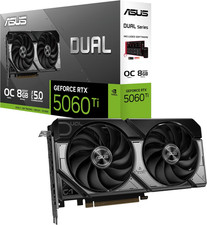
Compare · 2 products compared
NVIDIA GeForce RTX 5060vsIntel Arc B580: Spec Comparison
The NVIDIA GeForce RTX 5060 and the Intel Arc B580 target mainstream desktop builders looking for modern graphics performance. They differ sharply in price, memory capacity, and power efficiency, giving buyers a clear choice between budget value and advanced efficiency.
eBay prices refresh hourly — check the listing before you buy. We may earn a commission.
- MOST WINSNVIDIAGeForce RTX 5060
Best for Builders wanting lower power draw and faster memory speeds
Wins8 / 14 
Best for Value-focused gamers needing a larger video memory buffer
Wins6 / 14
Biggest differences
Shader cores
NVIDIA GeForce RTX 5060 leads
+50%
higher is better
- NVIDIA GeForce RTX 50603,840 cores
- Intel Arc B5802,560 cores
Video memory
Intel Arc B580 leads
+50%
higher is better
- NVIDIA GeForce RTX 50608 GB
- Intel Arc B58012 GB
Memory bus width
Intel Arc B580 leads
+50%
higher is better
- NVIDIA GeForce RTX 5060128 bit
- Intel Arc B580192 bit
Video encoders
Intel Arc B580 leads
2×
higher is better
- NVIDIA GeForce RTX 50601 encoders
- Intel Arc B5802 encoders
Where each one wins
NVIDIA GeForce RTX 5060
- Shader cores
- Memory type
- Memory speed
- Board power
- Recommended PSU
- PCIe version
- HDMI version
- DisplayPort version
Intel Arc B580
- Launch price
- Boost clock
- Video memory
- Memory bus width
- Memory bandwidth
- Video encoders
What both have
- Power connectors8-pin
- PCIe lanes8 lanes
- HDMI outputs1 ports
- DisplayPort outputs3 ports
- Max displays4 displays
Every spec
Red marks the better value in each row.
| Spec | NVIDIA GeForce RTX 5060 | Intel Arc B580 |
|---|---|---|
| Overview | ||
| Release date | 2025-05 | 2024-12 |
| Launch price | 299 USD | 249 USD |
| Graphics chip | ||
| Architecture | Blackwell | Xe2 |
| Shader cores | 3,840 cores | 2,560 cores |
| Boost clock | 2,500 MHz | 2,670 MHz |
| Base clock | 2,280 MHz | Not published |
| FP32 compute | 19.2 TFLOPS | Not published |
| Memory | ||
| Video memory | 8 GB | 12 GB |
| Memory type | Gddr7 | Gddr6 |
| Memory bus width | 128 bit | 192 bit |
| Memory bandwidth | 448 GB/s | 456 GB/s |
| Memory speed | 28 Gbps | 19 Gbps |
| Last-level cache | Not published | 18 MB |
| Power | ||
| Board power | 145 W | 190 W |
| Recommended PSU | 550 W1 | 600 W |
| Power connectors | 8-pin2 | 8-pin |
| Interface | ||
| PCIe version | 5.0 | 4.0 |
| PCIe lanes | 8 lanes | 8 lanes |
| Display outputs | ||
| HDMI version | 2.1b | 2.1 |
| DisplayPort version | 2.1b3 | 2.14 |
| HDMI outputs | 1 ports | 1 ports |
| DisplayPort outputs | 3 ports | 3 ports |
| Max displays | 4 displays | 4 displays |
| Video engine | ||
| Hardware encode | AV1 | H.264, HEVC, AV15 |
| Video encoders | 1 encoders | 2 encoders |
| Size | ||
| Card length | Not published | 272 mm |
| Card height | Not published | 115 mm6 |
| Slot width | Not published | 2 slots |
Notes on 6 values — test conditions and caveats
- 1NVIDIA GeForce RTX 5060, Recommended PSU: NVIDIA's 550 W minimum assumes a PC with a Ryzen 9 9950X; power needs vary by system configuration.
- 2NVIDIA GeForce RTX 5060, Power connectors: The card takes one 8-pin; a 300 W or greater Gen 5 (16-pin) PSU cable can be used with the in-box adapter.
- 3NVIDIA GeForce RTX 5060, DisplayPort version: DisplayPort 2.1b outputs run at the UHBR20 link rate per NVIDIA's footnote.
- 4Intel Arc B580, DisplayPort version: Intel rates the DisplayPort outputs at DP 2.1 up to UHBR 13.5 (second output listed at UHBR 10).
- 5Intel Arc B580, Hardware encode: Intel's spec table also lists H.264 and H.265 (HEVC) hardware encode as Yes.
- 6Intel Arc B580, Card height: Intel publishes this dimension as the card's 'Width' (115 mm) alongside the 272 mm length.
Price and Value
The Intel B580 undercuts the competition with a launch price of $249, making it significantly more affordable than the $299 RTX 5060. That savings leaves room in a budget build for other core components without sacrificing feature access.
Buyers who choose the Intel card keep more cash in their pocket, while the NVIDIA card demands a higher upfront investment for its feature set.
Memory and Performance
The Intel card equips 12 GB of video memory on a 192-bit bus, offering more capacity for demanding textures and high-resolution assets than the 8 GB found on the NVIDIA card. However, the RTX 5060 counters with faster Gddr7 memory and a higher shader core count of 3,840 cores to drive smooth frame rates.
Content creators and gamers prioritizing raw memory buffer size will lean toward the Intel option, while the NVIDIA choice relies on architectural efficiency and faster memory speed.
Power and Efficiency
The RTX 5060 draws less power with a 145 W board power rating, requiring only a 550 W recommended PSU that assumes a system paired with a Ryzen 9 9950X. The Intel card demands a heavier 190 W draw and a 600 W power supply, generating more heat inside the chassis.
Energy-conscious builders with tighter power budgets will find the NVIDIA card easier to cool and power efficiently over long gaming sessions.
The Verdict
Buy the NVIDIA GeForce RTX 5060 if you want lower power consumption and faster memory speeds. Buy the Intel Arc B580 if you prefer a lower price and a larger video memory buffer.
Where to buy
NVIDIA GeForce RTX 5060
Best for Builders wanting lower power draw and faster memory speeds
Intel Arc B580
Best for Value-focused gamers needing a larger video memory buffer
FAQ
What power connector do these graphics cards require?
Both the RTX 5060 and the B580 use an 8-pin power connector, though the NVIDIA card can also use a 300 W or greater Gen 5 16-pin PSU cable with its in-box adapter.
How many displays can connect to each card?
Both graphics cards support a maximum of 4 displays across three DisplayPort outputs and one HDMI port.
Which card supports more video encoding formats?
The B580 includes dual video encoders with hardware support for H.264, HEVC, and AV1, whereas the NVIDIA card supports AV1.
Spotted something wrong? Tap the next to any section or spec group to let us know. Every report is read.