Compare · 2 products compared
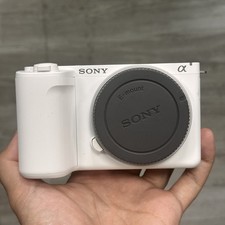
Sony ZV-E10 IIvsCanon EOS R8: Crop or Full-Frame?
Both cameras shoot 4K 60p in 10-bit with log profiles and fully articulating screens, so video basics are close. The real split is sensor size and body design: the Canon EOS R8 gives you a full-frame sensor, a viewfinder, and faster burst shooting, while the Sony ZV-E10 II stays smaller, lighter, and cheaper to run.
eBay prices refresh hourly — check the listing before you buy. We may earn a commission.
- MOST WINS
 Sony
SonyBest for Vloggers and travelers who want light gear, long battery life, and affordable lenses
7of 12 specs better - Canon
Best for Photographers who need full-frame depth of field, a viewfinder, and fast burst shooting
5of 12 specs better
Biggest differences
Continuous shooting (electronic)
Canon EOS R8 leads
3.64×
higher is better
- Sony ZV-E10 II11 fps
- Canon EOS R840 fps
Native ISO maximum
Canon EOS R8 leads
3.2×
higher is better
- Sony ZV-E10 II32,000 ISO
- Canon EOS R8102,400 ISO
Battery life
Sony ZV-E10 II leads
+65%
higher is better
- Sony ZV-E10 II610 shots
- Canon EOS R8370 shots
Max mechanical shutter speed
Sony ZV-E10 II leads
2×
higher is better
- Sony ZV-E10 II8,000 1/s
- Canon EOS R84,000 1/s
Where each one wins
Sony ZV-E10 II
- Effective pixels
- Max mechanical shutter speed
- Battery life
- Weight
- Width
- Height
- Depth
Canon EOS R8
- Sensor format
- Native ISO maximum
- Continuous shooting (electronic)
- Viewfinder resolution
- Rear screen resolution
What both have
- Sensor typeCMOS
- Max video resolution4K
- 4K max frame rate60 fps
- Video codecsH.264, HEVC
- 4K max frame rate (full width)60 fps
- Raw video recordingNone
- Video bit depth10 bit
- Log profile support✓
- Screen size3 in
- Screen articulationFully articulated
- Memory card slots1 slots
- USB charging & power delivery✓
- Minimum operating temperature0 °C
- Headphone port✓
- HDMI port typeMicro
Every spec
Red marks the better value in each row.
| Spec | Sony ZV-E10 II | Canon EOS R8 |
|---|---|---|
| Overview | ||
| Release date | 2024-07 | Not published |
| Launch price | 999 USD | Not published |
| Lens mount | Sony E | Canon RF |
| High resolution pixel-shift mode | No | No |
| Sensor & Image | ||
| Effective pixels | 26 MP | 24.2 MP |
| Sensor format | APS-C | Full-frame |
| Native ISO maximum | 32,000 ISO | 102,400 ISO |
| In-body image stabilization | Not published | 0 stops |
| Sensor readout speed | Not published | Not published |
| Sensor type | CMOS | CMOS |
| Aspect ratios | Not published | 3:2, 4:3, 1:1, 16:9 |
| Lens & Autofocus | ||
| Continuous shooting (mechanical) | Not published | 6 fps |
| Continuous shooting (electronic) | 11 fps | 40 fps |
| Max mechanical shutter speed | 8,000 1/s | 4,000 1/s |
| Pre-burst capture duration | Not published | 0.5 s |
| AF subject detection | Human, animal, bird | Human, animal, bird, car, train, airplane, motorcycle |
| Video | ||
| Max video resolution | 4K | 4K |
| 4K max frame rate | 60 fps | 60 fps |
| Video codecs | H.264, HEVC | H.264, HEVC |
| 4K max frame rate (full width) | 60 fps | 60 fps |
| Raw video recording | None | None |
| Video bit depth | 10 bit | 10 bit |
| Log profile support | Yes | Yes |
| Video dynamic range (log) | Not published | Not published |
| Viewfinder & Screen | ||
| Viewfinder resolution | 0 M dots | 2.36 M dots |
| Viewfinder magnification | Not published | 0.7 x |
| Screen size | 3 in | 3 in |
| Screen articulation | Fully articulated | Fully articulated |
| Rear screen resolution | 1.037 M dots | 1.62 M dots |
| Handling & Power | ||
| Battery life | 610 shots | 370 shots |
| Memory card slots | 1 slots | 1 slots |
| Weather sealing | Not published | Dust and drip resistant |
| Weight | 377 g | 461 g |
| Width | 114.8 mm | 132.5 mm |
| Height | 67.5 mm | 86.1 mm |
| Depth | 54.2 mm | 70 mm |
| USB charging & power delivery | Yes | Yes |
| Minimum operating temperature | 0 °C | 0 °C |
| Headphone port | Yes | Yes |
| HDMI port type | Micro | Micro |
Sensor: full-frame vs APS-C
The Canon EOS R8 uses a 24.2 MP full-frame sensor, which captures more light and gives shallower depth of field at the same aperture. That matters for portraits, low-light events, and anyone chasing background blur without fast glass. Native ISO reaches 102,400, useful when light runs out.
The Sony ZV-E10 II packs 26 MP into an APS-C sensor, so it resolves slightly more detail but gathers less light per pixel area. Full-frame lenses also tend to cost and weigh more, which offsets some of the Canon's advantage over a full kit.
Video
Both hit 4K 60p at full sensor width, record 10-bit with H.264 or HEVC, and support log profiles. Neither offers raw video internally, so if you need raw you are looking at external recorders or a different class of camera entirely.
The practical difference is lens choice. The Sony's E-mount has a deep, affordable APS-C lineup built for hybrid shooters, while RF glass skews toward full-frame pricing. For run-and-gun video on a budget, the Sony's ecosystem is easier to grow into.
Autofocus and burst shooting
Subject detection is broader on the Canon: human, animal, bird, car, train, airplane, and motorcycle. The Sony covers human, animal, and bird. If you shoot motorsport or aviation, the Canon recognizes more of what you point it at.
Burst speed widens the gap. The Canon fires 40 fps electronically versus the Sony's 11 fps, and the Canon can also do 6 fps with the mechanical shutter. The Sony uses an electronic-only shutter, so it has no mechanical burst figure at all. For fast action, the Canon is the clear pick.
Viewfinder and screen
The Canon EOS R8 includes a 2.36 M-dot electronic viewfinder with 0.7x magnification. The Sony ZV-E10 II has no viewfinder at all, which matters in bright sun where an LCD washes out, and for anyone who prefers eye-level framing.
The Canon's rear screen also resolves more detail at 1.62 M dots versus 1.037 M dots on the Sony. Both are fully articulated and 3 inches, so vlogging and self-recording work equally well on either.
Battery and size
Battery life favors the Sony by a wide margin: 610 shots versus 370 on the Canon. A full day of stills is realistic on the Sony without a spare, while the Canon may need a second battery for extended shoots.
The Sony is also much smaller and lighter at 377 g versus 461 g, and it is narrower on every dimension. That is the difference between a camera you carry daily and one you leave home. Against that, the Canon is dust and drip resistant while the Sony publishes no weather sealing rating.
The Verdict
Buy the Sony ZV-E10 II if you want a small, light hybrid that runs all day on one battery and pairs with affordable APS-C glass. Buy the Canon EOS R8 if full-frame image quality, a viewfinder, and 40 fps burst shooting matter more than size and battery life. The Sony wins on portability and endurance. The Canon wins on sensor, speed, and framing.
Where to buy
Sony ZV-E10 II
Best for Vloggers and travelers who want light gear, long battery life, and affordable lenses
Canon EOS R8
Best for Photographers who need full-frame depth of field, a viewfinder, and fast burst shooting
FAQ
Does the Sony ZV-E10 II have a viewfinder?
No. It relies entirely on its 3-inch fully articulated rear screen, while the Canon EOS R8 includes a 2.36 M-dot electronic viewfinder.
Which camera shoots faster bursts?
The Canon EOS R8 at 40 fps electronically, plus 6 fps with the mechanical shutter. The Sony ZV-E10 II tops out at 11 fps electronic.
Can either camera record raw video internally?
No. Both the Sony ZV-E10 II and Canon EOS R8 record 4K 60p in 10-bit H.264 or HEVC with log profiles, but neither offers internal raw video.
Is the Canon EOS R8 weather sealed?
Yes, Canon describes it as dust and drip resistant. Sony publishes no weather sealing rating for the ZV-E10 II.
Which has better battery life?
The Sony ZV-E10 II, rated at 610 shots versus 370 for the Canon EOS R8 under CIPA testing.
Spotted something wrong? Tap the next to any section or spec group to let us know. Every report is read.