Compare · 2 products compared
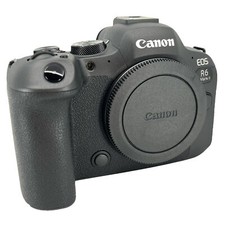
Canon EOS R6 Mark IIvsCanon EOS R8: Which to Buy
Both cameras share a 24.2MP full-frame sensor, RF mount, 40 fps electronic burst and 4K60 video, so image quality and autofocus are a wash. The R6 Mark II adds in-body stabilization, a second card slot and a larger viewfinder. The R8 gives you the same core at less bulk.
eBay prices refresh hourly — check the listing before you buy. We may earn a commission.
- MOST WINS
 Canon
CanonBest for Event, sports and handheld video shooters who need IBIS and dual cards
8of 12 specs better - Canon
Best for Travelers and casual shooters who want full-frame quality in the lightest body
4of 12 specs better
Biggest differences
Battery life
Canon EOS R6 Mark II leads
2.05×
higher is better
- Canon EOS R6 Mark II760 shots
- Canon EOS R8370 shots
Memory card slots
Canon EOS R6 Mark II leads
2×
higher is better
- Canon EOS R6 Mark II2 slots
- Canon EOS R81 slots
Viewfinder resolution
Canon EOS R6 Mark II leads
+56%
higher is better
- Canon EOS R6 Mark II3.69 M dots
- Canon EOS R82.36 M dots
Continuous shooting (mechanical)
Canon EOS R6 Mark II leads
2×
higher is better
- Canon EOS R6 Mark II12 fps
- Canon EOS R86 fps
Where each one wins
Canon EOS R6 Mark II
- In-body image stabilization
- Continuous shooting (mechanical)
- Max mechanical shutter speed
- Raw video recording
- Viewfinder resolution
- Viewfinder magnification
- Battery life
- Memory card slots
Canon EOS R8
- Weight
- Width
- Height
- Depth
What both have
- Lens mountCanon RF
- Effective pixels24.2 MP
- Sensor formatFull-frame
- Native ISO maximum102,400 ISO
- Sensor typeCMOS
- Aspect ratios3:2, 4:3, 1:1, 16:9
- Continuous shooting (electronic)40 fps
- Pre-burst capture duration0.5 s
- AF subject detectionHuman, animal, bird, car, train, airplane, motorcycle
- Max video resolution4K
- 4K max frame rate60 fps
- Video codecsH.264, HEVC
- 4K max frame rate (full width)60 fps
- Video bit depth10 bit
- Log profile support✓
- Screen size3 in
- Screen articulationFully articulated
- Rear screen resolution1.62 M dots
- Weather sealingDust and drip resistant
- USB charging & power delivery✓
- Minimum operating temperature0 °C
- Headphone port✓
- HDMI port typeMicro
Every spec
Red marks the better value in each row.
| Spec | Canon EOS R6 Mark II | Canon EOS R8 |
|---|---|---|
| Overview | ||
| Release date | Not published | Not published |
| Launch price | 2,499 USD | Not published |
| Lens mount | Canon RF | Canon RF |
| High resolution pixel-shift mode | Not published | No |
| Sensor & Image | ||
| Effective pixels | 24.2 MP | 24.2 MP |
| Sensor format | Full-frame | Full-frame |
| Native ISO maximum | 102,400 ISO1 | 102,400 ISO |
| In-body image stabilization | 8 stops2 | 0 stops |
| Sensor readout speed | Not published | Not published |
| Sensor type | CMOS | CMOS |
| Aspect ratios | 3:2, 4:3, 1:1, 16:9 | 3:2, 4:3, 1:1, 16:9 |
| Lens & Autofocus | ||
| Continuous shooting (mechanical) | 12 fps | 6 fps |
| Continuous shooting (electronic) | 40 fps | 40 fps |
| Max mechanical shutter speed | 8,000 1/s | 4,000 1/s |
| Pre-burst capture duration | 0.5 s3 | 0.5 s |
| AF subject detection | Human, animal, bird, car, train, airplane, motorcycle | Human, animal, bird, car, train, airplane, motorcycle |
| Video | ||
| Max video resolution | 4K | 4K |
| 4K max frame rate | 60 fps | 60 fps |
| Video codecs | H.264, HEVC4 | H.264, HEVC |
| 4K max frame rate (full width) | 60 fps | 60 fps |
| Raw video recording | External5 | None |
| Video bit depth | 10 bit6 | 10 bit |
| Log profile support | Yes | Yes |
| Video dynamic range (log) | Not published | Not published |
| Viewfinder & Screen | ||
| Viewfinder resolution | 3.69 M dots | 2.36 M dots |
| Viewfinder magnification | 0.76 x | 0.7 x |
| Screen size | 3 in | 3 in |
| Screen articulation | Fully articulated | Fully articulated |
| Rear screen resolution | 1.62 M dots | 1.62 M dots |
| Handling & Power | ||
| Battery life | 760 shots7 | 370 shots |
| Memory card slots | 2 slots | 1 slots |
| Weather sealing | Dust and drip resistant8 | Dust and drip resistant |
| Weight | 670 g | 461 g |
| Width | 138.4 mm | 132.5 mm |
| Height | 98.4 mm | 86.1 mm |
| Depth | 88.4 mm | 70 mm |
| USB charging & power delivery | Yes9 | Yes |
| Minimum operating temperature | 0 °C10 | 0 °C |
| Headphone port | Yes | Yes |
| HDMI port type | Micro | Micro |
Notes on 10 values — test conditions and caveats
- 1Canon EOS R6 Mark II, Native ISO maximum: ISO 204800 (H) is an expanded setting; the native range tops out at ISO 102400.
- 2Canon EOS R6 Mark II, In-body image stabilization: The 8-stop rating combines lens optical IS with in-body IS; results vary by lens.
- 3Canon EOS R6 Mark II, Pre-burst capture duration: Pre-release capture works in RAW burst mode and buffers up to 0.5s of action before full shutter press.
- 4Canon EOS R6 Mark II, Video codecs: Movies record H.264 by default; H.265/HEVC is used when Canon Log 3 or HDR PQ is enabled.
- 5Canon EOS R6 Mark II, Raw video recording: 6K ProRes RAW requires an external Atomos Ninja V+ recorder connected over HDMI.
- 6Canon EOS R6 Mark II, Video bit depth: Standard profiles record 8-bit 4:2:0; 10-bit 4:2:2 requires Canon Log 3 or HDR PQ.
- 7Canon EOS R6 Mark II, Battery life: 760 shots is the CIPA power-saving rating with the rear LCD; Canon's smooth-mode rating is 580 shots.
- 8Canon EOS R6 Mark II, Weather sealing: Sealed dust- and water-resistant build, not IP-rated; Canon cautions ingress cannot be fully prevented.
- 9Canon EOS R6 Mark II, USB charging & power delivery: In-body USB charging and power supply require Canon's optional PD-E1 USB power adapter.
- 10Canon EOS R6 Mark II, Minimum operating temperature: Canon's product manual rates 0–40°C; regional Canon spec sheets list a 2°C minimum.
Stabilization: the R6 II's biggest edge
The R6 Mark II has in-body image stabilization rated at 8 stops when combined with a lens that has optical IS; actual benefit varies by lens. The R8 has none. That difference matters most for handheld shooting in dim light, slow shutter work and video where you can't use a gimbal.
If you shoot mostly on a tripod, or you already own stabilized RF lenses, the R8's lack of IBIS costs you less. For run-and-gun stills and video, the R6 Mark II is the one that keeps the shot steady without extra gear.
Burst speed and shutter
Both cameras hit 40 fps with the electronic shutter, so the headline speed is identical. The gap shows up with the mechanical shutter: the R6 Mark II manages 12 fps against the R8's 6 fps.
The R6 Mark II also tops out at 1/8000 s mechanically versus 1/4000 s on the R8. If you shoot fast action in bright light with wide apertures, that faster shutter helps you avoid overexposure without reaching for an ND filter. The frame-rate gap also decides tight sports and wildlife sequences, where the R6 Mark II simply captures more usable frames per burst.
Video: same resolution, different ceiling
Both shoot 4K at up to 60 fps across the full sensor width, support Canon Log 3 and can record in 10-bit when that profile or HDR PQ is enabled. Codec options match: H.264 and HEVC.
The one real divergence is RAW. The R6 Mark II can output 6K ProRes RAW, but only when connected to an external Atomos Ninja V+ recorder over HDMI. The R8 has no RAW video option at all. For editors who want maximum grading latitude, that external path is the deciding feature.
Viewfinder and handling
The R6 Mark II uses a 3.69M-dot electronic viewfinder at 0.76x magnification; the R8 uses a 2.36M-dot panel at 0.7x. The difference is noticeable when manually focusing or tracking small subjects, since a sharper, larger view makes it easier to confirm focus.
Both cameras have a 3-inch fully articulated screen at 1.62M dots, so composing from the rear is the same. Handling is where size cuts both ways: the R8 weighs 461 g and is shorter in every dimension, which is a real benefit for travel and all-day carry, while the R6 Mark II's larger body gives bigger controls and a more secure grip with long lenses.
Battery, cards and weather protection
The R6 Mark II is rated for 760 shots on the rear LCD in power-saving mode, versus 370 for the R8. That roughly doubles shooting time per charge, which matters on long event days. Both charge and run over USB, though the R6 Mark II needs Canon's optional PD-E1 adapter for that.
The R6 Mark II also has two card slots; the R8 has one. For paid work that means backup recording or separating stills from video on the fly. Both bodies are described as dust- and drip-resistant rather than IP-rated, so neither is a dive or monsoon camera. If you shoot professionally or in unpredictable weather, dual slots plus longer battery life tilt the decision.
The Verdict
Buy the Canon EOS R6 Mark II if you want stabilization, two card slots, a faster mechanical burst and a bigger viewfinder for paid or demanding work. Buy the Canon EOS R8 if you want the same sensor, autofocus and 4K60 video in a body that weighs 461 g and fits in a small bag.
Where to buy
Canon EOS R6 Mark II
Best for Event, sports and handheld video shooters who need IBIS and dual cards
Canon EOS R8
Best for Travelers and casual shooters who want full-frame quality in the lightest body
FAQ
Do the Canon EOS R6 Mark II and R8 take the same lenses?
Yes. Both use the Canon RF mount, so any RF lens works on either body, and the R6 Mark II's IBIS pairs with stabilized RF lenses for its 8-stop rating.
Which one is better in low light?
The sensors and ISO ceilings are identical, so image noise is comparable. The R6 Mark II pulls ahead in practice because its stabilization lets you handhold slower shutter speeds, and its 1/8000 s mechanical shutter helps in bright light with fast lenses.
Can the R6 Mark II or R8 shoot 10-bit video?
Both can, but only when Canon Log 3 or HDR PQ is enabled; standard profiles record 8-bit. That applies to the R8 as well, so log grading is available on either camera.
Is the Canon EOS R8 weather sealed?
Canon describes it as dust- and drip-resistant, the same wording used for the R6 Mark II, and neither carries an IP rating. Neither should be treated as fully waterproof.
Does either camera have a pre-burst mode?
Yes, both buffer 0.5 seconds of action before you fully press the shutter, but this works in RAW burst mode. It helps capture the moment just before you react.
Spotted something wrong? Tap the next to any section or spec group to let us know. Every report is read.