Compare · 2 products compared
Canon EOS R100vsSony a6700: Which APS-C Camera?
Both are APS-C mirrorless cameras with 24-26 MP sensors, a 2.36 M-dot electronic viewfinder and a single card slot. The Sony a6700 adds in-body stabilization, far more capable autofocus and 10-bit video, while the Canon EOS R100 stays small, light and simple for first-time buyers.
eBay prices refresh hourly — check the listing before you buy. We may earn a commission.
 Canon
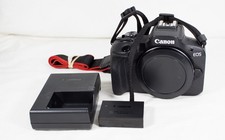
CanonBest for Beginners and travel shooters who want the lightest, cheapest-feeling APS-C body for portraits and everyday stills.
3of 18 specs better- MOST WINSSony
Best for Hybrid shooters who need fast autofocus, stabilization, 10-bit video and slow motion in one APS-C body.
15of 18 specs better
Biggest differences
4K max frame rate
Sony a6700 leads
4.8×
higher is better
- Canon EOS R10025 fps
- Sony a6700120 fps
Native ISO maximum
Sony a6700 leads
2.5×
higher is better
- Canon EOS R10012,800 ISO
- Sony a670032,000 ISO
Weight
Canon EOS R100 leads
−28%
lower is better
- Canon EOS R100356 g
- Sony a6700493 g
Continuous shooting (mechanical)
Sony a6700 leads
+69%
higher is better
- Canon EOS R1006.5 fps
- Sony a670011 fps
Features not all of them have
Log profile support
- Canon EOS R100✕
- Sony a6700✓
USB charging & power delivery
- Canon EOS R100✕
- Sony a6700✓
Headphone port
- Canon EOS R100✕
- Sony a6700✓
Where each one wins
Canon EOS R100
- Weight
- Width
- Depth
Sony a6700
- Effective pixels
- Native ISO maximum
- In-body image stabilization
- Continuous shooting (mechanical)
- Continuous shooting (electronic)
- 4K max frame rate
- 4K max frame rate (full width)
- Video bit depth
- Log profile support
- Viewfinder magnification
- Screen articulation
- Battery life
- Height
- USB charging & power delivery
- Headphone port
What both have
- Sensor formatAPS-C
- Sensor typeCMOS
- Max mechanical shutter speed4,000 1/s
- Max video resolution4K
- Raw video recordingNone
- Viewfinder resolution2.36 M dots
- Screen size3 in
- Rear screen resolution1.04 M dots
- Memory card slots1 slots
- Minimum operating temperature0 °C
- HDMI port typeMicro
Every spec
Red marks the better value in each row.
| Spec | Canon EOS R100 | Sony a6700 |
|---|---|---|
| Overview | ||
| Release date | Not published | Not published |
| Launch price | Not published | Not published |
| Lens mount | Canon RF | Sony E |
| High resolution pixel-shift mode | Not published | No |
| Sensor & Image | ||
| Effective pixels | 24.1 MP | 26 MP |
| Sensor format | APS-C | APS-C |
| Native ISO maximum | 12,800 ISO1 | 32,000 ISO |
| In-body image stabilization | 0 stops2 | 5 stops |
| Sensor readout speed | Not published | Not published |
| Sensor type | CMOS | CMOS |
| Aspect ratios | 3:2, 4:3, 1:1, 16:9 | Not published |
| Lens & Autofocus | ||
| Continuous shooting (mechanical) | 6.5 fps | 11 fps |
| Continuous shooting (electronic) | 0 fps3 | 11 fps |
| Max mechanical shutter speed | 4,000 1/s | 4,000 1/s |
| Pre-burst capture duration | Not published | Not published |
| AF subject detection | Human | Human, animal, bird, insect, car, train, airplane |
| Video | ||
| Max video resolution | 4K | 4K |
| 4K max frame rate | 25 fps | 120 fps |
| Video codecs | H.264 | H.264, HEVC |
| 4K max frame rate (full width) | 0 fps4 | 60 fps5 |
| Raw video recording | None | None |
| Video bit depth | 8 bit | 10 bit |
| Log profile support | No | Yes |
| Video dynamic range (log) | Not published | 14 stops |
| Viewfinder & Screen | ||
| Viewfinder resolution | 2.36 M dots | 2.36 M dots |
| Viewfinder magnification | 0.59 x6 | 0.7 x |
| Screen size | 3 in | 3 in |
| Screen articulation | Fixed | Fully articulated |
| Rear screen resolution | 1.04 M dots | 1.04 M dots |
| Handling & Power | ||
| Battery life | 430 shots | 570 shots |
| Memory card slots | 1 slots | 1 slots |
| Weather sealing | None | Not published |
| Weight | 356 g7 | 493 g |
| Width | 116.3 mm | 122 mm |
| Height | 85.5 mm | 69 mm |
| Depth | 68.8 mm | 75.1 mm |
| USB charging & power delivery | No8 | Yes |
| Minimum operating temperature | 0 °C | 0 °C |
| Headphone port | No | Yes |
| HDMI port type | Micro | Micro |
Notes on 8 values — test conditions and caveats
- 1Canon EOS R100, Native ISO maximum: ISO 25600 (H) is an expanded setting, not a native sensitivity.
- 2Canon EOS R100, In-body image stabilization: No in-body stabilization; shake correction relies on IS lenses or Movie Digital IS.
- 3Canon EOS R100, Continuous shooting (electronic): The electronic (silent) shutter does not support continuous shooting on this camera.
- 4Canon EOS R100, 4K max frame rate (full width): All 4K recording uses a ~1.6x centre crop, so no full-width 4K mode exists.
- 5Sony a6700, 4K max frame rate (full width): Full-width 4K tops out at 60p; 120p 4K uses a crop.
- 6Canon EOS R100, Viewfinder magnification: Canon's 0.95x is quoted with a 50mm lens on APS-C; in 35mm-equivalent terms it is 0.59x.
- 7Canon EOS R100, Weight: CIPA weight: body with battery and memory card, without lens.
- 8Canon EOS R100, USB charging & power delivery: The battery must be charged in the external LC-E17E charger; no USB power delivery.
Stills and sensor
Both cameras use an APS-C CMOS sensor, so they capture similar field-of-view and depth-of-field character with the same focal length. The Sony a6700 has slightly more resolution (26 MP vs 24.1 MP) and a higher native ISO ceiling of 32,000, which means cleaner files in dim light without pushing into expanded settings. The Canon EOS R100 tops out at 12,800 ISO natively, with 25,600 ISO available only as an expanded setting the camera labels with an H.
The bigger stills gap is burst speed. The Canon manages 6.5 fps with the mechanical shutter, and its electronic shutter cannot shoot continuously at all, so silent shooting is limited to single frames. The Sony reaches 11 fps with either shutter. For sports, wildlife or any moving subject, that roughly doubles the number of keepers per second of action.
Autofocus and subject tracking
The Canon EOS R100 detects only human subjects, so pet portraits, birds and motorsports fall back on generic area tracking. The Sony a6700 recognizes humans plus animals, birds, insects, cars, trains and airplanes, which means the camera holds focus on a dog running toward you or a bird in flight without you chasing it around the frame.
If you shoot people and static scenes, the Canon's simpler system is fine. If you shoot anything that moves and is not a person, the Sony does meaningful work for you.
Video
Both record 4K, but the Canon EOS R100 does it only from a roughly 1.6x center crop, so every 4K clip is tighter than what you framed in the viewfinder, and 4K tops out at 25 fps. The Sony a6700 records full-width 4K up to 60p and can hit 120p 4K with a crop, which gives you slow-motion options the Canon cannot match.
The Sony also records 10-bit video with a log profile, giving colorists more room to grade and recover highlights; the Canon is limited to 8-bit with no log. The Sony's headphone jack lets you monitor audio on set, and USB charging means you can top up from a power bank between shoots — the Canon requires its external charger.
Battery and size
The Sony a6700 is rated for 570 shots per charge against 430 for the Canon EOS R100, which matters on a long day out with no spare battery. In-body stabilization on the Sony (5 stops) also opens up handheld shooting at slower shutter speeds and steadier video without a gimbal; the Canon relies on lens IS or digital stabilization in movie mode only.
The Canon fights back on portability. At 356 g versus 493 g it is noticeably lighter, and it is narrower and thinner, making it a better fit for a small bag or a day of walking. Both cameras have just one card slot, so neither offers instant backup.
Viewfinder, screen and handling
The viewfinder resolution is identical, but the Sony's is larger (0.7x vs an equivalent 0.59x for the Canon), so it is easier to see framing and focus. The Sony also has a fully articulated screen that flips forward for vlogging and out to the side for odd angles; the Canon's screen is fixed, so you cannot see yourself when recording or compose from above and below easily.
Both offer USB-C and a micro HDMI port, and neither has published weather sealing. If you shoot in the rain or on a dusty trail, plan on protection for either camera.
The Verdict
Buy the Canon EOS R100 if you want the lightest, simplest APS-C body for stills of people and static scenes and the smaller size matters more than burst speed or video features. Buy the Sony a6700 if you shoot action, wildlife, or video and want stabilization, 10-bit recording, a flip screen and longer battery life in one body.
Where to buy
Canon EOS R100
Best for Beginners and travel shooters who want the lightest, cheapest-feeling APS-C body for portraits and everyday stills.
Sony a6700
Best for Hybrid shooters who need fast autofocus, stabilization, 10-bit video and slow motion in one APS-C body.
FAQ
Does the Canon EOS R100 have in-body image stabilization?
No. It relies on lens IS or Movie Digital IS for shake correction, while the Sony a6700 has 5 stops of in-body stabilization built into the sensor.
Can the Canon EOS R100 shoot 4K without a crop?
No. All of its 4K recording uses a roughly 1.6x center crop, so there is no full-width 4K mode. The Sony a6700 records full-width 4K up to 60p, with 120p 4K using a crop.
Which camera has a flip-out screen?
The Sony a6700 has a fully articulated screen. The Canon EOS R100's screen is fixed, so it cannot be tilted or turned toward the front.
Do either of these cameras record raw video?
No. Neither the Canon EOS R100 nor the Sony a6700 offers raw video recording internally.
Which has better battery life?
The Sony a6700, rated for 570 shots per charge versus 430 for the Canon EOS R100.
Spotted something wrong? Tap the next to any section or spec group to let us know. Every report is read.